Hacker News
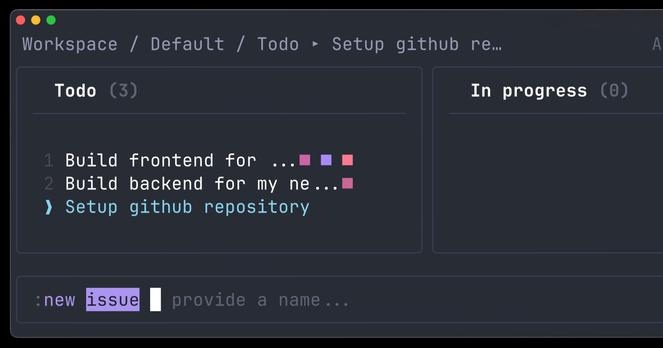
Epiq – Distributed Git based issue tracker TUI
#HackerNews #Epiq #DistributedGit #IssueTracker #TUI #TechNews #OpenSource
Epiq – Distributed Git based issue tracker TUI
#HackerNews #Epiq #DistributedGit #IssueTracker #TUI #TechNews #OpenSource
« J'ai découvert Beads, Dolt et DoltgreSQL »
La suite : « Shape Up sans backlog ne me choque pas : ma pratique Scrum intègre déjà le principe du sponsor pour les issues »
Hmm it’s not easy finding a simple issue tracker that’s cheap or free and that doesn’t use AI.
OpenProject is almost there, but is a bit complicated and does one too many things. I wish there were a self-hosted version like Trello that’s simple to use and install.
Project #introduction
Introducing DITS — a Developer Issue Tracking System built exclusively for solo developers. 🛠️
Tired of Jira-shaped tools designed for teams of 50? Every feature in those tools assumes collaboration — approvals, assignments, team dashboards — and you pay the complexity tax even when you're the only user. DITS strips all of that away.
What makes it different:
→ Zero-friction capture — create issues from the web app, CLI, IDE, or mobile with minimal keystrokes
→ Keyboard-first design — every action has a shortcut, with a Command Palette (Cmd/Ctrl+K) as the primary interface
→ Sub-100ms interactions — optimized for flow state, not loading spinners
→ Deep Git integration — auto-creates branches from issues, links PRs and commits bidirectionally, closes issues on merge
→ Smart Views — Inbox, Today, Upcoming, and Logbook keep your work organized without manual effort
→ Projects vs. Areas — a first-class distinction between finite work (ship v2.0) and ongoing responsibilities (maintenance, learning)
→ Your data, your rules — full export and portability, always
Tech stack: TypeScript, React, PostgreSQL, Redis, GraphQL (primary) + REST, with native desktop and mobile apps planned.
Currently in early Phase 1 — building out the core foundation. More updates as things take shape.
The project is not #openSource, but in the future, when it's more developed, It probably will be.
#progromming #devtools #issuetracker #buildinpublic #indiedev #typescript #react #solodev
Matt Cengia agreed in 2023: Discord has most of the same problems as Slack, the sole permitted client has flashy distractions, searching history is difficult, and exporting history is infeasible. Describes pros and cons of several alternatives, including Slack, IRC, XMPP, Mattermost, Signal, Discourse, and issue trackers of GitHub and other forges. 3/4
https://blog.mattcen.com/2023/07/04/stop-using-discord-for-your-open-source-communities/
#chat #discord #slack #xmpp #matrix #discourse #IssueTracker #BugTracker #mattermost #signal #github
Dave Cheney went further in 2017: Please stop using chat in general for open-source communities. Even a free protocol like IRC, XMPP, or Matrix disadvantages people with a full-time job and people in less-privileged time zones. Use issue trackers, mailing lists, newsgroups, and other asynchronous forums instead. 2/4
https://dave.cheney.net/2017/04/11/why-slack-is-inappropriate-for-open-source-communications
#chat #timezones #slack #discord #irc #matrix #xmpp #forums #MailingLists #IssueTracker #BugTracker #FreeSoftware #OpenSource #FOSS
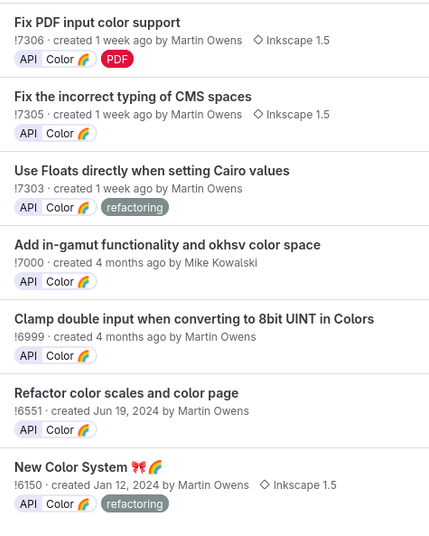
Heh, you can add emoji into #GitLab labels.
Ich denke, das ließe sich mit (automatisiertem) Tagging und gut benutzbaren Filtern passabel in den Griff kriegen. Und es wäre ja schon auch ein Mehrwert, wenn es eine Anlaufstelle für die von mir wahrgenommenen öffentlichen Probleme gäbe.
Mir geht es auch darum, dass sehr viele Menschen sehr schnell dabei sind, rüde ihren Unmut ins Netz abzusondern, dass aber 0,0 zur Lösung beiträgt, wohl aber die allgemeine Stimmung runterzieht und Zweifel an der Problemlösefähigkeit der Demokratie zu nähren.
Ein Issue-Tracker z.B. mit LLM-basiertem Eingabe-Assistent, könnte, wie gesagt den Unmut aufnehmen und konstruktiv kanalisieren...
Ich versuche den Prototyp demnächst™ mal weiterzubauen. Vielleicht ist ja eine Demo überzeugender als meine lauwarmen Worte 😉
 Jürgen
 Stéphane Klein
 @
@ Michael Biel
 Damian Yerrick
 Martin Owens
 CarK
CarK