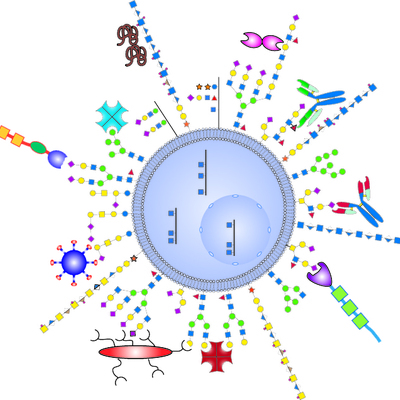
📢 Our latest work describing a new versatile click chemistry glycan linker which enabled us to create glycan derivatives for use in microarrays, Luminex (bead based arrays) and ELISA assays.

Check it out in @acs.org ACS Central Science https://doi.org/10.1021/acscentsci.4c02124

#glycotime #clickchemistry #luminex

Check our new preprint !
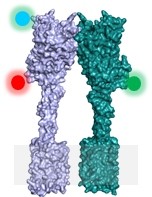
Triple orthogonal labeling with 2 unnatural aminoacids + 1 SNAP-Tag for 3 color #smFRET.
We resolve a new intermediate in the activation of metabotropic glutamate receptor 2.

#GPCR #clickchemistry

https://biorxiv.org/content/10.1101/2024.10.31.621373v1

Collaboration with Jean Philippe Pin & Philippe Rondard (IGF Montpellier) & Don Lamb (LMU Munich)

New ribozyme can make #RNA molecules accessible for #clickchemistry in living cells https://phys.org/news/2023-09-ribozyme-rna-molecules-accessible-click.html

Damn this is hot - imagine the possibilities for single sell #RNAseq @nanopore
#sequencing

New ribozyme can make RNA molecules accessible for click chemistry in living cells

RNA molecules are real all-rounders. They transfer the genetic information from the DNA in the cell. They regulate the activity of genes. And some of them have a catalytic effect: just like enzymes, they enable biochemical reactions that would be difficult or impossible to occur on their own. These special RNA molecules that accelerate such reactions are called ribozymes.

Phys.org

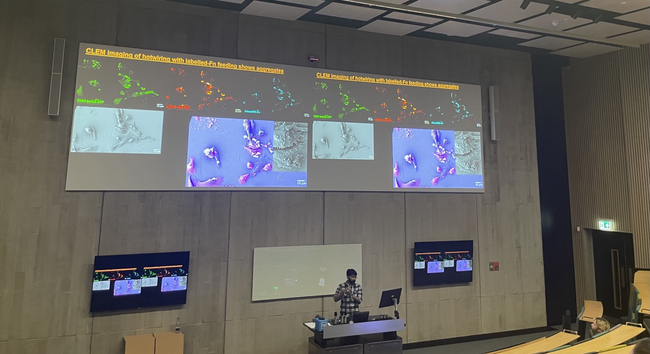
Sahil Kamboj from our collaborator Ambroise Lambert’s lab showed us how @roylelab’s favourite tools can be used to develop probes to tackle key questions for understanding the #tumour microenvironment. The #clem + endocytosis hot-wiring in spheroids were amazing 🤩

It’s been a joy to follow my DTP colleague + friend Will Scott’s journey on using genetic code expansion + #clickchemistry to develop new tools for imaging #actin. I’m looking forward to seeing this probe in cells soon! #cellbiology

Nanotech Enzyme Process Boosts T-Cell Cancer Therapies

A #bioengineering team devised techniques for feasibly adding cancer-killing #enzymes to engineered #immune cells that in lab mice kill solid #tumor and blood #cancer cells.

https://sciencebusiness.technewslit.com/?p=44317

#News #Science #Engineering #Biotechnology #Chemistry #ClickChemistry #Nanotechnology #Cytokines #Preclinical #University

Nanotech Enzyme Process Boosts T-Cell Cancer Therapies

A bioengineering team devised techniques for feasibly adding cancer-killing enzymes to engineered immune cells that in lab mice kill solid-tumor and blood cancer cells.

Science and Enterprise

Sorry to the reviewer who chose an arbitrary out-of-subject field (chemistry) while trying to argue against the significance of my sister's paper. You couldn't have known we were related, but I got to squee at her about click chemistry for 10 minutes to describe why tool development is important for future discovery.

#SorryNotSorry #Science #ClickChemistry #ChemicalBiology #ChemiVerse

What a great, accessible summary of the work awarded the 2022 Nobel Prize in Chemistry (@[email protected], Meldal, Sharpless) by @[email protected] and @[email protected]!

#clickchemistry

https://www.nejm.org/doi/pdf/10.1056/NEJMcibr2213596?articleTools=true

Click Here for Better Chemistry | NEJM

Clinical Implications of Basic Research from The New England Journal of Medicine — Click Here for Better Chemistry

New England Journal of Medicine

Great piece by the very talented
Claire O'Connell out on The Irish Times @irishtimes celebrating the #ChemNobel to #ClickChemistry and #BioOrthogonalChemistry with some enthusiastic feedback from me and Andrew Kellet

@bertozzi I hope you'll like it 😊👏👏👏

https://www.irishtimes.com/science/2022/12/01/click-and-collect-the-nobel-prize-in-chemistry/

#glycotime #chemiverse #chemistry #Nobel

Click and collect the Nobel Prize in chemistry

Click and bio-orthogonal chemistry open new worlds

The Irish Times

This 2021 article was shared by RSC chemical biology for #FluorescenceFriday:
https://pubs.rsc.org/en/content/articlelanding/2021/cb/d1cb00002k

Tbh I was not aware of click-based amplification techniques and this paper hasn't been cited yet or gained much attention otherwise.

The research this was based on has been applied only to nucleic acid imaging:
https://chemistry-europe.onlinelibrary.wiley.com/doi/10.1002/cbic.201700209

So the question is has anyone tried this? Does it work and is it useful?

#clickchemistry #bioimaging #bioorthogonal

Click-based amplification: designed to facilitate various target labelling modes with ultralow background amplification

We here describe a fluorescent signal amplification method termed “Click-based amplification” that can be well integrated with various click-labelling modes, including chemical labelling, genetic incorporation and covalent inhibitor probe mediated target labelling. Picolyl azide (pAz) was used as a functiona