🧠 New preprint by Lee et al.: Fast dendritic excitations primarily mediate #backpropagation in #CA1 pyramidal #neurons during #behavior

Using kHz #VoltageImaging across the full #dendritic tree, they show that fast dendritic spikes are usually driven by somatic #bAPs, not independently initiated. #bAP propagation into apical dendrites is contin. modulated by pre-spike dendritic voltage & can trigger slower plateau potentials linked to complex spikes.

🌍https://doi.org/10.64898/2026.01.03.696606

#NeuralDynamics

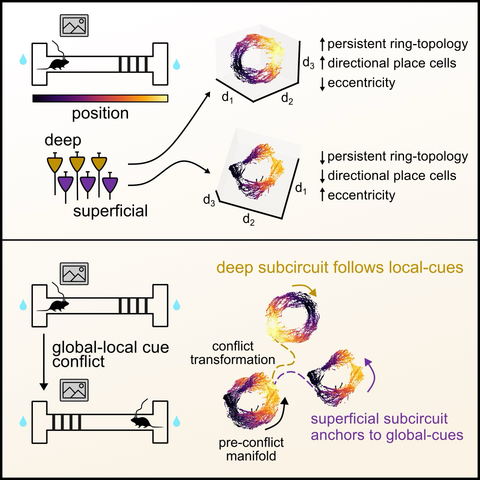
📚 New article by Esparza et al. and @LMPrida : Cell-type-specific #manifold analysis discloses independent parallel #SpatialMaps in #hippocampal #CA1. Using #miniscope imaging, they show deep and superficial CA1 #PyramidalNeurons encode position and running direction via distinct ring manifolds, manipulable via #chemogenetics. Fascinating for revealing parallel, cell-type–specific spatial topologies 👌

🌍 https://doi.org/10.1016/j.neuron.2025.01.022

#Neuroscience #CompNeuro

📚 New article by Lopes-dos-Santos, Brizee & Dupret: Spatio-temporal organization of network activity patterns in the #hippocampus. They use a low-dimensional embedding of #CA1#DG #LFP in behaving mice to reveal layer-specific #GammaRhythms and distinct firing motifs aligned with hippocampal microcircuit architecture – offering a data-driven view of how #oscillations coordinate #InformationFlow across hippocampal layers.

🌍 https://doi.org/10.1016/j.celrep.2025.115808

#Neuroscience #GammaOscillations #CompNeuro

📖 Vaidya et al. investigate how #hippocampal #CA1 #PlaceCells form expanding #memory representations over days. Using longitudinal in vivo recordings, they show that stable #PlaceFields progressively emerge as active cells increase their likelihood of remaining active across sessions. This gradual stabilization hinges on #behavioral‑timescale #SynapticPlasticity, offering a new model of how CA1 memories solidify w/o #CatastrophicOverwriting.

🌍 https://www.nature.com/articles/s41593-025-01986-3

#Hippocampus #Neuroscience

Formation of an expanding memory representation in the hippocampus - Nature Neuroscience

Multiday imaging of CA1 neurons during learning reveals that the representation stabilizes as the number of readily retrievable, information-rich and stable place cells increases and suggests novel mechanisms of hippocampal memory formation.

Nature
If you liked our lab’s SFN poster from @saman, here’s the #preprint, just up! Laminar CA1 recordings in freely moving🐒 🛜 and that buys us some interesting fields in task and overnight #sleep, #inhibitory cell responses, and best of all: superficial/ deep #CA1 #pyramidalneuron #cellassemblies !! @cogneurophys
#hippocampus #neuroscience
https://www.biorxiv.org/content/10.1101/2023.12.06.570369v1.article-metrics
If you missed our poster at #sfn2023, here's the article: https://www.biorxiv.org/content/10.1101/2023.11.10.566641v1
_______
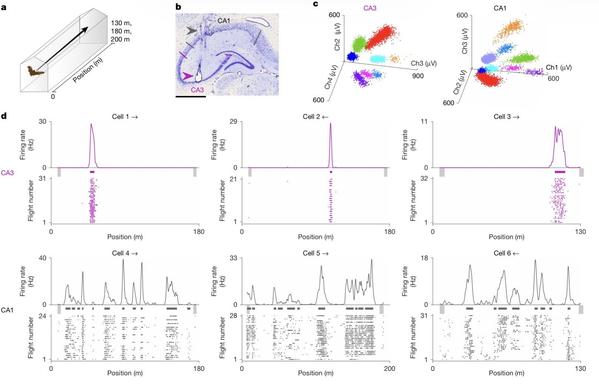
In a nutshell, we looked at how >30,000 #CA1 #hippocampus neurons coordinate their activity in relation to #space / #time both at the population and single neuron level. We also look at presynpatic (#CA3) and postsynaptic (#lateralseptum) neurons to evaluate hierarchical computations. Also tried my best at modelling a grid-to-time cell circuit based on real data to get insights in local integration

Paper here: https://elifesciences.org/articles/86548

and hopefully we did alright by the 'persuasive communication devices’ on what are some dramatic theta/gamma results from #macaque #hippocampus #CA1 #oscillations @cogneurophys

Theta- and gamma-band oscillatory uncoupling in the macaque hippocampus

Oscillations that co-occur in hippocampal CA1 during exploration in the rodent are shown to segregate according to exploratory and sleep states in the primate.

eLife
After years of perfecting my scrambled eggs technique, I am happy to report that our paper on optogenetic scrambling to dissociate spatiotemporal codes and memory is out in Nature Communications: https://doi.org/10.1038/s41467-023-35825-5 #hippocampus #CA1 #CalciumImaging #Miniscope #GCaMP #Optogenetics #Memory #InVivo #Electrophysiology #ThetaOscillations

An article "A Hippocampal Cognitive Prosthesis: Multi-Input, Multi-Output Nonlinear Modeling and VLSI Implementation" by Theodore W. Berger, et al.
(https://www.ncbi.nlm.nih.gov/pmc/articles/PMC3395724/) tells about a brain implant with 16 analog-to-digital converters and 32 channels of output.

I've been discussing it with Prozion (https://github.com/prozion) before and he has a very good question.
"How does the implant function at all with that amount of channels?"

The previous explanation from "Computational Cognitive Neuroscience" about memory de-indexing sheds some light on that: the article is about the same brain regions: CA1, CA3 and DG.

#neuroscience #CA1 #CA3 #Hippocampus

A Hippocampal Cognitive Prosthesis: Multi-Input, Multi-Output Nonlinear Modeling and VLSI Implementation

This paper describes the development of a cognitive prosthesis designed to restore the ability to form new long-term memories typically lost after damage to the hippocampus. The animal model used is delayed nonmatch-to-sample (DNMS) behavior in the rat, ...

Andrew Yang 🧢 Retweeted:
Nearly out of buttons at the first #NevadaCounty #YangGang tabling at the #NevadaCity farmers market. #CA1

https://pic.twitter.com/wdEJu32yJa
Neil Horning🧢 on Twitter

“Nearly out of buttons at the first #NevadaCounty #YangGang tabling at the #NevadaCity farmers market. #CA1”

Twitter