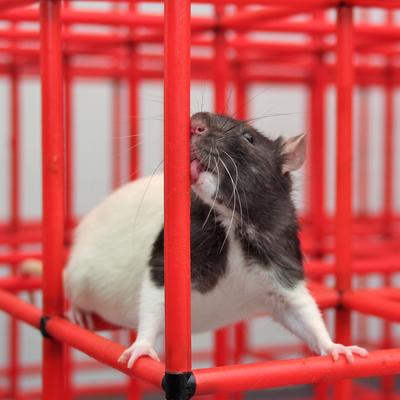
🗺️🐀 How does the #brain map uneven terrain? New paper by @rmgrieves, @elduvelle_neuro & Taube suggests that the #hippocampal map is shaped by terrain #geometry itself, not only by where the animal runs. Slopes, ridges & surface contours may act as spatial structure for #PlaceCells. Read more about in the 🧵👇

📄 https://doi.org/10.1126/sciadv.adz9893
"Hippocampal #PlaceCells map terrain geometry independently of #behavior"

#Hippocampus #SpatialNavigation #Neuroscience https://fediscience.org/@rmgrieves/116692850991318267
RE: https://fediscience.org/@rmgrieves/116692850991318267

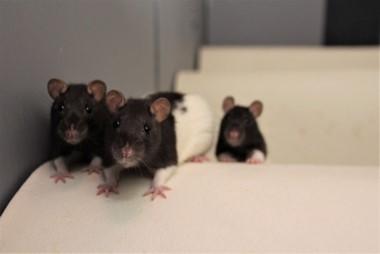
“This is a hill I’ll die on!” - says the scientist feeding smelly paste to rats running in a home-made maze with hills and troughs just like the waves in the rat’s brain and the emotions in the scientist’s life… 🏔️ 🌊 🧠

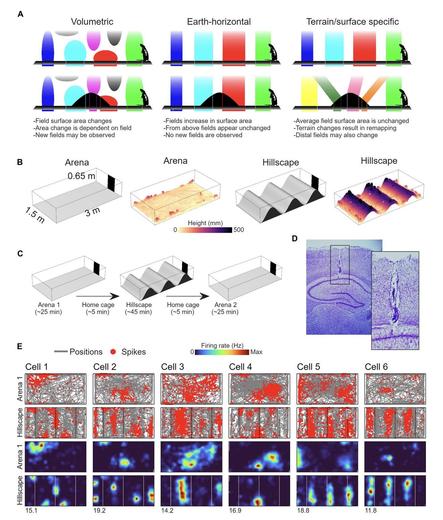
@rmgrieves 's latest paper is out, with rats on hills, #PlaceCells recordings and modelling looking at how the brain maps real-life environments: Hippocampal place cells map terrain geometry independently of behavior

It was great fun to work with him and Jeff Taube on this, even with all the emotional rollercoasters (inherent to science-making)!

#Neuroscience #Hippocampus #3DMapping #NeuroRat #SpatialCognition

Side-note:
What exactly are "place cells"? ⁉️

When you walk around your kitchen, a specific neuron activates (fires action potentials) only when you stand next to the fridge. Move over to the sink, and a completely different neuron activates.

Because these cells are tied to specific physical locations in your environment, we call them "place cells". Together, they underlie what we call a "cognitive map" - an internal representation of the world around you.

These cells are mostly found in a really cool brain region called the hippocampus 🧠 which is very similar in rats and humans.

The area where a place cell becomes active is known as its "place field" (we will talk about these in a minute).

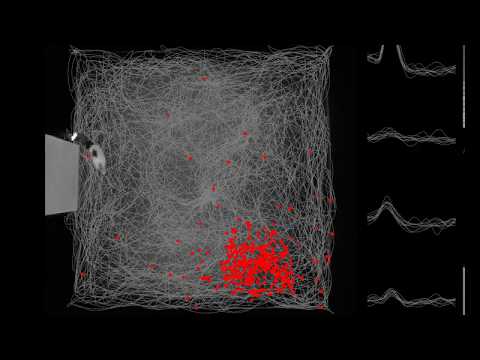
Here is a video showing the activity of a single place cell: https://www.youtube.com/watch?v=ZNEEvfZz4hU
#PlaceCells #CognitiveMap #Hippocampus
3/

Place cell (rat hippocampus CA1) activity recorded over 50 minutes of foraging

YouTube

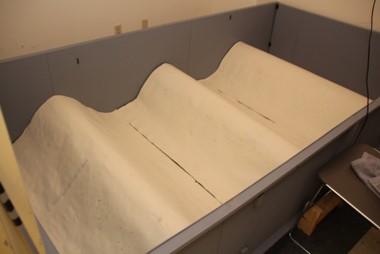
To find out, we recorded from hippocampal place cells, which are thought to underlie the brain's internal map, while rats foraged in a large (3x1.5 meters!) custom-built 3D "Hillscape" featuring three sinusoidal ridges.
⛰️ ⛰️ ⛰️

#placecells #hippocampus
2/

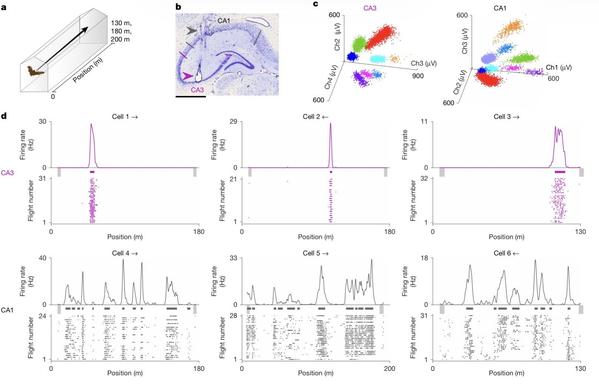
New paper by Maimon et al (Ulanovsky lab): recordings from #bats flying through tunnels up to 200 m reveal a sparse-to-dense transformation between #hippocampal #CA3 and #CA1.

In small environments, CA3 and CA1 #PlaceCells look similar. At large spatial scales, however, CA3 #neurons mostly show single, ultrasparse #PlaceFields, while CA1 neurons show dense multifield coding.

🌍 https://doi.org/10.1038/s41586-026-10537-0

🧵1/2

#Neuroscience #Hippocampus #SpatialNavigation #NeuralDynamics

Sometimes you wonder why the labs with all the funding (not just this one! This is just one example) do not do slightly more risky experiments instead of rediscovering the wheel.. 🤔 This is something anyone who records in hippocampus has observed and there's even specific papers about it.

Place cells in CA1 lack topographical organization of firing locations

See for example Redish et al., 2001: Independence of Firing Correlates of Anatomically Proximate Hippocampal Pyramidal Cells from @adredish (at least it is cited)

#PlaceCells #Hippocampus #SpatialCognition

@aheadofthenerve Super nice, thanks for this excellent preprint and explainer thread!
If you don't mind me asking, how do you think this switch in population code is triggered? Is it just a change in excitatory input patterns to CA1 that overrides an otherwise active place cell network? Or also a change in neuromodulatory input (e.g. dopaminergic burst or so)?

If ok I'd also add some hashtags for greater reach:
#neuroscience #newpreprint #tootsuite #hippocampus #placecells #invivo

Which of these famous "spatial cell" type is better?

Well, which is your favourite anyway? Yes it's a silly question

#SillyPoll #Neuroscience #PlaceCells #GridCells #BorderCells #BVCs #HeadDirectionCells

Border / BVC Cells
12.5%
Grid Cells
50%
Head-direction Cells
12.5%
Place Cells
25%
don't know / see results
0%
Poll ended at .

Here's a very interesting paper from the #KeinathLab:

Environmental representations in mouse hippocampal CA1 reflect the predictive structure of navigation

In the absence of task or reward, #PlaceCells appear to reflect the past history of behavioural biases, i.e. the accumulated past paths taken by each individual mouse. I am actually starting to think that #HippocampalReplay is doing a similar thing - just reflecting an average of the individual's past behaviour, and that all supposed "coding" of reward is purely driven by this (notice how reward "coding" always seems to happen in cases where reward biases the behavioural patterns..) 👀🧠🤔

#Neuroscience #Hippocampus #NeuroMice

Very cool retrospective AND review of the hippocampal #SpatialCognition field from Neil Burgess:
Oscillations and Boundaries in My Route Through the Hippocampal Cognitive Map

Mentions @adredish @tom_hartley and many others, unfortunately not on Mastodon I think
#Neuroscience #PlaceCells #GridCells #Hippocampus #ThetaRhythm