
This allows condensate behaviour to respond to different inputs, such as lysine #acetylation in IDRs in other CBP domains. It can help to explain how #transcription factors binding to different regions of CBP differentially regulate CBP activity. #enhancers #generegulation #llps #chromatin #imaging #biochemistry #molecularbiology #CellBiology
Researchers reveal how acetylation regulates centromere dynamics, chromosome segregation and mitotic progression

Cell division produces new cells, which underpin life proliferation and development. Mitosis is the shortest and the most dynamic phase of the cell cycle. During mitosis, chromosomes are evenly distributed between the two daughter cells, preserving the integrity of the genome.
Phys.org

IOB
“…here, we screen #histone #acetylation in the house #sparrow; we studied this species because #DNA #methylation was important in the spread of this #bird globally."
doi.org/10.1093/iob/ob…
by Ray, Sheldon (@)cedzimmer , (@)MartinlabUSF
(@)Big_Biology ) , Schrey

#epigenetic #bio

https://doi.org/10.1093/iob/obae004

Screening H3 Histone Acetylation in a Wild Bird, the House Sparrow (Passer Domesticus)

Synopsis. Epigenetic mechanisms are increasingly understood to have major impacts across ecology. However, one molecular epigenetic mechanism, DNA methylat

OUP Academic

IOB
Screening H3 Histone #Acetylation in a Wild #Bird, the House #Sparrow (Passer Domesticus)

by D Ray, E L Sheldon, C Zimmer, L B Martin, A W Schrey

https://doi.org/10.1093/iob/obae004

Screening H3 Histone Acetylation in a Wild Bird, the House Sparrow (Passer Domesticus)

Synopsis. Epigenetic mechanisms are increasingly understood to have major impacts across ecology. However, one molecular epigenetic mechanism, DNA methylat

OUP Academic

The cell's 'read–write' mechanism: Researchers uncover how instructions for #gene #expression are relayed.

#Epigenetic #histone #p300_CBP #acetylation

https://phys.org/news/2023-11-cell-readwrite-mechanism-uncover-gene.html

The cell's 'read–write' mechanism: Researchers uncover how instructions for gene expression are relayed

The "read–write" mechanism by which cells replicate and use chemical instructions for expressing genes has been uncovered by RIKEN researchers. The quality and quantity of gene expression correlates not only with instructions by transcription factors but also with chemical modifications to the various histone proteins, which provide a scaffold for DNA in the chromosomes.

"CD8+ Teff cells preferentially used #ketone bodies (KBs) over #glucose to fuel the tricarboxylic acid (TCA) cycle in vitro and in vivo. KBs directly boosted the respiratory capacity and TCA cycle-dependent metabolic pathways that fuel CD8+ T cell function. Mechanistically, βOHB was a major substrate for acetyl-CoA production in CD8+ T cells and regulated effector responses through effects on #histone #acetylation"

https://www.cell.com/immunity/fulltext/S1074-7613(23)00314-X?_returnURL=https%3A%2F%2Flinkinghub.elsevier.com%2Fretrieve%2Fpii%2FS107476132300314X%3Fshowall%3Dtrue

How does #centrosome #amplification -common in #cancer- promote #cellmigration through confined spaces?
Susana Godinho and colleagues show that it alters intracellular organization via effects on #tubulin #acetylation and #organelle transport along #microtubules
https://www.embopress.org/doi/full/10.15252/embj.2022112812

😱

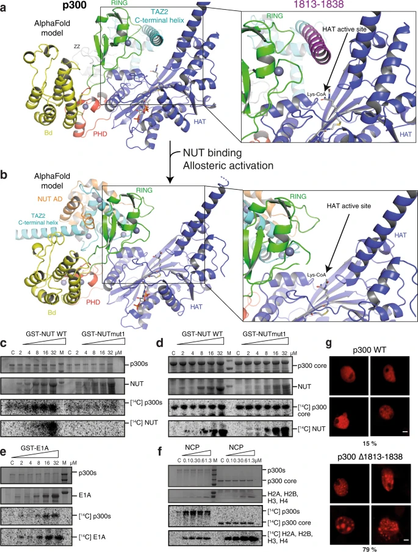
#Structural insights into p300 regulation and #acetylation-dependent genome organisation
https://www.nature.com/articles/s41467-022-35375-2

@strucbio

- #alphafold model of p300 suggests that the TAZ2 domain is positioned over the p300 HAT active site

- #alphafold model in the presence of NUT AD shows that the TAZ2 domain is displaced from the HAT active site and suggest that the TAZ2 domain auto-inhibits the HAT domain

- domain truncation and #mutagenesis support the #computational #models !

Structural insights into p300 regulation and acetylation-dependent genome organisation - Nature Communications

Here the authors use structural analyses to show that an intrinsically disordered transcription activation domain in the oncogene BRD4-NUT binds to and activates p300. This in-turn drives formation of higher-order, acetylation-dependent chromatin condensates.

Nature