 Hacker News
Era: From Nature publication to catalyzing Computational Discovery
#HackerNews #Era #Nature #Publication #Computational #Discovery #Research #Google
Era: From Nature publication to catalyzing Computational Discovery
#HackerNews #Era #Nature #Publication #Computational #Discovery #Research #Google
International Course on #Computational #SystemsBiology of #Cancer taking place at Institut Curie from September 21st – 25th, 2026 (Paris campus).
The course will review current methods and tools for analysing and interpreting multimodal genomic data, with a focus on generative artificial intelligence and network approaches, as well as concrete applications related to cancer.
More details and registration: https://training.institut-curie.org/courses/csbc2026

The Coordinated Action “Diagnostic, Therapeutic and Vaccine Viral Targets” of #ANRS MIE is organising a #webinar on #AI for molecular discovery. This webinar will explore how AI and #computational #modelling are advancing #drugdesign and protein research.
Speakers will present approaches for molecular design, prediction of protein variant effects and dynamics, and structural modelling of protein–protein interactions. The session will also take a critical perspective, addressing current limitations in #cheminformatics and practical considerations for researchers.
🚨 TOMORROW🚨
⚠️ AI for molecular discovery: From drug design to protein dynamics⚠️
April 15th 2026
12:30 - 14:00
Wednesday April 15th 2026, from 12:30 to 14:00 — online (Zoom)
Programme :
1️⃣ "AI for drug design" — Dragos Horvath, Strasbourg University
2️⃣ "Computational approaches for protein variant effect and motion prediction" — Elodie Laine, Sorbonne University
3️⃣ "Structural modelling and binding affinity prediction of the Human PDZ-PBM interactome" — Victor Reys, Utrecht University
➡️ Registration : https://services.hosting.augure.com/Response/c7juk/%7B6f9b7a92-f72c-4db8-9259-d92aaa0f0cc3%7D
“The relevance of a simple mathematical model breaks down when applied to the human brain, she says. “I don’t think these models are bad,” she says. “They become problematic when people get set in a model that’s been made to explain a very nuanced piece of data, and use it to explain the brain.””
https://www.nature.com/articles/d41586-026-00836-x
#neuroscience #dopamine #computational #ComputationalNeuroscience #modeling #data #brain
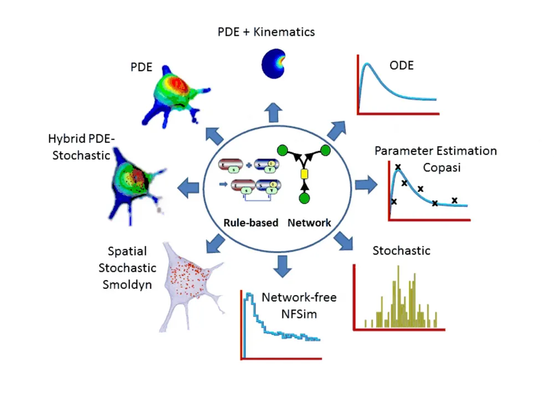
A #Virtual #Cell is a comprehensive #Computational #Model that simulates the biological functions, physical interactions, and chemical processes of a living cell.
These models are used by researchers to predict how cells respond to drugs, genetic mutations, or environmental changes without needing to perform every experiment in a physical laboratory.
MetaGenesis Core – offline verification for computational claims
https://www.metagenesis-core.dev/
#HackerNews #MetaGenesis #Core #offline #verification #computational #claims #blockchain #technology
Python's Global Interpreter Lock prevents execution on more than one CPU core at the same time, even when multiple threads are used. However, starting with Python 3.13 an experimental build allows disabling the GIL. While prior work has examined speedup implications of this disabling, the effects on energy consumption and hardware utilization have received less attention. This study measures execution time, CPU utilization, memory usage, and energy consumption using four workload categories: NumPy-based, sequential kernels, threaded numerical workloads, and threaded object workloads, comparing GIL and free-threaded builds of Python 3.14.2. The results highlight a trade-off. For parallelizable workloads operating on independent data, the free-threaded build reduces execution time by up to 4 times, with a proportional reduction in energy consumption, and effective multi-core utilization, at the cost of an increase in memory usage. In contrast, sequential workloads do not benefit from removing the GIL and instead show a 13-43% increase in energy consumption. Similarly, workloads where threads frequently access and modify the same objects show reduced improvements or even degradation due to lock contention. Across all workloads, energy consumption is proportional to execution time, indicating that disabling the GIL does not significantly affect power consumption, even when CPU utilization increases. When it comes to memory, the no-GIL build shows a general increase, more visible in virtual memory than in physical memory. This increase is primarily attributed to per-object locking, additional thread-safety mechanisms in the runtime, and the adoption of a new memory allocator. These findings suggest that Python's no-GIL build is not a universal improvement. Developers should evaluate whether their workload can effectively benefit from parallel execution before adoption.
The Coordinated Action “Diagnostic, Therapeutic and Vaccine Viral Targets” of #ANRS MIE is organising a #webinar on #AI for molecular discovery. This webinar will explore how AI and #computational #modelling are advancing #drugdesign and protein research.
Speakers will present approaches for molecular design, prediction of protein variant effects and dynamics, and structural modelling of protein–protein interactions. The session will also take a critical perspective, addressing current limitations in #cheminformatics and practical considerations for researchers.
🚨 MARK YOUR CALENDAR 🚨
⚠️ AI for molecular discovery: From drug design to protein dynamics⚠️
April 15th 2026
12:30 - 14:00
Wednesday April 15th 2026, from 12:30 to 14:00 — online (Zoom)
Programme :
1️⃣ "AI for drug design" — Dragos Horvath, Strasbourg University
2️⃣ "Computational approaches for protein variant effect and motion prediction" — Elodie Laine, Sorbonne University
3️⃣ "Structural modelling and binding affinity prediction of the Human PDZ-PBM interactome" — Victor Reys, Utrecht University
➡️ Registration : https://services.hosting.augure.com/Response/c7juk/%7B6f9b7a92-f72c-4db8-9259-d92aaa0f0cc3%7D

 Dr. Bruce Simpson
 Laurent Gatto
 François Ferron 🇪🇺 🔷️🔶️
 Neurofrontiers
 Knowledge Zone
 Unofficial PetaPixel Bot
 N-gated Hacker News