Centromere sizes determine Unique Meiosis in Dogrose   
The dogrose (Rosa canina), the wild rose plant species, has a pentaploid genome with 35 chromosomes............
#Canina #Caninameiosis #Cell #Celldivision #Centromere #Dogrose #Meiosis #Pentapoidy
Umesh Prasad


https://www.scientificeuropean.co.uk/sciences/biology/centromere-sizes-determine-unique-meiosis-in-dogrose/

Centromere sizes determine Unique Meiosis in Dogrose   
The dogrose (Rosa canina), the wild rose plant species, has a pentaploid genome with 35 chromosomes............
#Canina #Caninameiosis #Cell #Celldivision #Centromere #Dogrose #Meiosis #Pentapoidy
Umesh Prasad

https://www.scientificeuropean.co.uk/sciences/biology/centromere-sizes-determine-unique-meiosis-in-dogrose/

1-Jan-2025
Revealing a key mechanism of rapid centromere #evolution
Researchers clarify a key mechanism of genetic element insertions in the #centromere, the “waist” of a #chromosome

https://www.eurekalert.org/news-releases/1069128 #science #DNA #MolecularBiology #transposon

Revealing a key mechanism of rapid centromere evolution

A joint research group team led by Sayuri Tsukahara and Tetsuji Kakutani of the University of Tokyo has clarified a mechanism of how retrotransposons, genetic elements that can “jump around” chromosomes and are known drivers of evolution, preferentially insert in the centromere. The findings were published in the journal Nature.

EurekAlert!
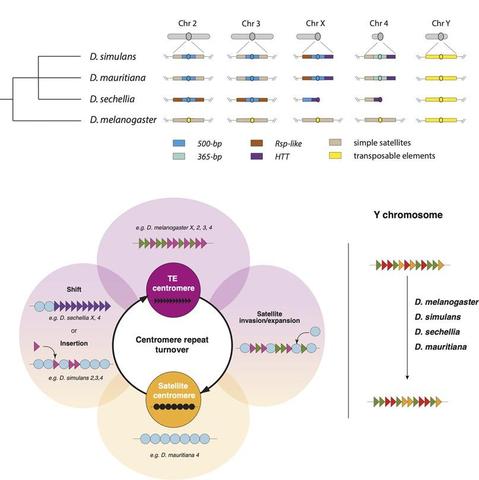
Rapid centromere evolution: @CecileCourret @AmLarracuente &co's study of #centromere #evolution over short timescales in #Drosophila reveals dramatic #centromere reorganization involving recurrent shifts between retroelements & satellites #PLOSBiology https://plos.io/3CBwHQe
Turnover of retroelements and satellite DNA drives centromere reorganization over short evolutionary timescales in Drosophila

Centromeres reside in rapidly evolving, repeat-rich genomic regions, despite their essential function in chromosome segregation. This study of centromere evolution over short evolutionary timescales in Drosophila reveals dramatic centromere reorganization involving recurrent shifts between retroelements and satellite DNAs.

Scientists Unravel Key to the #Centromere’s Eternal Life, Solving Decades-Old Mystery
Researchers discovered that PLK1 triggers a process ensuring centromere preservation during cell division by activating the Mis18 complex and controlling CENP-A loading. This finding is key to understanding how cells correctly divide their genetic material, preventing diseases like cancer.
https://scitechdaily.com/scientists-unravel-key-to-the-centromeres-eternal-life-solving-decades-old-mystery/
Scientists uncover mechanism preserving centromere during cell division

Scientists have solved a decade-long question about the mechanism that preserves the centromere, the hub that ensures DNA divides correctly during cell division.

Phys.org
Researchers reveal how acetylation regulates centromere dynamics, chromosome segregation and mitotic progression

Cell division produces new cells, which underpin life proliferation and development. Mitosis is the shortest and the most dynamic phase of the cell cycle. During mitosis, chromosomes are evenly distributed between the two daughter cells, preserving the integrity of the genome.

Phys.org
Centromere research yields new insights into the mechanisms of chromosome segregation errors

Researchers from the Hubrecht Institute's Kops group, in collaboration with researchers from the University of Edinburgh, have made a surprising new discovery in the structure of the centromere, a structure involved in ensuring that chromosomes are segregated properly when a cell divides. Mistakes in chromosome segregation can lead to cell death and cancer development.

Phys.org
Study gives first view of centromere variation and evolution

A genomic study of human and selected nonhuman primate centromeres has revealed their unimaginable diversity and speed of evolutionary change.

Phys.org
New insights in the regulation of genetic information exchange

Within every cell in our body, our DNA is tightly bundled with proteins to form structures known as chromosomes. The commonly known shape of a chromosome relates to an X-shaped appearance in many organisms. The formation of the X-shaped chromosome results from a close connection at a site called the centromere. This centromere acts as a link between the sister chromatids, the identical copies that are created during DNA replication.

Phys.org