#Brazil is the largest producer of coffee beans.

"Farmers in the region have long viewed #coffee as a good way to make a living. Today the coffee industry employs more than 14 million people across #LatinAmerica. In recent years, though, #ClimateChange, pests and declining coffee prices have created a perfect storm that threatens the welfare of millions of producers and their families."

https://www.iadb.org/en/improvinglives/most-unexpected-effect-climate-change

A future without coffee? Climate change could wipe out 50% of global coffee crop by 2050.

Rising temperatures and a fungus that spreads with them are jeopardizing the livelihood of 14 million people who grow coffee in five Latin American countries. How can we solve the problem?

"#Climate breakdown is already changing the taste and quality of #beer, scientists have warned.

The quantity and quality of #hops, a key ingredient in most beers, is being affected by global heating, according to a study. As a result, beer may become more expensive and manufacturers will have to adapt their brewing methods."

#ClimateInflation
https://www.theguardian.com/world/2023/oct/10/climate-crisis-will-make-europes-beer-cost-more-and-taste-worse-say-scientists

Climate crisis will make Europe’s beer cost more and taste worse, say scientists

Experts say hop yields and quality will continue to drop by 2050 if farmers don’t adapt to higher temperatures

The Guardian

"Over the last 30 years, an estimated $3.8 trillion worth of #crops and #livestock production has been lost due to #disaster events, corresponding to an average loss of $123 billion per year or 5 percent of annual global agricultural gross domestic product (GDP), according to a new report released today by the Food and Agriculture Organization of the United Nations (#FAO)."

In case you're wondering why food is getting so expensive.
#ClimateInflation

https://www.fao.org/newsroom/detail/first-ever-global-estimation-of-the-impact-of-disasters-on-agriculture/en

First-ever global estimation of the impact of disasters on agriculture

New FAO report shows that about $3.8 trillion worth of crops and livestock production has been lost over the last 30 years 

Newsroom

It's not just about extreme weather, but also about pests and diseases that spread more easily in a warming climate. Food storage also becomes more crucial.

But the bottom line is that food becomes more expensive.

https://www.foodnavigator.com/Article/2023/10/19/eight-crops-endangered-by-climate-change

Eight crops endangered by climate change

From staple crops like potatoes and maize, to cash crops for wealthier customers like cocoa and coffee, climate change is having a widespread impact on global agricultural production.

foodnavigator.com

"Entire fields have been submerged in water after #StormBabet swept across the #UK, with crops ruined. #ExtremeWeather events are becoming more likely and frequent due to #climate breakdown, and have caused food shortages and price increases.

Last year, farmers faced turmoil because of the extended drought and #ExtremeHeat, which caused crop losses, water shortages and effects on planting and harvesting."

https://www.theguardian.com/environment/2023/oct/25/farmers-crops-uk-floods

UK farmers warn of rotting crops after Storm Babet flooding

National union members urge government to create water strategy to prevent such losses

The Guardian

"Apple season is winding down in New York’s Finger Lakes Region. And would-be pickers may have found less fruit than usual this year.

A warm spell in the early spring lured fruit trees out of their winter dormancy.

Then, on May 18, temperatures plunged into the mid-20s, killing blossoms and baby fruit."

#ClimateInflation
https://yaleclimateconnections.org/2023/11/wild-spring-weather-swings-hurt-new-yorks-fall-apple-harvest/

Wild spring weather swings hurt New York’s fall apple harvest

It’s a problem that’s getting worse as the weather gets more erratic.

Yale Climate Connections

#ClimateChange makes life less sweet

"Europe’s flooded fields are delaying #sugar harvesting and threatening to wipe out 15% of #beet crops still to be collected in #France, one of the region’s biggest growers of the sweetener.

Dutch farmers still have about 50% of beets in fields.
Harvest delays will probably prolong #Germany’s beet campaign until February, increasing the risk of crop losses to frost."

https://www.bloomberg.com/news/articles/2023-11-20/flooded-fields-delay-european-sugar-harvest-and-risk-beet-losses

Floods Delay European Sugar Harvest and Risk Beet Losses

Europe’s flooded fields are delaying sugar harvesting and threatening to wipe out 15% of beet crops still to be collected in France, one of the region’s biggest growers of the sweetener.

Bloomberg

"The Energy and Climate Intelligence Unit (ECIU) thinktank said that global heating was directly contributing to the #CostOfLiving crisis.

Combined with the impact of Russia’s invasion of Ukraine [driving] up gas, energy and fertiliser prices, it said British households had been hit by £605 in additional food costs in 2022 and 2023. While energy prices have fallen back this year, it warned that the impact from the #climate emergency was increasing."

#ClimateInflation
https://www.theguardian.com/business/2023/nov/27/climate-crisis-energy-costs-fuel-uk-household-food-bill-rise

Climate crisis and energy costs fuel £600 rise in UK household food bill, analysis finds

Extreme weather contributing one-third of all food price inflation with worse to come in 2024, warn climate researchers

The Guardian

"In 2023— the hottest year in recorded history— the escalating threat posed by #climate impacts on #food security compounded the global cost-of-living crisis, intensifying challenges already faced by vulnerable countries, low-income consumers and jeopardizing global nutrition levels."

#ClimateInflation #CostOfLiving
https://www.forbes.com/sites/daphneewingchow/2023/12/31/here-are-the-foods-hit-hardest-by-climate-change-in-2023/

Here Are The Foods Hit Hardest By Climate Change In 2023

Farmers have been hit by an increase in climate change related extreme weather. Here are the foods most impacted in 2023, the hottest year in recorded history.

Forbes

"#Farmers and fishers in #Bangladesh’s coastal belt report losses as #climate-induced disasters and coastline changes threaten livelihoods."

https://www.eco-business.com/news/rising-tides-ruined-fields-show-how-bangladeshs-farmers-grapple-with-climate-change/

Rising tides, ruined fields show how Bangladesh’s farmers grapple with climate change

Farmers and fishers in Bangladesh’s coastal belt report losses as climate-induced disasters and coastline changes threaten livelihoods.

Eco-Business

"A new study finds that #MarineHeatwaves are changing the base of the marine #food chain, disrupting ecosystems and potentially global food supplies."

https://www.voanews.com/a/study-finds-ocean-heatwaves-could-affect-global-food-supplies/7471051.html

Study Finds Ocean Heatwaves Could Affect Global Food Supplies

Researchers warn of global implications of abnormally warm oceans.

Voice of America (VOA News)

"#Rice prices in the #Philippines continued to rise in January despite slowing overall #inflation, with El Nino and India's export ban promising to exacerbate the trend in the coming months.

Velasquez pointed out poor households have been hit hard by expensive rice, with low earners forced to spend outsized percentages of their income on the grain."

https://asia.nikkei.com/Economy/Inflation/Philippine-rice-inflation-hits-highest-level-since-2009

Philippine rice inflation hits highest level since 2009

Overall price growth down but global conditions cause food costs to climb

Nikkei Asia

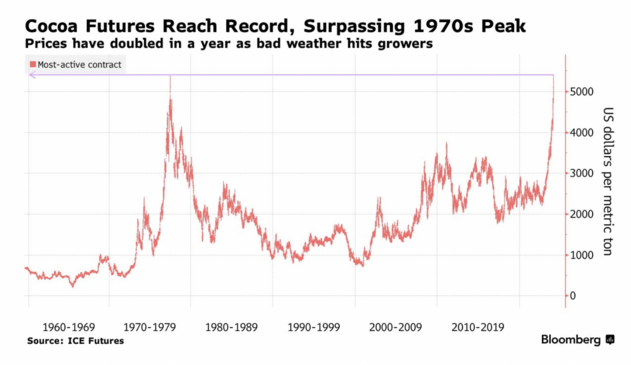
Also #ClimateChange is coming for your #chocolate:

"[Cocoa] Prices have doubled during the past year as growers in West Africa — who produce the bulk of global supply — are battered by extreme weather. Earlier rains promoted the spread of crop disease and delayed harvesting. That has been followed by a seasonal dry spell, which could further crimp production."

https://www.bloomberg.com/news/articles/2024-02-08/cocoa-hits-record-on-tight-supply-threatening-pricier-treats

This is not your staple food, but YOW.

Cocoa Prices Hit Record on Tight Supply, Threatening Pricier Treats

Cocoa futures extended their surge to a record in New York as a shortfall gripped the market, threatening to further raise prices for chocolate and other confectionery.

Bloomberg

“The results confirmed the industry’s worst fears, with the vast majority of samples showing no signs of life in their primary or secondary buds,” a report by Cascadia Partners for Wines of BC, released this week, says. “This means that the production of 100% #BC #grapes and #wine is projected to be 97-99% lower than usual in 2024."

https://infotel.ca/inwine/okanagan-grape-harvest-wiped-out-for-2024/it103222

Okanagan grape harvest wiped out for 2024

Five days of extremely cold weather in January killed just about every wine grape bud in the Okanagan.Thousands of primary and secondary buds were studied at the Summerland Research Centre and a number of wineries over t

iNFOnews

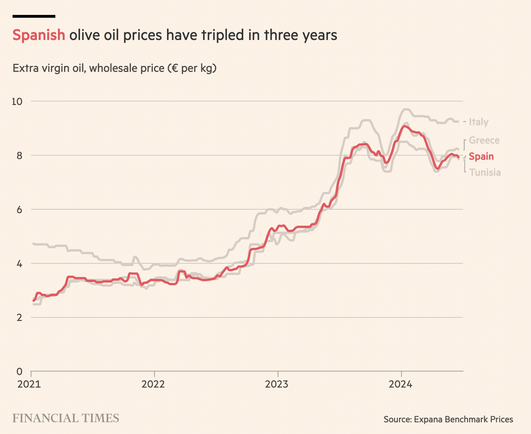
"For the 2022 to 2023 harvest, overall European Union #OliveOil production declined by 26 per cent compared to the previous year. This year, it is expected to drop by 39 per cent, the lowest level since the mid-1990s. 

Limited supplies have driven prices skywards, with a 115 % increase in #Spain and a 50 % hike in #Greece between 2022 and 2023. Olive oil thefts have increased, with supermarkets resorting to padlocking olive oil bottles to shelves."

https://www.theparliamentmagazine.eu/news/article/olive-oil-climate-change-crisis

#ClimateInflation

Oil crisis: How olive farmers are adapting to climate change to preserve a cultural commodity

Changing weather patterns are making it harder to grow olives across Europe, increasing consumer prices and threatening growers’ livelihoods. As te...

The Parliament Magazine

"Fruit trees evolved to live in more stable conditions; they’re exquisitely well adapted to the rhythm of a usual year. But instead of reliable seasons, they’re getting weather chaos. As a result, trees’ sense of seasonality is scrambled. And instead of reliable peaches and plums, we’re getting fruit chaos. It may not happen every year, but it’s happening more frequently."

https://www.theatlantic.com/science/archive/2024/03/fruit-climate-change-chaos-spring/677701/

Fruit Chaos Is Coming

Climate change is threatening to turn sublime summer stone fruits disgusting, or rob us of their pleasures entirely.

The Atlantic

"Industry experts say the price of #bananas globally is very likely to rise due to the impact of #ClimateChange — but some believe paying more for bananas now could mitigate those risks. "

https://www.cbsnews.com/news/bananas-cost-price-climate-change-experts-say-too-cheap-now/

#ClimateInflation

Climate change will make bananas more expensive. Here's why some experts say they should be already.

Experts say climate change will drive up the price of bananas, but consumers should already be paying more.

CBS News

"#ClimateChange is set to reduce the country’s available #apple-growing regions; the fast-aging population in the country’s rural areas has reduced the number of apple growers; and the country’s complicated and strict regulations on fresh fruit and vegetable imports have effectively blocked apple imports. "

#SouthKorea
https://www.kedglobal.com/the-deep-dive/newsView/ked202403140008

Korea faces apple crisis amid climate, demographic change

Apples, normally among the most common and available fruit, are poised to be a rarity in South Korea, where people are suffering a so-called “appflation&

KED Global

#Vietnam farmers struggle for fresh #water as drought brings salinisation

"The area is crisscrossed by waterways, but the prolonged #heatwave and lack of rain are causing #salinisation -- the intrusion of salt water from the sea -- badly affecting crops in a region vital to feeding the nation of 90 million people."

https://www.france24.com/en/live-news/20240320-vietnam-farmers-struggle-for-fresh-water-as-drought-brings-salinisation

Vietnam farmers struggle for fresh water as drought brings salinisation

Every day, farmer Nguyen Hoai Thuong prays in vain for rain to fall on the cracked dry earth of her garden in Vietnam's Mekong Delta -- the country's "rice bowl" agricultural heartland.

FRANCE 24

Higher temperatures mean higher food and other prices. A new study links climate shocks to #inflation

“There are these productivity shocks that we know about from climate change, from the weather phenomena caused by climate change, from heat waves and so forth to reduce agricultural productivity,” Kotz said. “Those also then have a knock-on effect on food inflation, on headline inflation.”

#ClimateInflation
https://www.latimes.com/business/story/2024-03-22/higher-temperatures-mean-higher-food-and-other-prices-a-new-study-links-climate-shocks-to-inflation

Higher temperatures mean higher food and other prices. A new study links climate shocks to inflation

A study by an environmental scientist and the European Central Bank finds that food prices and overall inflation will rise as temperatures climb with climate change.

Los Angeles Times

Beyond #ClimateInflation: hunger.

In Zimbabwe, "people grow the cereal grain sorghum and pearl millet, crops that are drought resistant and offer a chance at harvests, but even they failed to withstand the conditions this year.

With this year’s harvest a write-off, millions in #Zimbabwe, southern #Malawi, #Mozambique and #Madagascar won’t be able to feed themselves well into 2025."

#hunger
https://www.9news.com.au/world/extreme-drought-in-southern-africa-leaves-millions-hungry/38d2f918-8f2c-42b1-85de-e1f32c6ae0fe

Extreme drought in southern Africa leaves millions hungry

<p>While human-made climate change has spurred more erratic weather globally, there is something else parching southern Africa this year.</p>

9News

"The United Nations children’s fund says there is a “dire situation” in several eastern and southern African countries, where at least 45 million children are dealing with severe #FoodInsecurity made worse by #ClimateChange."

#UNICEF #hunger
https://www.voazimbabwe.com/a/unicef-climate-change-leaves-dire-situation-for-45-million-african-children/7552463.html

UNICEF: Climate Change Leaves ‘Dire Situation’ for 45 Million African Children

HARARE, ZIMBABWE — The United Nations children’s fund says there is a “dire situation” in several eastern and southern African countries, where at least 45 million children are dealing with severe food insecurity made worse by climate change. In a statement, Eva Kadilli, the UNICEF director...

VOA

"#UK #harvests of important crops could be down by nearly a fifth this year due to the unprecedented wet weather farmers have faced, increasing the likelihood that the prices of bread, beer and biscuits will rise.

Some farms were badly affected by persistent rain since October, meaning they have not been able to plant any crops, while the wet weather has significantly depleted the amount other farms have been able to plant."

https://www.theguardian.com/environment/2024/apr/29/washout-winter-spells-price-rises-for-uk-shoppers-with-key-crops-down-by-a-fifth
#ClimateInflation

‘Washout winter’ spells price rises for UK shoppers with key crops down by a fifth

Analysts say impact on wheat, barley, oats and oilseed rape harvests means price rises on beer, bread and biscuits and more food imported

The Guardian

Drought is driving #OliveOil prices to staggering new heights

"#Spain, which is the world’s largest olive supplier and home to 40% of the global crop, has been dealing with droughts that have cut output by anywhere from 30% to 50% of its usual 1.3 million metric-ton harvests.
In February Spanish farmers were calling on the government to do more to fight #ClimateChange amid persistent #heatwaves that have decimated their trades."

https://qz.com/olive-oil-prices-climate-change-1851458811
#ClimateInflation

Drought is driving olive oil prices to staggering new heights

The cost of olives has spent the last two years skyrocketing because of climate change

Quartz

"#Bananas are at risk of a “devastating” disease as extreme heat and volatile rain cycles put the plants under stress, Colombian farmers have warned.

Small-scale producers in the northern Magdalena region who supply bananas to the UK say the impacts of #ClimateChange have increased their costs and hit yields by as much as 50%."

https://www.independent.co.uk/climate-change/news/life-banana-pip-columbia-el-nino-b2543239.html
#ClimateInflation

Bananas at risk of devastating disease and extreme heat, Colombian farmers warn

Small-scale producers who supply bananas to the UK say the impacts of climate change have increased their costs and hit yields by as much as 50%.

The Independent

"Global warming is leading to smaller yields and poorer quality in #rice crops, according to new research that suggests rice harvests could decrease by up to 35% and quality by up to 85% compared to plants in 1990s climate conditions.

The research suggests that additional high CO2 concentration further worsened production compared to the high temperature alone."

(So much for that claim that CO2 is "plant food" eh).

https://www.yahoo.com/news/study-rice-harvests-quality-worsening-195323415.html
#ClimateInflation

Study: Rice harvests and quality are worsening under climate change

Global warming is leading to smaller yields and poorer quality in rice crops, according to new research that suggests rice harvests could decrease by up to...

Yahoo News

#ClimateChange comes for your #Avocados

"Researchers at the charity Christian Aid said that a hotter, drier world would make it more difficult to provide the significant amount of water needed to grow the fruit.

Mexico, the world’s biggest producer, could see its potential growing area reduced by 31 per cent by 2050 - even if global average temperature rises are limited to under 2C, according to the report. "

https://www.standard.co.uk/news/uk/climate-change-avocados-uk-water-production-christian-aid-report-b1157475.html

Climate change having 'terrible impact' on avocados, report says

Charity warns that higher temperatures will make it more difficult to provide water needed for production

Evening Standard

"Global warming is bringing on a succession of negative effects on a range of marine creatures across #Japan, such as the relocated habitats of fish and fluctuations in #seafood catches.

Concerns are growing that the summer #heatwave expected this year as well may further exacerbate the situation.
The total seafood catch in Japan has been on a continuous decline."

https://www.asahi.com/ajw/articles/15244124
#ClimateInflation

Climate change turns up the heat on Japanese seafood industry | The Asahi Shimbun: Breaking News, Japan News and Analysis

Much to his dismay, longtime kelp farmer Shigeki Aiki found that his konbu seedlings had many fewer leaves that were to be processed for food.

The Asahi Shimbun

"#Morocco’s harvest of three main grains, soft #wheat, #durum, and #barley, dropped 43% to 3.12 million tons in 2024, due to a severe #drought that slashes cultivated areas."

https://northafricapost.com/77635-drought-ditches-moroccos-cereals-harvest-by-43-in-2024.html

#ClimateInflation

Drought ditches Morocco’s cereals harvest by 43% in 2024 – The North Africa Post

"“Two years ago, we produced 500 tons of oil, and last year, 70,” he said. “The reduced production shattered my dreams.

Athanasios Molasiotis, a professor of agronomy at the Aristotle University of Thessaloniki, said that higher-than-usual temperatures, which are attributed to #ClimateChange, are affecting the Greek #OliveOil sector in multiple ways."

https://www.oliveoiltimes.com/production/farmers-in-greece-witness-the-impacts-of-climate-change-after-historically-low-harvest/132043

Farmers in Greece Witness the Impacts of Climate Change After Historically Low Harvest

Farmers and millers throughout Greece have reported that climate change is making it increasingly difficult to produce award-winning extra virgin olive oil.

Olive Oil Times

Where this is going:

This study on "Global impacts of heat and #water stress on #FoodProduction and severe food insecurity" says that if we keep emitting carbon like we do now, 1.36 billion extra people will experience "severe food insecurity" by 2050.

That's 17% of the world population.

https://www.nature.com/articles/s41598-024-65274-z

Global impacts of heat and water stress on food production and severe food insecurity - Scientific Reports

In contrast to most integrated assessment models, with limited transparency on damage functions and recursive temporal dynamics, we use a unique large-dimensional computational global climate and trade model, GTAP-DynW, to directly project the possible intertemporal impacts of water and heat stress on global food supply and food security to 2050. The GTAP-DynW model uses GTAP production and trade data for 141 countries and regions, with varying water and heat stress baselines, and results are aggregated into 30 countries/regions and 30 commodity sectors. Blue water stress projections are drawn from WRI source material and a GTAP-Water database to incorporate dynamic changes in water resources and their availability in agricultural production and international trade, thus providing a more general measure for severe food insecurity from water and heat stress damages with global warming. Findings are presented for three representative concentration pathways: RCP4.5-SSP2, RCP8.5-SPP2, and RCP8.5-SSP3 (population growth only for SSPs) and project: (a) substantial declines, as measured by GCal, in global food production of some 6%, 10%, and 14% to 2050 and (b) the number of additional people with severe food insecurity by 2050, correspondingly, increases by 556 million, 935 million, and 1.36 billion compared to the 2020 model baseline.

Nature

This is what #ClimateInflation looks like:

People in the heartland of olive oil - Portugal, Spain, Italy, Greece - are consuming less of it: as harvests have gone down, prices have soared.

https://www.ft.com/content/9b284294-1c76-46a0-9fe7-97ea94542c68

Soaring olive oil prices hurt sales of ‘liquid gold’ in Mediterranean heartland

Poor harvests hitting production have forced up the cost of key ingredient

Drought, early frosts, and birds who can't find enough insects to eat in the drought all contribute to a "horror season" for #NewZealand #olive growers.

https://www.rnz.co.nz/news/country/520499/horror-season-for-many-olive-oil-producers

Horror season for many olive oil producers

Growers in Wairarapa, Nelson/Marlborough and Canterbury are pressing a third fewer olives than last season.

RNZ

"A third of the food price increases in the UK in 2023 was down to climate change, according to the Energy and Climate Intelligence Unit think-tank."

https://www.ft.com/content/125e89c0-308a-492f-ae8e-6834847d1186

That's ... a lot.
For the UK, that's called #ClimateInflation .

For developing countries that spend more of their budget on food (and where the ability of growing food is closer to the temperature limits), this could spell real trouble.

Climate change is pushing up food prices — and worrying central banks

Shifting weather patterns are reducing crop yields and squeezing supplies, creating what could become a permanent source of inflation

Financial Times

"Many [wheat] farmers saw a decline in crop production.

Al-Akhras and others like him say that decades of conflict in #Syria and #ClimateChange are to blame. And we can see the evidence all around the country."

https://www.msn.com/en-us/news/world/syrian-farmers-caught-between-grinding-conflict-and-climate-change/ar-BB1pcKvJ?item=flightsprg-tipsubsc-v1a%3Futm_source%3Dmilei.news%2F

MSN

"Portions of Iowa, South Dakota and Nebraska are grappling with the aftermath of #flooding, while continuing to fight a swollen river. The Mississippi River is facing flood threats, too. The high waters and flooding are suffocating fields, causing #CropDamage to key growing areas across the Midwest."

https://www.agweb.com/news/crops/crop-production/flooding-across-midwest-may-have-wiped-out-1-million-acres-crops-new

You know all this will contribute to #ClimateInflation

And yet.

Whem the article talks about where does all this water come from?
"High pressure"
"Cold front"
"Gulf Moisture"
"Recycle local moisture"
and even
"An unbroken jet stream flow from Japan"
But not a single word about global warming.

https://www.agweb.com/news/crops/crop-production/flooding-across-midwest-may-have-wiped-out-1-million-acres-crops-new

"Different parts of [#China] are being simultaneously hit by floods, droughts and tropical storms, threatening to spur food #inflation if output of wheat, soybeans, rice and corn is affected.

Major rice-growing areas in the south have been soaked by flooding, while droughts further north have damaged wheat and delayed corn and soybean planting."

https://www.bloomberg.com/news/articles/2024-07-08/extreme-weather-poses-risks-for-chinese-crops-power-over-summer

Extreme Weather Poses Risks for Chinese Crops, Power Over Summer

Another exceptionally hot summer, accompanied by drought, flooding and typhoons, is risking Chinese crop harvests and lifting power demand as climate change creates more extreme weather.

Bloomberg

"Futures for [robusta] have surged about 60% this year, touching a fresh high of $4,667 per ton. Concerns about the next harvest are adding to supply fears after hot and dry weather in parts of #Vietnam damaged #coffee trees earlier this year.

#Brazil’s top growing regions have also faced the brunt of harsh weather, pushing up arabica prices. Some farmers pick smaller-than-usual beans following droughts in late 2023 that hurt crop development."

https://www.bloomberg.com/news/articles/2024-07-09/coffee-prices-will-keep-rising-into-2025-roaster-lavazza-says
#ClimateInflation

Coffee Prices Will Keep Rising into 2025, Roaster Lavazza Says

Coffee prices will keep rising until the middle of 2025 due to supply shortages in key growers, with European consumers set to pay even more for their caffeine hit as new deforestation regulations kick in.

Bloomberg

@CelloMomOnCars this is an amazing thread.

I was just talking to someone about how to convince people to take action on climate, we need to first identify their values, and then show how climate change would affect that thing they care about deeply.

He said he valued food and his children - so I brought up the price of chocolate from January and the arabica to robusta shift in coffee. Both things he was unaware of, and it made him even more worried about climate.

@MisterMadge

So cool how you were able to connect the dots for your friend! Sounds like he is already got climate on his radar but it hits home when it's about, like you said, something you care about.

There are lots of solutions - when I give a talk I show a slide that has them crammed on a page, and it's still not complete - so we need to get to work on those.