 Headlines Africa
EU climate monitor says sea temperatures could reach record high in May http://newsfeed.facilit8.network/TSRdrZ #ClimateCrisis #ElNiño #GlobalWarming #ClimateChange #SeaTemperature

Geochemical proxies are frequently utilized in the reconstruction of past ocean temperatures. Due to resource constraints, these reconstructions typically rely on a single sediment core, raising questions about the local and regional representativeness of paleotemperature records. To address this, we analyzed four sediment cores located within a 10-km radius in the northern Okinawa Trough (OT), which share the same climatic forcing and thus should reflect similar climate variations. We compiled published data and generated new paleotemperature estimates based on three widely used geochemical proxies (foraminiferal Mg/Ca, $${\text{U}}_{37}^{{{\text{K}}^{\prime}}}$$ U 37 K ′ , $${\text{TEX}}_{86}$$ TEX 86 ). Analysis of the mean absolute deviations for nearby records based on the same proxy revealed that $${\text{U}}_{37}^{{{\text{K}}^{\prime}}}$$ U 37 K ′ has the highest reproducibility, followed by Mg/Ca and $${\text{TEX}}_{86}$$ TEX 86 . However, inconsistencies in inter-proxy offsets among nearby sites suggest the presence of noise in the proxy records, likely stemming from instrumental errors and sediment heterogeneity. Furthermore, the Mg/Ca and $${\text{U}}_{37}^{{{\text{K}}^{\prime}}}$$ U 37 K ′ paleotemperature records agree within uncertainty when accounting for inter-site variability and calibration uncertainties, challenging previous interpretations of temperature signals from different seasons. All proxies indicate similar glacial-interglacial trends, albeit with varying magnitudes of temperature change. Both Mg/Ca and $${\text{U}}_{37}^{{{\text{K}}^{\prime}}}$$ U 37 K ′ records suggest a glacial cooling of ~ 3 °C, whereas $${\text{TEX}}_{86}$$ TEX 86 sea surface temperature (SST) data indicate a stronger glacial cooling of approximately ~ 6–8 °C. Modern observations indicate a subsurface $${\text{TEX}}_{86}$$ TEX 86 recording depth of 50–100 m, coinciding with the thermocline. However, the $${\text{TEX}}_{86}$$ TEX 86 subsurface temperature (subT) record does not resemble the Mg/Ca records of thermocline-dwelling foraminifera species. Instead, there is a better agreement with benthic foraminiferal Mg/Ca records of Uvigerina spp. (~ 700 m) and the intermediate temperature record derived from radiolarian assemblages (~ 500 m), pointing to a $${\text{TEX}}_{86}$$ TEX 86 recording depth that is deeper than the thermocline. In summary, our findings show that proxy noise can impact inter-proxy comparisons of paleotemperature records, but not the direction of glacial-interglacial shifts. Future research should prioritize constraining the recording depth of paleotemperature proxies and reducing calibration uncertainty for more precise and reliable quantitative paleotemperature reconstruction.
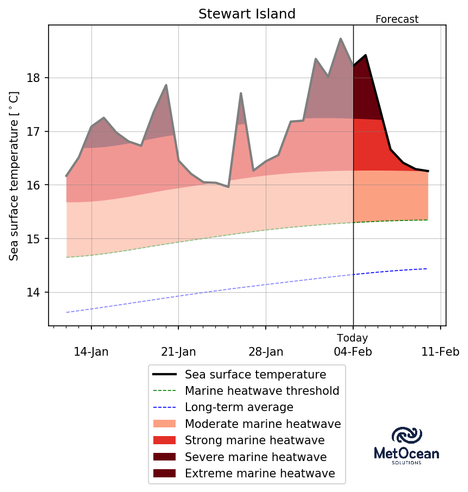
New Zealand’s sea temperatures have hit record highs, outstripping global averages threefold in one region, and prompting alarm over the health of the country’s marine life and ecosystems.
Even small rises in temperature can disrupt marine ecosystems, cause some species to relocate, and increase disease risks.
No, but don’t worry, it’s all perfectly normal and there is nothing like that climate change thing every scientist has been talking about 🙄
Average sea-surface temperature equals the record set in Aug23... But in January!!!
#Climate #ClimateAction #ClimateChange #ClimateCrisis #ClimateDiary #Climat #SeaTemperature #RecordTemperatures #GlobalWarming
https://climatereanalyzer.org/clim/sst_daily/
@pauleric_70 The argumentation of the blog is:
1. T in Ocean water is rising. That's true
2. It will lead to #methane plumes from #methanehydrate
second point is not true: Leading #science articles refute this.
So the author should explain why other articles are wrong or how these arguments can both exists and be true.
Also author does not explain how much methane would leak. This is a second weak point.
The argument that higher #seatemperature leads to #methaneplumes is moot
"It's the sea temperature stupid"
I encourage you to make the effort to read the full article.
("120 million Americans were under some form of heat advisory")
#Climate #ClimateChange #ClimateCrisis #Heatwave #SeaTemperature #RecordTemperatures

 Nina Davtian
 earthling
 Matthieu Bessat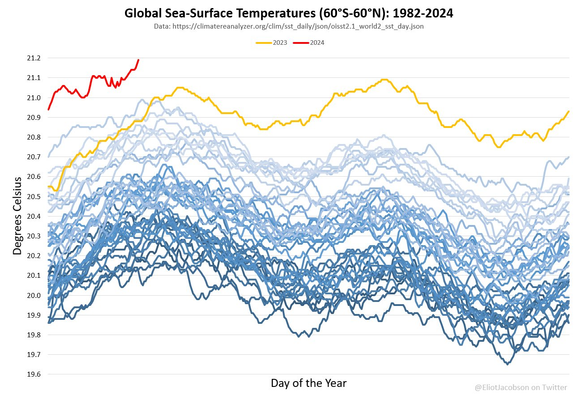
 Francesco Marini
 Grant
Grant hanscees
 💧🌏 Greg Cocks