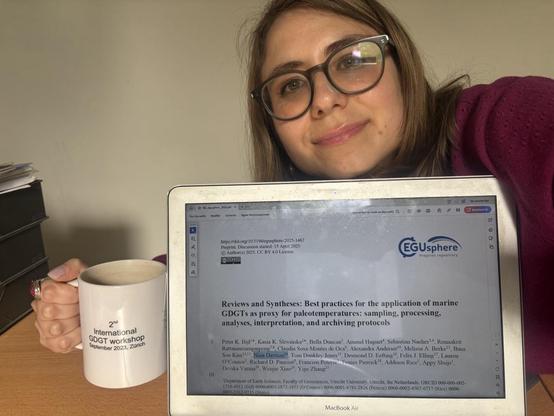
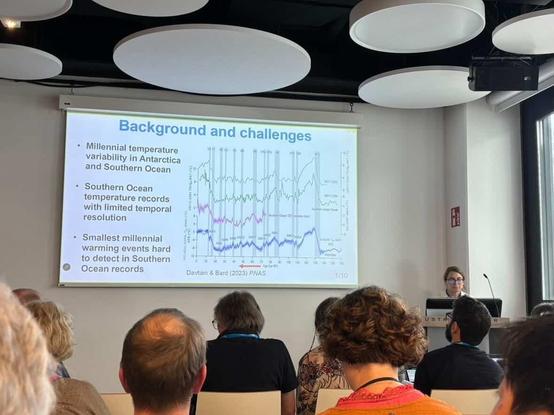
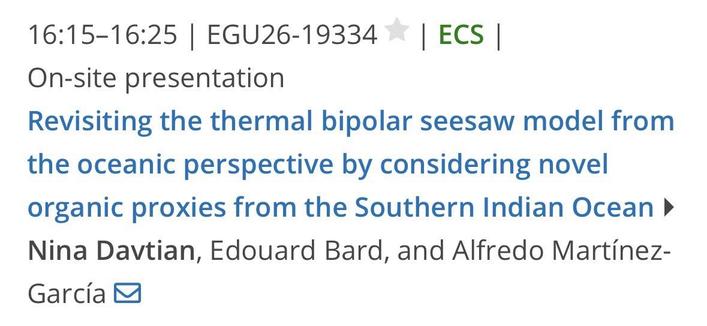
I am so happy to co-author this #preprint #review on #archaeal #tetraether #lipids, aka #GDGTs, as #marine paleoenvironmental indicators led by Felix Elling and Gordon Inglis!
The #consensus presented in this preprint review was written by 40 experts on GDGTs, including both lead authors and myself.
The Earth and Space Science Open Archive preprint is available there:
https://doi.org/10.22541/essoar.176409484.44403346/v1
(1/2)
#Science
#ScienceMastodon
#AcademicMastodon
#isoGDGTs #TeamArchaea
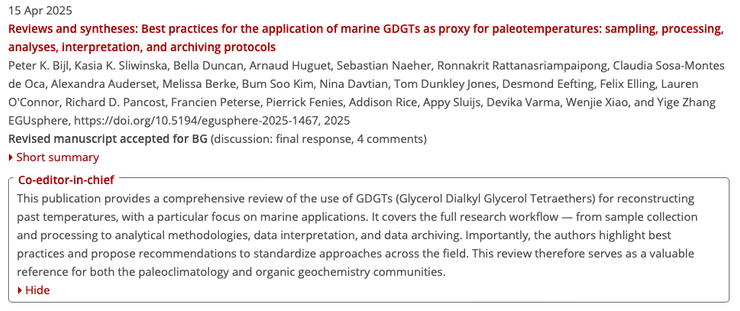
As we* hoped, my co-authored #marine GDGT « cookbook » #review #paper (https://doi.org/10.5194/egusphere-2025-1467) was accepted for publication in the @EuroGeosciences #journal #Biogeosciences after peer-review and (minor) revision! 🥳 🍾
*Peter Bijl, Kasia Sliwinska, and all co-authors, including myself.
#Science
#ScienceMastodon
#AcademicMastodon
#PaperAccepted
#GDGTs #isoGDGTs #brGDGTs #TeamArchaea #TeamBacteria
#archaeal #bacterial #tetraether #lipids
This new #scientific #publication is in favor of a (further) consideration of isoGDGT-0 and crenarchaeol in addition to isoGDGT-1 to isoGDGT-3 and crenarchaeol isomer for paleo-reconstructions.
Siqi Zhao et al. (2025) Communications #Earth & #Environment
https://doi.org/10.1038/s43247-025-02450-7
Disclaimer: I am just an interested reader, with no relationship with this #study, not even as a reviewer.
#Science
#ScienceMastodon
#AcademicMastodon
#MolecularDynamics
#GDGTs #isoGDGTs
#TeamArchaea
Four weeks ago, my first co-authored @EuroGeosciences #preprint « #Reviews and syntheses: Best practices for the application of #marine #GDGTs as proxy for paleotemperatures: sampling, processing, analyses, interpretation, and archiving protocols » went online!
https://doi.org/10.5194/egusphere-2025-1467
#Science #ScienceMastodon #AcademicMastodon
#Review #Consensus
#EGUsphere
#isoGDGTs #brGDGTs #TeamArchaea #TeamBacteria
#archaeal #bacterial #tetraether #lipids
(1/2)
Reviews and syntheses: Best practices for the application of marine GDGTs as proxy for paleotemperatures: sampling, processing, analyses, interpretation, and archiving protocols

Abstract. Marine glycerol dialkyl glycerol tetraethers (GDGTs) are used in various proxies (such as TEX86) to reconstruct past ocean temperatures. Over 20 years of improvements in GDGT sample processing, analytical techniques, data interpretation and our understanding of proxy functioning have led to the collective development of a set of best practices in all these areas. Further, the importance of Open Science in research has increased the emphasis on the systematic documentation of data generation, reporting and archiving processes for optimal reusability of data. In this paper, we provide protocols and best practices for obtaining, interpreting and presenting GDGT data (with a focus on marine GDGTs), from sampling to data archiving. The purpose of this paper is to optimize inter-laboratory comparability of GDGT data, and to ensure published data follows modern open access principles.

Investigating paleotemperature proxies based on archaeal hydroxylated tetraether lipids

Understanding past sea surface temperatures (SSTs) is crucial for reconstructing Earth's climate history. Devika Varma has focused her PhD research pr…

Utilizing Probability Estimates from Machine Learning and Pollen to Understand the Depositional Influences on Branched GDGT in Wetlands, Peatlands, and Lakes

Abstract. Branched glycerol dialkyl glycerol tetraethers (brGDGTs) serve as critical molecular biomarkers for the quantitative reconstruction of past environments, ambient temperature and pH across various archives. Despite their success, numerous issues persist that limit their application. The distribution of brGDGTs varies significantly based on provenance, resulting in biases in environmental reconstructions that rely on fractional abundances and derived indices, such as the MBT’5ME. This issue is especially significant in shallow lakes, wetlands, and peatlands within semi-arid and arid regions, where ecosystems are sensitive to diverse environmental and climatic factors. Recent advancements, such as machine learning techniques, have been developed to identify changes in sources; however, these techniques are insufficient for detecting mixed source environments. The probability estimates derived from five machine learning algorithms are employed here to detect provenance changes in brGDGT downcore records and to identify periods of mixed provenance. A new global modern database (n=2301) was compiled to train, validate, test, and apply these algorithms to two sedimentary records. Our findings are corroborated by pollen and non-pollen palynomorphs obtained from the identical records. These microfossil proxies are utilized to discuss changes in provenance, hydrology, and ecology that influence the distribution of brGDGTs. Probability estimates derived from Random Forest with a sigmoid calibration are most effective in detecting changes in brGDGT distribution. Minor changes in the relative contributions of brGDGTs provenance can significantly influence the distribution of brGDGTs, especially regarding the MBT'5ME index. This study introduces a novel brGDGT wetland index aimed at monitoring potential biases arising from wetland development.

Towards quantitative reconstruction of past monsoon precipitation based on tetraether membrane lipids in Chinese loess

Abstract. Variations in the oxygen isotope composition (δ18O) of cave speleothems and numerous proxy records from loess–paleosol sequences have revealed past variations in East Asian monsoon (EAM) intensity. However, challenges persist in reconstructing precipitation changes quantitatively. Here, we use the positive relationship between the degree of cyclization (DC) of branched glycerol dialkyl glycerol tetraethers (brGDGTs) in modern surface soils from the Chinese Loess Plateau (CLP) and mean annual precipitation (MAP) to quantify past monsoon precipitation changes on the CLP. We present a new ∼ 130 000-year-long DC-based MAP record for the Yuanbao section on the western edge of the CLP, which closely tracks the orbital- and millennial-scale variations in available records of both speleothem δ18O and the hydrogen isotope composition of plant waxes (δ2Hwax) from the same section. Combing our new data with existing brGDGT records from other CLP sites reveals a spatial gradient in MAP that is most pronounced during glacials, when the western CLP experiences more arid conditions and receives up to ∼ 250 mm less precipitation than in the southeast, whereas MAP is ∼ 850 mm across the CLP during the Holocene optimum. Furthermore, the DC records show that precipitation amount on the CLP varies at both the precession scale and the obliquity scale, as opposed to the primarily precession-scale variations in speleothem δ18O and δ2Hwax at Yuanbao and the 100 kyr cycle in other loess proxies, such as magnetic susceptibility, which rather indicates the relative intensity of the EAM. At the precession scale, the DC record is in phase with δ2Hwax from the same section and the speleothem δ18O record, which supports the hypothesis that monsoon precipitation is driven by Northern Hemisphere summer insolation.

Replicability of paleotemperature records in the northern Okinawa Trough and its implications for paleoceanographic reconstructions - Progress in Earth and Planetary Science

Geochemical proxies are frequently utilized in the reconstruction of past ocean temperatures. Due to resource constraints, these reconstructions typically rely on a single sediment core, raising questions about the local and regional representativeness of paleotemperature records. To address this, we analyzed four sediment cores located within a 10-km radius in the northern Okinawa Trough (OT), which share the same climatic forcing and thus should reflect similar climate variations. We compiled published data and generated new paleotemperature estimates based on three widely used geochemical proxies (foraminiferal Mg/Ca, $${\text{U}}_{37}^{{{\text{K}}^{\prime}}}$$ U 37 K ′ , $${\text{TEX}}_{86}$$ TEX 86 ). Analysis of the mean absolute deviations for nearby records based on the same proxy revealed that $${\text{U}}_{37}^{{{\text{K}}^{\prime}}}$$ U 37 K ′ has the highest reproducibility, followed by Mg/Ca and $${\text{TEX}}_{86}$$ TEX 86 . However, inconsistencies in inter-proxy offsets among nearby sites suggest the presence of noise in the proxy records, likely stemming from instrumental errors and sediment heterogeneity. Furthermore, the Mg/Ca and $${\text{U}}_{37}^{{{\text{K}}^{\prime}}}$$ U 37 K ′ paleotemperature records agree within uncertainty when accounting for inter-site variability and calibration uncertainties, challenging previous interpretations of temperature signals from different seasons. All proxies indicate similar glacial-interglacial trends, albeit with varying magnitudes of temperature change. Both Mg/Ca and $${\text{U}}_{37}^{{{\text{K}}^{\prime}}}$$ U 37 K ′ records suggest a glacial cooling of ~ 3 °C, whereas $${\text{TEX}}_{86}$$ TEX 86 sea surface temperature (SST) data indicate a stronger glacial cooling of approximately ~ 6–8 °C. Modern observations indicate a subsurface $${\text{TEX}}_{86}$$ TEX 86 recording depth of 50–100 m, coinciding with the thermocline. However, the $${\text{TEX}}_{86}$$ TEX 86 subsurface temperature (subT) record does not resemble the Mg/Ca records of thermocline-dwelling foraminifera species. Instead, there is a better agreement with benthic foraminiferal Mg/Ca records of Uvigerina spp. (~ 700 m) and the intermediate temperature record derived from radiolarian assemblages (~ 500 m), pointing to a $${\text{TEX}}_{86}$$ TEX 86 recording depth that is deeper than the thermocline. In summary, our findings show that proxy noise can impact inter-proxy comparisons of paleotemperature records, but not the direction of glacial-interglacial shifts. Future research should prioritize constraining the recording depth of paleotemperature proxies and reducing calibration uncertainty for more precise and reliable quantitative paleotemperature reconstruction.

SpringerOpen