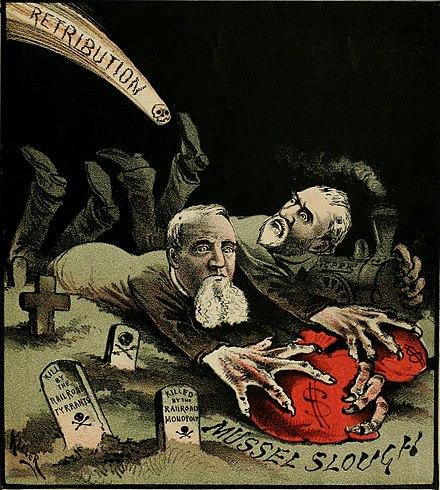
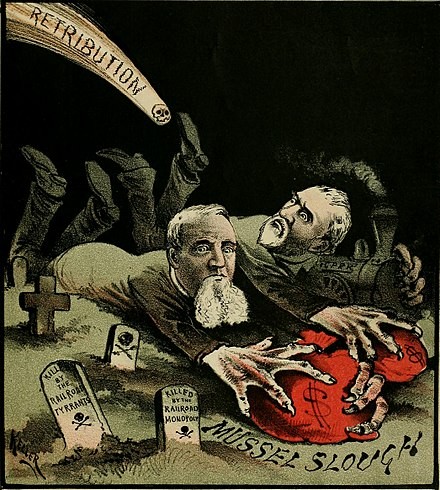
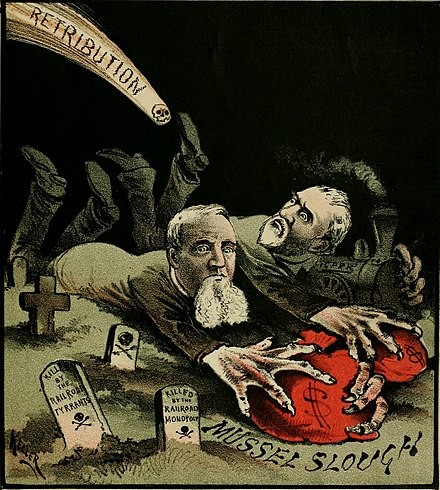
Today in Labor History May 11, 1880: The Mussel Slough Tragedy occurred on this day in Hanford, California. It was a land dispute between squatters and the Southern Pacific Railroad (SP), one of the nation’s most powerful corporations. Former California governor, Leland Stanford, was president of SP. The conflict began as a picnic of settlers and their supporters. However, when word spread that the railroad was actively evicting settlers, a group of twenty left the picnic to confront them. Seven died in the confrontation. A federal Grand Jury indicted seventeen people and five were found guilty of interfering with a federal marshal. The newspapers seized on the event as an example of corporate greed and the excesses of capitalism. Several great historical novels were based on this incident. Frank Norris wrote The Octopus: A Story of California (1901), about the incident. W.C. Morrow’s 1882 novel Blood-Money was also about this tragedy. And May Merrill Miller wrote about it, as well, in her novel, First the Blade (1938).

#workingclass #LaborHistory #massacre #robberbarrons #railroad #stanford #fiction #novel #historicalfiction #books #author #writer @bookstadon

@HighlandLawyer @Geri Or just consider how many hereditary Lords actually own and manage large estates? Today, in the 21st century those professionals in the business of property don’t want to be associated with corruption; those who run rentals not fit for purpose or who pay off council officials to walk the other way. Any in property, commercial or private can be as good or corrupt as those in any other business. The epicentre of economic collapse, is those who serve private equity investors first; to secure bonuses as free from any regulation e.g. the water utility companies who poisoned our rivers. Failure to ethically regulate those in energy and arms should be called the EnergyLords or ArmsLords or just Robber Barrons, as the consequence of unleashing those who finance fascist clowns and mobsters threatens everyone’s rights, peace, security and wellbeing! #Landlordism #RobberBarrons #ReignOfTheMob #EnergyLords #ArmsLords #RobberBarons #professionals #Goodbusiness #BalancedEconomics #JusticeIsFreedom

With full knowedge of how the robber barons swindled the nation after the 1918-20 bird flu pandemic, corrupt neoliberal democracy allowed them to do it again, with vengence.

#RobberBarrons #HistoryRhymes #Oligarchy #UsPol #Capitalism #Oligarchy

#Greed and the #GildedAge: Power, Wealth, and Corruption in 19th-Century America

Examining Wealth, Corruption, and Social Change in the Gilded Age

November 16, 2021

Excerpt: "From the 1870s to the 1890s, the United States entered a period of rapid #industrialization. There was a shift from an agrarian economy to an industrial economy and many Americans began to move to urban areas. #MarkTwain called this period the Gilded Age and criticized the era as a time of #greed and #PoliticalCorruption.

Industrialization greatly increased the need for workers in the nation’s factories. The availability of factory jobs that required little or no skills was one of the reasons for a dramatic increase in immigration to the United States. Although working conditions in most factories were poor and unsafe, there was a steady stream of immigrant workers to fill the positions.

While there were millions of factory workers, the #wealthy #entrepreneurs who owned the factories represented a tiny fraction of Americans. The few wealthy controlled most of the wealth in the United States during this time.

During the Gilded Age, the economic disparities between the workers and big business owners grew exponentially. Workers continued to endure low wages and dangerous working conditions in order to make a living. #BigBusiness owners, however, enjoyed #lavish lifestyles.

he industrialization of the United States brought economic growth to the country like never before. The economy moved from agrarian to industrial; consumer goods were mass-produced and readily available. However, manufacturing was not the only industry that experienced growth. The railroad industry grew as the need to transport people and goods increased.

The rapid growth of the manufacturing industry created a great need for unskilled workers. This demand caused migration as farm workers moved from rural areas of the United States to find jobs in America’s rapidly growing cities. The increase in jobs was also a draw for people in foreign countries. Many people immigrated to the United States in search of work and the opportunity to live the American dream.

While industrialization led to an increase in jobs, it also led to poor working conditions for this new industrial labor force. Workers were forced to work in dangerous conditions surrounded by heavy machinery. Unskilled laborers required little training and completed routine tasks. They also worked long hours and were paid low wages.

Big business owners benefitted tremendously from the economic changes in the United States. Some historians have said that these entrepreneurs were robber barons because they got rich through ruthless means. Others have called them captains of industry because they were greatly responsible for increasing productivity, expanding markets, providing jobs, and increasing the nation’s wealth."

Read more:
https://brewminate.com/greed-and-the-gilded-age-in-19th-century-america/

#Capitalism #CapitalismSucks #CorporateColonialism #IndustrialAge #RobberBarrons #TechBros #EatTheRich #YeetTheRich #LifestylesOfTheRichAndFamous
Greed and the Gilded Age in 19th-Century America

Explore America’s Gilded Age—an era of dazzling wealth, deep inequality, and the ruthless pursuit of power that shaped modern capitalism.

Brewminate: A Bold Blend of News and Ideas
I cannot tell you what mysteries are, because in 1982, fresh out of high school, I was recruited as an aide to a member of now notorious #RobberBarrons that built this country.His progenitor , Robert Coe, along with Rockefellers and Vanderbilts ( just down the street)had built this country and bore no resemblance to Trump and current Republicans who hew more to pickpocket and petty thieves that ultimately stand for nothing but that next mark. Regardless, he told me things that have become clear-

Today in Writing History May 11, 1880: The Mussel Slough Tragedy occurred on this day in Hanford, California. It was a land between squatters and the Southern Pacific Railroad (SP), one of the nation’s most powerful corporations. Former California governor, Leland Stanford, was president of SP. The conflict began as a picnic of settlers and their supporters. However, when word spread that the railroad was actively evicting settlers, a group of twenty left the picnic to confront them. Seven died in the confrontation. A federal Grand Jury indicted seventeen people and five were found guilty of interfering with a federal marshal. The newspapers seized on the event as an example of corporate greed and the excesses of capitalism. Several great historical novels were based on this incident. Frank Norris wrote The Octopus: A Story of California (1901), about the incident. W.C. Morrow’s 1882 novel Blood-Money was also about this tragedy. And May Merrill Miller wrote about it, as well, in her novel, First the Blade (1938).

#workingclass #LaborHistory #massacre #robberbarrons #railroad #stanford #fiction #novel #historicalfiction #books #author #writer @bookstadon

Comedian Bill Burr Goes SCORCHED-EARTH on Billionaires in Spicy Rant

YouTube

Irony truly died in this speech:

https://www.youtube.com/watch?v=lNTcbbSrHw0

But also, toddler shield now has some creepy military dictator uniform costume.

#ToddlerShield #Musk #Trump #MSNBC #Irony #RobberBarrons #Crime #USPol

‘Irony died while he was talking’: Nicolle Wallace on Elon Musk’s takeover of Oval Office 

YouTube
Bluesky

Bluesky Social

Today in Writing History May 11, 1880: The Mussel Slough Tragedy occurred on this day in Hanford, California. It was a land between squatters and the Southern Pacific Railroad (SP), one of the nation’s most powerful corporations. Former California governor, Leland Stanford, was president of SP. The conflict began as a picnic of settlers and their supporters. However, when word spread that the railroad was actively evicting settlers, a group of twenty left the picnic to confront them. Seven died in the confrontation. A federal Grand Jury indicted seventeen people and five were found guilty of interfering with a federal marshal. The newspapers seized on the event as an example of corporate greed and the excesses of capitalism. Several great historical novels were based on this incident. Frank Norris wrote The Octopus: A Story of California (1901), about the incident. W.C. Morrow’s 1882 novel Blood-Money was also about this tragedy. And May Merrill Miller wrote about it, as well, in her novel, First the Blade (1938).

#workingclass #LaborHistory #massacre #robberbarrons #railroad #stanford #fiction #novel #historicalfiction #books #novel #author #writer @bookstadon