Understanding Stochastic Gradient Descent in PyTorch Through a Linear Regression Example

📰 Original title: PyTorch Stochastic Gradient Optimization Technique

🤖 IA: It's not clickbait ✅
👥 Users: It's not clickbait ✅
View full AI summary https://en.killbait.com/understanding-stochastic-gradient-descent-in-pytorch-through-a-linear-regression-example.html?utm_source=mastodon_world&utm_medium=social&utm_campaign=killbait.mastodon_world

#artificialintelligence #pytorch #sgd #machinelearning

Understanding Stochastic Gradient Descent in PyTorch Through a Linear Regression Example

This article explains how PyTorch uses Stochastic Gradient Descent (SGD) to train machine learning models by minimizing prediction error. The author introduces a simple linear regression model defined by the equation y = wx + b and demonstrates how the model learns the optimal weight and bias values through iterative updates. The discussion begins with the Mean Squared Error (MSE) loss function, which measures the difference between predicted and actual outputs. During training, the model calculates gradients of the loss with respect to the parameters and updates them using a learning rate. The article provides a detailed explanation of forward propagation, where predictions and loss values are computed, and backward propagation, where gradients are calculated using the chain rule. To illustrate the process, the author breaks down the computational graph used by PyTorch's automatic differentiation system and derives the mathematical formulas for the gradients of both the weight and bias parameters. A numerical example is then presented using a reference equation y = 2x + 10. A small dataset is divided into mini-batches, and SGD updates are manually calculated for each batch. The resulting gradients, losses, and parameter updates demonstrate how the model gradually adjusts its values toward the target relationship. Finally, the article verifies the manual calculations with a PyTorch implementation using the SGD optimizer and MSE loss function. The Python code reproduces the same results, confirming the correctness of the mathematical derivations and illustrating how PyTorch automates gradient computation and parameter optimization during training.

KillBait

Understanding Stochastic Gradient Descent in PyTorch Through a Linear Regression Example

📰 Original title: PyTorch Stochastic Gradient Optimization Technique

🤖 IA: It's not clickbait ✅
👥 Users: It's not clickbait ✅

View full AI summary https://en.killbait.com/understanding-stochastic-gradient-descent-in-pytorch-through-a-linear-regression-example.html?utm_source=mastodon_social&utm_medium=social&utm_campaign=killbait.mastodon_social

#artificialintelligence #pytorch #sgd #machinelearning

Understanding Stochastic Gradient Descent in PyTorch Through a Linear Regression Example

This article explains how PyTorch uses Stochastic Gradient Descent (SGD) to train machine learning models by minimizing prediction error. The author introduces a simple linear regression model defined by the equation y = wx + b and demonstrates how the model learns the optimal weight and bias values through iterative updates. The discussion begins with the Mean Squared Error (MSE) loss function, which measures the difference between predicted and actual outputs. During training, the model calculates gradients of the loss with respect to the parameters and updates them using a learning rate. The article provides a detailed explanation of forward propagation, where predictions and loss values are computed, and backward propagation, where gradients are calculated using the chain rule. To illustrate the process, the author breaks down the computational graph used by PyTorch's automatic differentiation system and derives the mathematical formulas for the gradients of both the weight and bias parameters. A numerical example is then presented using a reference equation y = 2x + 10. A small dataset is divided into mini-batches, and SGD updates are manually calculated for each batch. The resulting gradients, losses, and parameter updates demonstrate how the model gradually adjusts its values toward the target relationship. Finally, the article verifies the manual calculations with a PyTorch implementation using the SGD optimizer and MSE loss function. The Python code reproduces the same results, confirming the correctness of the mathematical derivations and illustrating how PyTorch automates gradient computation and parameter optimization during training.

KillBait

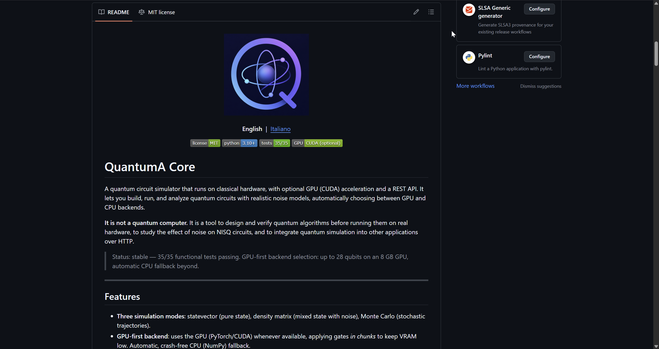
🙂 Just released QuantumA Core,an open-source quantum circuit simulator with GPU acceleration and a REST API.

⚛️ Statevector / density-matrix / Monte Carlo
🎮 Up to 28 qubits on an 8 GB GPU (CUDA), automatic CPU fallback
🧪 Realistic T1/T2 noise models
🔬 Includes a validated H₂ VQE example (ground-state energy from first principles)

MIT, Python.

👉 github.com/ShinRalexis/QuantumA-Core

#QuantumComputing #OpenSource #Python #CUDA #VQE #QuantumChemistry #PyTorch #FOSS

Языковые модели без лишних слов

Представляем новинку, которая уже получила высокие оценки от экспертов мирового уровня. Книга Андрея Буркова « Что там внутри?

https://habr.com/ru/companies/bhv_publishing/articles/1041960/

#машинное_обучение #нейросети #искусственный_интеллект #python #PyTorch #NLP #LLM #книги #бхв #bhv

Языковые модели без лишних слов

Представляем новинку, которая уже получила высокие оценки от экспертов мирового уровня. Книга Андрея Буркова « Языковые модели без лишних слов: Практика на PyTorch » — это продолжение...

Хабр

Hand coding PyTorch helps me learn faster, even with AI.

#pytorch #coding #learning

Я хотел повторить Growing Neural CA за вечер. Ушёл месяц

Месяц назад я прочитал на Хабре статью про нейронные клеточные автоматы. Маленькие нейросети управляют клетками на сетке, клетки сами собираются в букву T или крест, и всё это обучается без учителя через что‑то вроде эволюции. Я подумал: круто, повторю за пару вечеров, посмотрю, как себя ведёт. Эта статья — о том, что было дальше. Спойлер: пара вечеров превратилась в месяц, я провёл 22 эксперимента, упёрся в потолок IoU 0.44 на простой букве T, и главное, чему научился — вообще не о нейросетях.

https://habr.com/ru/articles/1039694/

#neural_cellular_automata #neuroevolution #genetic_algorithms #neural_networks #claude_code #ml_engineering #research #pytorch #optuna #reproducibility

Я хотел повторить Growing Neural CA за вечер. Ушёл месяц

22 эксперимента, 9 потолков, один champion и неприятная правда про дисциплину эксперимента Месяц назад я прочитал на Хабре статью про нейронные клеточные автоматы. Маленькие нейросети управляют...

Хабр
Novo PyTorch 2.12 chega com desempenho 100 vezes superior e nova API

A equipa de desenvolvimento anunciou a chegada da versão 2.12 do seu popular framework de inteligência artificial, prometendo mudar a forma como os programadore

TugaTech

Autograd tracks tensor ops to compute gradients for backpropagation in PyTorch.

#pytorch #autograd #deeplearning

🚀 Oh look, another "reinvent the wheel" guide for deep learning enthusiasts who think they're the next Newton of AI. Spoiler: 🤡 It's all about stumbling on Reddit tips, random #PyTorch versions, and hoping your model doesn't burn your GPU. 🔥
https://horace.io/brrr_intro.html #deeplearning #reinventthewheel #AItips #GPUburnout #Redditadvice #HackerNews #ngated
Making Deep Learning go Brrrr From First Principles

The hardest part of building Hoovik — my open-source AI-powered meeting platform — wasn’t WebRTC signaling or media pipelines.

It was managing real-time multimodal inference (PyTorch, MediaPipe, AudioWorklets) across distributed services without blocking the event loop or exhausting memory when packets drop, connections fluctuate, or webcams disappear.

🔗 https://dev.to/anupam_kumar/the-hardest-part-of-building-an-ai-powered-webrtc-platform-wasnt-webrtc-19bl

#WebRTC #AI #MachineLearning #OpenSource #NodeJS #FastAPI #PyTorch #EmotionAI #BuildInPublic #Python #Fediverse

Hoovik: The Hardest Part of Building an AI-Powered WebRTC Platform Wasn’t WebRTC

I spent the last few months building Hoovik — a video conferencing platform that watches...

DEV Community