Modulation of the antidepressant effects of ketamine by the mTORC1 inhibitor rapamycin - Neuropsychopharmacology

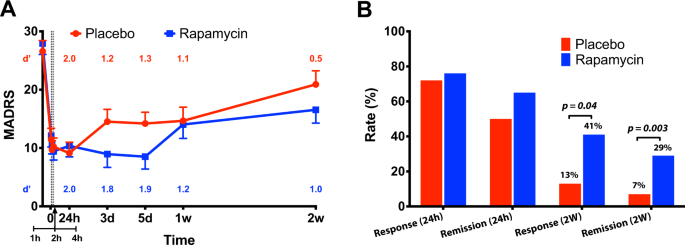
Twenty-four hours after administration, ketamine exerts rapid and robust antidepressant effects that are thought to be mediated by activation of the mechanistic target of rapamycin complex 1 (mTORC1). To test this hypothesis, depressed patients were pretreated with rapamycin, an mTORC1 inhibitor, prior to receiving ketamine. Twenty patients suffering a major depressive episode were randomized to pretreatment with oral rapamycin (6 mg) or placebo 2 h prior to the intravenous administration of ketamine 0.5 mg/kg in a double-blind cross-over design with treatment days separated by at least 2 weeks. Depression severity was assessed using Montgomery–Åsberg Depression Rating Scale (MADRS). Rapamycin pretreatment did not alter the antidepressant effects of ketamine at the 24-h timepoint. Over the subsequent 2-weeks, we found a significant treatment by time interaction (F(8,245) = 2.02, p = 0.04), suggesting a prolongation of the antidepressant effects of ketamine by rapamycin. Two weeks following ketamine administration, we found higher response (41%) and remission rates (29%) following rapamycin + ketamine compared to placebo + ketamine (13%, p = 0.04, and 7%, p = 0.003, respectively). In summary, single dose rapamycin pretreatment failed to block the antidepressant effects of ketamine, but it prolonged ketamine’s antidepressant effects. This observation raises questions about the role of systemic vs. local blockade of mTORC1 in the antidepressant effects of ketamine, provides preliminary evidence that rapamycin may extend the benefits of ketamine, and thereby potentially sheds light on mechanisms that contribute to depression relapse after ketamine administration.

Nature

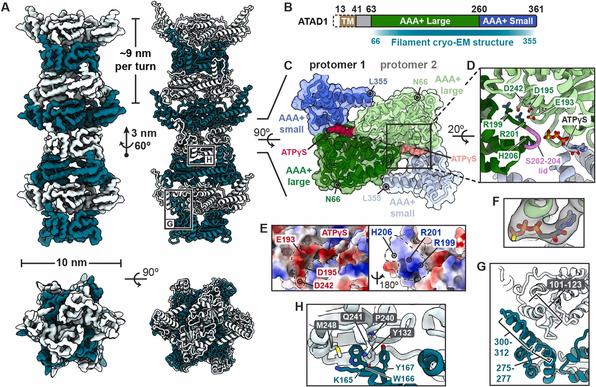
🌀 Could a protein that twists into filaments reveal how cells keep themselves in balance?

🔗 Cryo-EM structure of AAA + ATPase thorase reveals novel helical filament formation. Computational and Structural Biotechnology Journal, DOI: https://doi.org/10.1016/j.csbj.2025.05.018

📚 CSBJ: https://www.csbj.org/

#StructuralBiology #CryoEM #Thorase #MolecularBiology #mTORC1 #ProteinStructure #Biophysics #AAAplusATPase #SynapticPlasticity #Mitochondria

🔍 mTORC1 Research: New Findings Challenge Old Model 🧫🧪Congrats to the Demetriades Lab team! #mTORC1
#Research

https://www.age.mpg.de/415628/241122_mtor_on_the_move?c=2930

mTOR on the Move

Eating less, intermittent fasting, anti-ageing drugs such as rapamycin - there is a lot of public advice on preventing age-related diseases. A central regulator that appears to be linked to all these measures is a protein complex called mTORC1 that functions in our cells both as a sensor of nutrient availability and as a controller of most cellular functions. A research group at the Max Planck Institute for Biology of Ageing in Cologne has now shown for the first time that mTORC1 functions differently at different locations inside cells. These new findings broaden our understanding of how mTORC1 is activated by nutrients and may help to develop new, more-targeted therapies against ageing and age-associated diseases.

mTORC1 activation in macrophages contributes to persistent lung inflammation following respiratory viral infection

Respiratory virus infections cause millions of hospitalizations worldwide each year. Severe infections lead to lung damage that coincides with persistent inflammation and a lengthy repair period. Vaccination and anti-viral therapy help to mitigate severe infections prior to or during the acute stage of disease, but there are currently limited specific treatment options available to individuals suffering from the long-term sequelae of respiratory viral infection. C57BL/6 mice were infected with influenza A/PR/8/34 as a model for severe viral lung infection and allowed to recover for 21 days.

The American Journal of Pathology

An exciting article out in @biorxivpreprint shows that AMPK inhibits autophagy during glucose starvation in U2OS cells.

https://www.biorxiv.org/content/10.1101/2023.09.28.559981v2

Whether glucose starvation induces or inhibits autophagy is a controversial topic, something my lab discovered when we struggled for almost two years to publish our findings that in yeast glucose starvation actually actively suppresses autophagy ten years ago.

https://pubmed.ncbi.nlm.nih.gov/24753258/

#autophagy #AMPK #mTORC1 #CellBiology

Interesting 🤔. A common mechanism, located at the lysosome, linking amino acid and energy stress to organelle biosynthesis.

A few of my favourites in this one: #FNIP1 #AMPK #TFEB #mitochondria #mTORc1

https://doi.org/10.1126/science.abj5559