'MACHINATIONS' - JP Seabright + Kinneson Lalor | Trickhouse Press
MACHINATIONS is a dialogue between two poets, one a mathematician, the other dyscalculic, about machines and man. Or rather, one man, who thought a great deal about machines and their potential to think: Alan Turing. The poetry in this collection is experimental and exploratory, some of it creating entirely new forms by assigning words through the binary encoding of an image and its representation in phonemes. Some of it examines the life and work of Turing, responding to and reflecting upon his ground-breaking work in both computing and morphogenesis. Through this, themes of surveillance, difference, queerness are explored, as well as algorithmic influences upon our everyday lives, and the closing gap between what separates machines from humankind. Praise for MACHINATIONS:"What is the relationship between language and its binary encoding? What is the difference between man and machine? What makes a poem? These are some of the questions explored in MACHINATIONS – a dazzlingly inventive collaboration between two exceptionally gifted poets. At the heart of their poetic conversation are the tensions that informed Alan Turing's life and creativity. The result is profound, unflinching, agonised and exquisite."Marian Christie, author of Fractal Poems (Penteract Press) and From Fibs to Fractals: exploring mathematical forms in poetry (Beir Bua Press) Drawing on chance operations, human/android collaboration, glitching visual poetry, textual vandalism, QR code translation and more, MACHINATIONS uncovers the tense relationship between language-making and the biological, the social and libidinal. The text doesn’t idealise or catastrophise our relationship to technology, but reveals both parties as fallible, as vulnerable. It begins to read, with humankind's constant exploring of technology, like we were exploring ourselves all along. This is an inspiring book. Richard Capener, author of Dance! The Statue Has Fallen! (Broken Sleep Books) and KL7 (Red Ceilings Press) and Editor of Hem Press. There is no software, and there has never been; there is only self-similarity across protocols, electric differentials disappearing underneath machine language, which disappears underneath op code, which disappears underneath assemblers, which disappears underneath operating systems and graphic application interfaces. This may well mean that the human-computer relation is an ongoing negotiation whereby the human may well give as much, if not more, than the computer. But it also means that the computing machine emerges from differentials within brute alloys just as poetry is beauty emerging from differentials within brute letters. Perhaps the computing machine is implemented poetry, just as poetry is an implemented computing machine. Perhaps Alan Turing knew this. Perhaps JP Seabright and Kinneson Lalor know this. And thanks to this important collection, perhaps we now know this, too.Sascha Engel, author of 21 Computations (Beir Bua Press)60pp, A5, B&W.Limited edition: 49 of 100 remaining.
 lobster







 lobster BimBot

 C.
C. nope
nope 𝕎𝕖𝕣𝕥𝕙𝕒𝕞

 Lorraine
 JP Seabright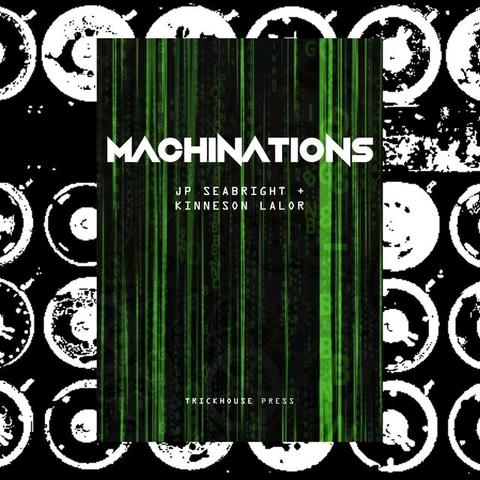
 @Om*
@Om*