BRECK: Dead Delivery: Chapter Fifteen: Stronger Than You Knew
Daily writing prompt What’s a moment that made you realize you were stronger than you thought?
View all responses BRECK: Dead Delivery — Chapter Fifteen
Stronger Than You Knew
This is Chapter 15 of BRECK: Dead Delivery, a serialized noble dark fantasy story by Chadwick Rye, set in the world of Lumenvale. New chapters post daily at noon Eastern.
The Story So Far
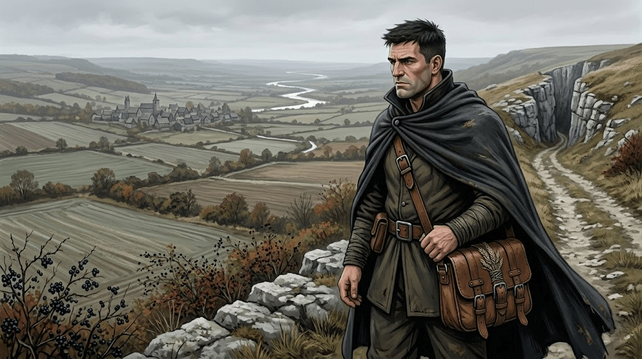
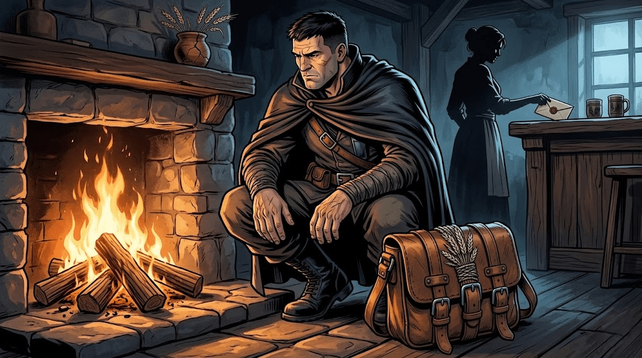
Breck is a veteran courier — 6’5″, 285 pounds, former Crystal Wars special operations — who arrived in Crestfall on a routine delivery and found a town quietly strangled by a corrupt magistrate named Voss. He built the case from the inside: the hidden ledger, the chalk map, the patrol gap. Last night he retrieved the original documents from Voss’s storage room and walked back through a dark corridor where Drav was waiting. Drav stepped aside. This morning, before dawn, Breck built the fire, gave Maret the sealed letter for the Regional Adjudicator in Millhaven, said what needed saying, and walked out into the dark before the second bell. He is on the north road now — the documents against his chest, the bracelet on the satchel strap, Crestfall behind him. But Voss discovered the empty room at the second bell. And Drav received his orders at the third.
← Chapter Fourteen — The Small Thing | Chapter Sixteen — Coming Tomorrow →
Chapter Fifteen: Stronger Than You Knew
This chapter explores the moment when you discover what you are made of — not in triumph, but in the testing.
The ambush was well-planned.
Breck gave it that. In the ten seconds between recognizing it and responding to it, he registered its architecture with the detached professional appreciation of a man who had spent four years designing exactly this kind of thing from the other side — the terrain selected for limited sightlines, the timing calculated for the gray half-light of early morning when eyes were still adjusting, three men positioned to create overlapping fields of engagement so that moving away from one moved you toward another.
Senne had planned it. The quiet one, the watchful one — the most dangerous of Drav’s remaining men after Pelk’s education in the alley behind the granary. Breck had tracked Senne’s movements for four days and had built a picture of a man who thought before he acted and acted without hesitation once the thinking was done. The ambush confirmed the picture. It was the work of someone who understood geometry and patience and the particular advantage of opponents who didn’t know they were being studied.
The problem — for Senne — was that Breck had spent four years being studied by men considerably better resourced than a regional enforcer with three weeks of preparation time, and he was still here.
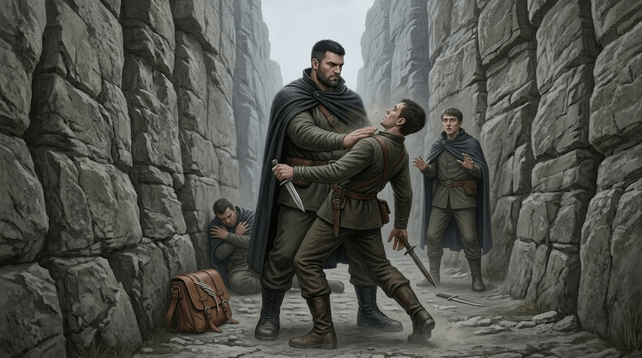
The north road ran through a cut in the limestone ridge two miles above Crestfall, where the banks rose on both sides and the road narrowed to accommodate a single cart. Senne had positioned himself at the far end of the cut, where the road widened again — the blocking position, intended to halt forward movement. The two others were on the banks above, one to each side, staggered so that their angles of descent didn’t interfere with each other.
Textbook. Clean. Competent.
Breck had identified the cut on his third evening in Crestfall, while walking the approaches to the north road under the guise of checking his horse at the waystation. He had noted it as the single unavoidable piece of terrain between Crestfall and the first junction, which meant it was the single unavoidable decision point for anyone who wanted to intercept someone leaving by the north road. He had filed it under problems that might require attention.
He had entered the cut at a walk, hands loose at his sides, satchel settled across his chest, because changing his pace or his posture in the approach would have communicated the wrong thing and he had no interest in communicating anything useful to people positioned to ambush him.
He had also entered it with his right hand already adjusted on the satchel strap — not reaching for anything, just repositioned, the way a man shifted his grip during a long walk — so that when the moment came, the movement required to do what needed doing was already half-completed.
The moment came at the cut’s midpoint.
Senne stepped out from behind a limestone shelf at the far end. Unhurried. Controlled. His right hand held a short blade — not a sword, practical choice, close quarters and limited swing room — and his expression was the expression Breck had been watching for four days: watchful, assessing, stripped of everything that wasn’t operationally relevant.
“Leave the satchel,” Senne said. His voice was level. “Walk back the way you came. That’s the whole transaction.”
The two on the banks hadn’t moved yet. They were holding their positions, which was correct — movement too early would break the geometry, and Senne was giving the verbal option its fair chance before escalating. Professional. Breck respected that.
He looked at Senne for a long moment. At the blade, the positioning, the gap between them — eighteen feet, enough for Senne to close before Breck could reach him but not enough to be comfortable about it. At the banks, where the two others were still and dark against the gray limestone.
He thought about the documents against his chest. About Aldric Moss’s neat architectural handwriting, preserved through fourteen months of darkness beside a hearthstone, finally in the light.
He thought about a girl in a valley who had given him everything she had to give and had received nothing adequate in return. About the specific weight of a debt that couldn’t be paid backward — only forward, in kind, to other people in other places, carried on the road from one town to the next with the same patient, aching, insufficient faithfulness.
He thought about the fire he had built this morning in a cold room, already burning without him.
He thought — briefly, with the compressed economy of a man who had long practice thinking quickly in narrow spaces — about what he was made of.
Not what he had been made of in the war. Not what the war had required of him, which had sometimes been things he did not choose to revisit in the daylight hours. But what he was made of beneath that — the original material, the grain-farm boy who had learned to read rivers, who had understood at ten years old that water found paths around obstacles by the simple application of patience and consistent pressure, not by force, not by declaration, just by continuing to move.
He had been continuing to move for a very long time.
“No,” he said.
Senne came forward the way Breck had expected — fast, low, direct, no wasted theater. He was good. Considerably better than Pelk, considerably better than the two in the alley, and the blade was an honest tool in his hand rather than a prop. The two on the banks came down simultaneously, which was the correct response to Breck declining the verbal option — both flanks activating together to prevent the obvious counter of engaging one before the other arrived.
The obvious counter was not what Breck had in mind.
He moved toward Senne rather than away — inside the blade’s effective reach, which negated its primary advantage and converted the distance between them from Senne’s asset to his own. His left forearm intercepted the blade arm above the wrist, pinning it, redirecting rather than blocking — he’d learned early that blocking a committed strike was a losing proposition against a man who meant it — and his right hand drove a precise open-palm strike into Senne’s sternum, not the hardest blow he could throw but accurately placed and sharply timed, targeting the body’s central nerve cluster.
Senne folded at the diaphragm. Not out — the man had iron in him — but compromised, the wind gone, the blade still in his hand but the hand no longer receiving reliable instructions from the rest of him.
The first bank man reached Breck’s left side three seconds later and found that Breck had already rotated — using Senne’s compromised body as a partial barrier, forcing the bank man to commit to an angle that took him away from his partner — and the elbow that met his forward momentum was not something he had been adequately prepared for. He went down hard. Stayed there, contributing the specific vocal expressions of someone whose collarbone had received new and unwelcome information.
The second bank man stopped.
He was six feet away, on Breck’s right, and he had seen the previous four seconds with full clarity, and he was performing the mathematics that the situation presented with the rapid, honest attention of a young man who had perhaps not fully modeled all the variables before signing on for this particular assignment.
His name, Pell’s map had noted, was Torven. He was nineteen years old. He had a mother in the lower town who mended sails for the river merchants and a younger brother who helped her on the days her hands ached.
“Torven,” Breck said. His breathing was elevated but controlled. “Put it down.”
The young man looked at him. At Senne on one knee in the road, blade dropped, both hands pressed to his sternum. At his partner on the ground with his collarbone. At Breck — at the size of him, at the quality of stillness that had descended over him in the aftermath of the preceding four seconds, the combat stillness, the particular absolute calm of a man who had found and settled into the thing he was made of and was standing in it without apology or performance.
Torven put the blade down.
It made a small sound on the limestone road. A very small sound, in the quiet of the gray morning, the limestone walls on either side and the sky overhead just beginning to consider the possibility of light.
Breck looked at him for a moment longer. Then at Senne, still on one knee, working his breathing back toward functional with the focused determination of a man who had been hurt before and understood the process.
“Tell Drav,” Breck said to Senne, “that the letter is already on its way. The documents too. It’s done. Whatever he does now — ” he paused, looking at the road that ran ahead between the limestone banks toward the first junction and the north road beyond — “doesn’t change what’s already been set in motion.”
Senne looked up at him. His eyes were steady and old even in their discomfort, the eyes of a man absorbing information and filing it with the professional rigor of someone who would deliver it accurately regardless of how it had been received.
He nodded once.
Breck picked up his satchel — he’d set it against the limestone wall before any of it started, because the job didn’t get damaged — settled the strap across his chest, touched the bracelet once.
Then he walked out of the cut and onto the north road and didn’t look back.
The sky had made its decision about the light by then. It was arriving, gray and thin and honest, the way mornings arrived in Lumenvale in late autumn — without ceremony, without announcement, simply present, simply real.
He walked into it.
This is Chapter 15 of BRECK: Dead Delivery, a serialized noble dark fantasy story by Chadwick Rye, set in the world of Lumenvale. Breck is a veteran courier — a man who can’t walk past certain things — moving through a medieval world one delivery at a time. New chapters post daily at noon Eastern.
← Chapter Fourteen — The Small Thing | Chapter Sixteen — Coming Tomorrow →
#Action #actionThriller #adventure #books #cozyFantasy #Crestfall #dailyprompt #dailyprompt2767 #DarkFantasy #EpicFantasy #fantasy #FantasyAdventure #FantasyFiction #fantasyThriller #fiction #FreeFantasyFiction #freeFantasyFictionOnline #FreeStory #HighFantasy #lowFantasy #Lumenvale #Millhaven #writing Christina Anne Hawthorne
 InterNutter
 Laura Blackwell (she/her)
 Chadwick Rye