The Fungus That Eats Plastic (and Why It’s Not a Sci-Fi Plot)

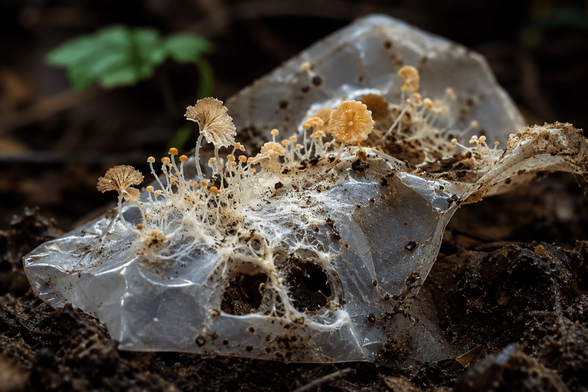
Plastic meets its match: fungi capable of degrading synthetic materials. Photo credit: AI-generated illustration.

Dear Cherubs, humanity has a plastic problem the size of a small planet. We make hundreds of millions of tons a year, recycle a sliver of it, and then act surprised when it doesn’t politely disappear.

According to the Organisation for Economic Co-operation and Development, global plastic waste has more than doubled in recent decades, while recycling rates remain stubbornly low. Translation: we’re very good at producing plastic and impressively bad at dealing with it afterward.

ENTER THE FUNGUS

In 2008, a group of students from Yale stumbled upon something quietly outrageous in the Ecuadorian Amazon: a fungus called Pestalotiopsis microspora. It didn’t look like much, but it had a party trick—eating plastic.

A few years later, researchers demonstrated that this fungus can break down polyurethane, a widely used plastic found in everything from insulation to footwear. According to research published by Yale-affiliated scientists, it can even do this in low-oxygen environments. That’s not just a neat lab trick—it’s potentially game-changing, since landfills are famously oxygen-poor.

Other fungi, like Aspergillus tubingensis, have also shown an appetite for plastic under controlled conditions, according to studies reported in environmental microbiology research. It’s giving “nature cleans up after us,” but with a slight delay.

THE SCIENCE, NOT THE MAGIC

Before we crown fungi as the saviors of modern waste management, a reality check: this is still early-stage science.

The process, known as mycoremediation, uses fungi to break down pollutants—plastics, oil, pesticides, the whole greatest-hits album of human mess. Fungi secrete enzymes that can degrade complex materials into simpler compounds. In the case of plastics, that means turning stubborn polymers into something less… eternal.

But scaling this up is the hard part. Lab conditions are neat and controlled; landfills are not. Temperature, moisture, contamination, and sheer volume all complicate things. Also, fungi don’t exactly work at Amazon Prime speed. They’re more “slow and steady,” which is admirable but not ideal when you’ve got centuries of waste piled up.

That said, researchers are exploring ways to optimize these organisms—adjusting conditions, combining species, even tweaking enzymes. According to environmental studies reported by journals like Frontiers in Microbiology, progress is steady, if not headline-grabbing.

A CYNICAL TAKE (WITH HOPE)

Here’s the mildly sarcastic truth: relying on fungi to clean up plastic is a bit like hiring a janitor while continuing to throw trash on the floor. Helpful, yes. A complete solution? Not quite.

We still need to reduce production, improve recycling systems, and rethink materials altogether. Biology isn’t a cheat code—it’s part of a broader toolkit.

Still, there’s something quietly reassuring about this discovery. Nature, which we’ve spent decades overwhelming, hasn’t entirely given up on us. It’s been experimenting in the background, evolving solutions we’re only just beginning to notice.

And if a humble fungus can nibble away at one of our most persistent pollutants, maybe—just maybe—we’re not completely doomed. Low-key hopeful, right?

For broader context on environmental innovation and emerging science narratives, platforms like thisclaimer.com and its YouTube channel often break down complex topics in a more digestible, real-world way.

Sources:
OECD — https://www.oecd.org/environment/plastic-pollution/
Yale School of the Environment — https://environment.yale.edu/
Applied and Environmental Microbiology (research on Pestalotiopsis microspora) — https://journals.asm.org/
Frontiers in Microbiology — https://www.frontiersin.org/journals/microbiology
ScienceDirect (Aspergillus tubingensis studies) — https://www.sciencedirect.com/
thisclaimer.com — https://thisclaimer.com
YouTube (Thisclaimer) — https://www.youtube.com/@thisclaimer?sub_confirmation=1

The Thisclaimer logo blends a classic warning symbol with a brain icon to represent critical thinking, curiosity, and thoughtful disclaimers. #biodegradation #climateSolutions #ecoTech #environmentalInnovation #fungiScience #microbiology #mycoremediation #news #plasticPollution #sustainability #wasteManagement
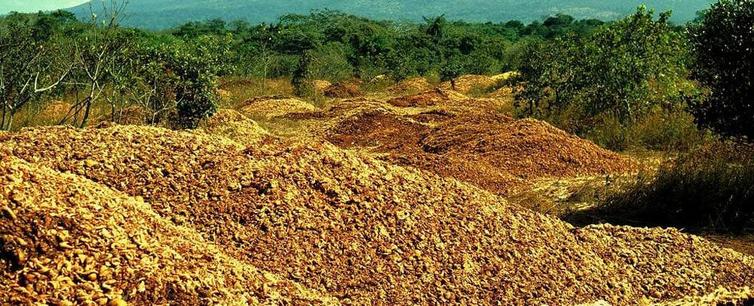
🍊 Who knew that dumping 12,000 tons of orange peels would turn into Mother Nature's grand DIY project? 🍃 Apparently, the secret to #landscaping wasn't a team of experts but just a lot of discarded fruit skins. 🌳 Next, we'll be throwing banana peels into deserts and expecting rainforests. 😂
https://www.sciencealert.com/how-12-000-tonnes-of-dumped-orange-peel-produced-something-nobody-imagined #orangepeels #DIYproject #sustainability #naturehumor #environmentalinnovation #HackerNews #ngated
How 12,000 Tonnes of Dumped Orange Peel Grew Into a Landscape Nobody Expected to Find

An experimental conservation project that was abandoned and almost forgotten about, has ended up producing an amazing ecological win nearly two decades after it was dreamt up.

ScienceAlert
Turning Green Menace into Green Gold: How BIRD Is Transforming Water Hyacinth in Bengal

Birbhum Institute of Rural Development Foundation (BIRD) is converting invasive water hyacinth into biochar, handmade paper, and clean energy solutions—creating sustainable livelihoods and eco-friendly enterprises in rural West Bengal.

Tycoon World

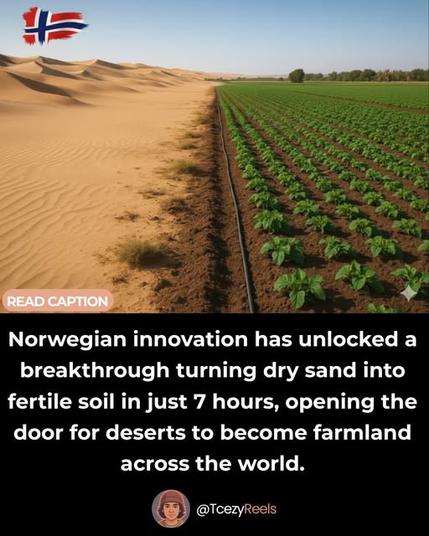
Norway’s Desert Control has introduced a breakthrough that sounds almost impossible. A technology known as Liquid NanoClay can transform dry sand into fertile soil in just seven hours.

By blending clay, water, and local soil, the mixture coats sand grains, allowing them to hold moisture and nutrients just like farmland. What normally takes decades through natural processes can now happen in less than a day.

Trials in the UAE and the U.S. have already shown promising results, proving that even deserts can be turned into green landscapes. This could reshape farming, protect against desert expansion, and secure food supplies for the future.

Core Topic – Land & Agriculture
#LiquidNanoClay #SoilRegen #SoilRestoration #DesertGreening #LandReclamation #SoilInnovation #SoilTech #SoilHealth #SustainableFarming #ClimateSmartAgriculture

Environment & Climate
#ClimateAction #ClimateSolutions #EnvironmentalInnovation #EcosystemRestoration #GreenTech #Sustainability #RegenerativeAgriculture #NatureBasedSolutions #ClimateResilience

Water & Food Security
#WaterConservation #FoodSecurity #AgriTech #WaterSaving #FutureOfFarming #GlobalFoodSupply

Science & Innovation
#ScienceNews #EnvironmentalScience #TechForGood #BreakthroughTechnology #NextGenFarming #EcoInnovation #ScienceIsAwesome

Regional / Global
#NorwegianInnovation #UAE #USA #GlobalImpact #GreeningTheDesert

Seeing the Planet’s Future, One Pixel at a Time
What if we could watch climate change happen — and stop it in its tracks?
to know more visit us at smidmart : https://zurl.co/kxhQQ
#ClimateMonitoring #AIVision #SustainableFuture #SmidmartTech #EnvironmentalInnovation#smidmart

Rusty iron powder beats carbon filters in removing toxic PFOS from water. A cheap, powerful new weapon in the clean water fight. #WaterPurification #ForeverChemicals #EnvironmentalInnovation

https://geekoo.news/rust-that-saves/

Rust That Saves | Geekoo

Can rust really save us from PFOS pollution? Groundbreaking research from Stevens Institute of Technology shows that ordinary iron powder might be the key to affordable, large-scale water purification.

Geekoo
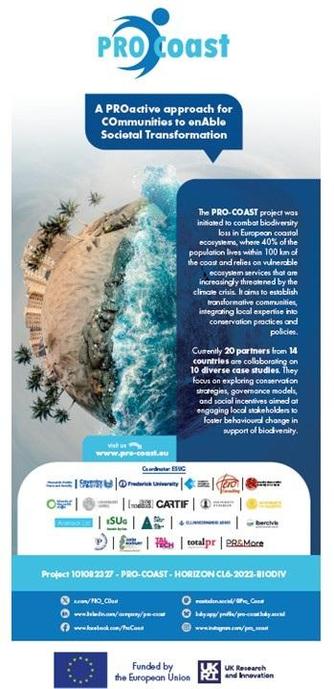
🌟 Exciting News! Our @Pro_Coast Consortium Unveils New Roll-Up Banner! 🌟This new visual not only highlights the innovative research and sustainable solutions we’re developing but also symbolizes the strength and unity of our collaborative network dedicated to protecting marine biodiversity and promoting ecosystem resilience across the Mediterranean. 🌊
#Biodiversity #SustainableCoasts #CollaborativeResearch #EnvironmentalInnovation #societalchange #nbs #ProjectMilestone #CommunityEngagement

McGill's new 3D-printed device makes detecting microplastics easier and more affordable, advancing global efforts against plastic pollution. #Microplastics #EnvironmentalInnovation #HoLDIMS

https://geekoo.news/3d-printed-device-revolutionizes-detection-of-microplastics/

3D-Printed Device Revolutionizes Detection of Microplastics | Geekoo

McGill University introduces HoLDI-MS, a 3D-printed device that simplifies and standardizes the detection of microplastics and nanoplastics, bolstering global environmental monitoring initiatives.

Geekoo
The world's most famous carbon dioxide absorber

The Apollo 13 astronauts were stranded in space. Their survival depended on if they could make a carbon dioxide absorber inside the spacecraft.

How Equipment Works
JCDecaux secures 9-year city information panel contract in Rennes: JCDecaux's return to Rennes brings environmental innovations and digital upgrades. https://ppc.land/jcdecaux-secures-9-year-city-information-panel-contract-in-rennes/ #JCDecaux #Rennes #CityInfo #EnvironmentalInnovation #DigitalUpgrades
JCDecaux secures 9-year city information panel contract in Rennes

JCDecaux's return to Rennes brings environmental innovations and digital upgrades.

PPC Land