The Fungus That Eats Plastic (and Why It’s Not a Sci-Fi Plot)
Plastic meets its match: fungi capable of degrading synthetic materials. Photo credit: AI-generated illustration.
Dear Cherubs, humanity has a plastic problem the size of a small planet. We make hundreds of millions of tons a year, recycle a sliver of it, and then act surprised when it doesn’t politely disappear.
According to the Organisation for Economic Co-operation and Development, global plastic waste has more than doubled in recent decades, while recycling rates remain stubbornly low. Translation: we’re very good at producing plastic and impressively bad at dealing with it afterward.
ENTER THE FUNGUS
In 2008, a group of students from Yale stumbled upon something quietly outrageous in the Ecuadorian Amazon: a fungus called Pestalotiopsis microspora. It didn’t look like much, but it had a party trick—eating plastic.
A few years later, researchers demonstrated that this fungus can break down polyurethane, a widely used plastic found in everything from insulation to footwear. According to research published by Yale-affiliated scientists, it can even do this in low-oxygen environments. That’s not just a neat lab trick—it’s potentially game-changing, since landfills are famously oxygen-poor.
Other fungi, like Aspergillus tubingensis, have also shown an appetite for plastic under controlled conditions, according to studies reported in environmental microbiology research. It’s giving “nature cleans up after us,” but with a slight delay.
THE SCIENCE, NOT THE MAGIC
Before we crown fungi as the saviors of modern waste management, a reality check: this is still early-stage science.
The process, known as mycoremediation, uses fungi to break down pollutants—plastics, oil, pesticides, the whole greatest-hits album of human mess. Fungi secrete enzymes that can degrade complex materials into simpler compounds. In the case of plastics, that means turning stubborn polymers into something less… eternal.
But scaling this up is the hard part. Lab conditions are neat and controlled; landfills are not. Temperature, moisture, contamination, and sheer volume all complicate things. Also, fungi don’t exactly work at Amazon Prime speed. They’re more “slow and steady,” which is admirable but not ideal when you’ve got centuries of waste piled up.
That said, researchers are exploring ways to optimize these organisms—adjusting conditions, combining species, even tweaking enzymes. According to environmental studies reported by journals like Frontiers in Microbiology, progress is steady, if not headline-grabbing.
A CYNICAL TAKE (WITH HOPE)
Here’s the mildly sarcastic truth: relying on fungi to clean up plastic is a bit like hiring a janitor while continuing to throw trash on the floor. Helpful, yes. A complete solution? Not quite.
We still need to reduce production, improve recycling systems, and rethink materials altogether. Biology isn’t a cheat code—it’s part of a broader toolkit.
Still, there’s something quietly reassuring about this discovery. Nature, which we’ve spent decades overwhelming, hasn’t entirely given up on us. It’s been experimenting in the background, evolving solutions we’re only just beginning to notice.
And if a humble fungus can nibble away at one of our most persistent pollutants, maybe—just maybe—we’re not completely doomed. Low-key hopeful, right?
For broader context on environmental innovation and emerging science narratives, platforms like thisclaimer.com and its YouTube channel often break down complex topics in a more digestible, real-world way.
Sources:
OECD — https://www.oecd.org/environment/plastic-pollution/
Yale School of the Environment — https://environment.yale.edu/
Applied and Environmental Microbiology (research on Pestalotiopsis microspora) — https://journals.asm.org/
Frontiers in Microbiology — https://www.frontiersin.org/journals/microbiology
ScienceDirect (Aspergillus tubingensis studies) — https://www.sciencedirect.com/
thisclaimer.com — https://thisclaimer.com
YouTube (Thisclaimer) — https://www.youtube.com/@thisclaimer?sub_confirmation=1
The Thisclaimer logo blends a classic warning symbol with a brain icon to represent critical thinking, curiosity, and thoughtful disclaimers.
#biodegradation #climateSolutions #ecoTech #environmentalInnovation #fungiScience #microbiology #mycoremediation #news #plasticPollution #sustainability #wasteManagement Jules 🍺
 SocialCuration
 Bri - for people & planet 💖
 Thoughtful Disclaimer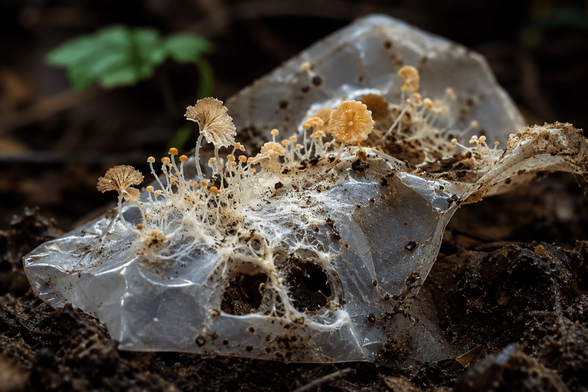

 Peoples.Solutions
 Andrew
 Ventura County CCL
 Parents For Future Italia