Hopefully not creepy, just human
I washed the entire body of Bob, paralyzed from the waist down, I took his clothes off, I put him in the fancy lift, I pushed him to the shower, I placed him back in t...
RE: https://urbanists.social/@Streetsweeper/116341614455296369
Zoning laws do function like this -- they increase car dependence. But that's not all they do. Laws are tools, and tools only very rarely have just one capability. Tools created to solve one problem are often repurposed to solve many others. For instance, hammers were invented hundreds of thousands of years before nails, but now driving nails is a common use of hammers.
Laws are different from hammers in at least one important sense. Almost everyone who has a problem that a hammer can solve has access to hammers and the ability to use them. Laws, on the other hand, can only be created and can only be used by a very small group of people -- the ruling class. [1]
So as in this article, the ruling class uses zoning to increase car dependence because they make money from it in a variety of ways -- car sales, gasoline sales, oil, etc. But car dependence serves other purposes -- it makes people easier to track, to control, etc
And increasing car dependence is not the only ruling class solution provided by zoning. Zoning laws prevent people from running businesses out of their homes, increasing the likelihood that they'll have to work for wages -- without wage laborers capitalism would collapse. Zoning laws also prevent tenants from sharing rentals to the full extent possible, so more rental units get rented. Without a steady supply of tenants the landlord business -- quintessential capitalism -- would collapse.
Zoning laws also allow local governments to take houses away from their putative owners -- can't afford to fix your fences, keep your lawn mowed, keep your house painted, etc, and the city will fine you until you comply. Can't afford to pay? They'll take your house. Eventually it gets sold to someone else and both the city and your mortgage holder make money.
I'm sure that many of these uses weren't foreseeable when modern zoning was invented, but as I said, tools are continually repurposed to solve new problems. Since effectively only the ruling class is able to create laws and to use them effectively they get repurposed for their benefit.
Attributing purposes to tools rather than to those who wield them is a common fallacy, and it leads to serious analytic errors. When people say that the purpose e.g. of police is to protect people and that we just need to get them back to this original use -- in other words advocating for reform -- they're falling into this trap. Look at the capabilities of police, remember that those capabilities can be directed in many ways and only the ruling class is able to decide how the police are used, and it becomes clear that reform is a pipe dream.
#Zoning #ZoningLaws #ACAB #Abolition #Tools #ToolTheory #Capitalism #WageLabor #Landlords
[1] Sometimes people who aren't in the ruling class manage to use laws to their advantage, but these are edge cases. Not only that, but the very possibility of non-rulers using laws serves as one of capitalism's many safety valves. When it does happen it relieves pressure from below and capitalism lives another day. Such cases are also examples of the ruling class using the laws

You should not need to be told, in 2026, why #capitalism and #liberalism are bad.
#PrivateProperty, #WageLabor, and #commodity #production are inherently #exploitative and #competitive, and always lead to #crisis, #inequality, and #imperialism.
The #progressive unfolding of #history toward #metaphysical #rights of the #individual to own, buy, and sell #property (assured by the #state of course) is a #narrative tool that diverts us from #ClassConsciousness and idealizes exploitation.
Today in History — September 2, 1789
The U.S. Treasury Department was established.
Alexander Hamilton became its first Secretary.
I love the musical.
I don’t even mind taxes all that much.
Annoying, sure—but fine.
But goddamnit, I hate wage labor.
And that’s all I can think about.
#ThisDayInHistory #Hamilton #USTreasury #WageLabor #Capitalism #LaborHistory
Just published a piece about working bar shifts where the sky is your real boss.
Rain, bad timing, the mythical “discerning guest,” and why sometimes stoicism is the only thing keeping you from losing your mind behind the stick.
Read it here → https://substack.com/home/post/p-172353285
#BartenderLife #ServiceIndustry #Labor #Weather #PoolBar #HospitalityTruths #WageLabor #PhilosophyOfWork
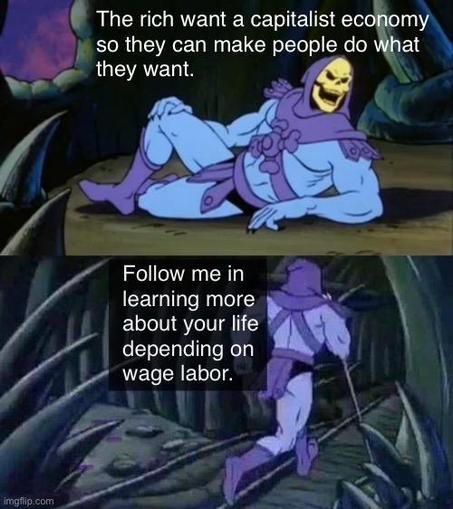
Skeletor dropping more (obvious?) truth bombs.
"'The conflict between wage labor and capital, while it has by no means disappeared, nonetheless lacks the all-embracing importance that it possessed in the past.' -- Murray Bookchin"
Wow. Murray Bookchin was a fucking dumbass. Don't be like him. Read Marxist theory and understand the very prevalent conflict between wage labor and capital that very well still exists.
#communism #socialism #marxism #capitalism #wagelabor #capital
https://www.marxists.org/archive/marx/works/1847/wage-labour/
Lately I've been trying to work on an essay about how I feel a lot of contemporary discourse around #neurodiversity in workplaces suffers from a failure to really grasp the primary, fundamental social function of #WageLabor. It seems very commonly argued (if sometimes only implicitly) that #neurodivergent people have unique talents that can benefit businesses' "bottom lines" if only they are unlocked by appropriate accomodations. Therefore, employers who don't embrace neurodiversity in their workplaces are clearly just uninformed about its upsides, and from there it follows that they can be persuaded to become more #autism- / #ADHD- / etc-friendly through education and awareness campaigns.
1 / 🧵
In his brilliant dissertation, “Property and the Power to Say No,” Karl Widerquist cites an exchange that occurred between Union soldiers and a group of newly emancipated people in Savannah, Georgia. When asked what they needed to secure their freedom:
“The group chose at its spokesman Garrison Frazier, a Baptist minister who had purchased the liberty of his wife and himself in 1856. Asked what he understood by slavery, Frazier responded that it meant one person's ‘receiving by irresistible power the work of another man, and not by his consent.’ Freedom he defined as ‘placing us where we could reap the fruit of our own labor, and take care of ourselves;’ the best way to accomplish this was ‘to have land, and turn it and till it by our own labor.’”
There’s a remarkably clear and clear-eyed understanding of freedom and unfreedom from people who had undeniable first-hand knowledge of slavery.
Many people, when they hear the phrase “wage slavery,” take offense to the idea of comparing the horrors of chattel slavery to the quite often banal insults of wage labor. But the thing that defines slavery isn’t “bad working conditions;” it’s the absence of the power to say “no.”
And both Douglas and Frazier were quite clear: wage laborers are as unfree as they were as slaves.
2/6
https://ora.ox.ac.uk/objects/uuid:a73bad11-7004-43f2-a02d-5ed151078476
This thesis examines the relationship between property and freedom in both the continuous sense of the word and the status sense of the word. Status freedom concerns the distinction between a free person and an unfree person. Continuous freedom concerns the continuum of liberties that make a person