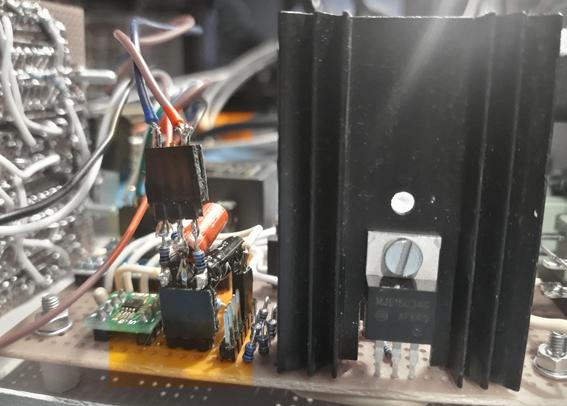
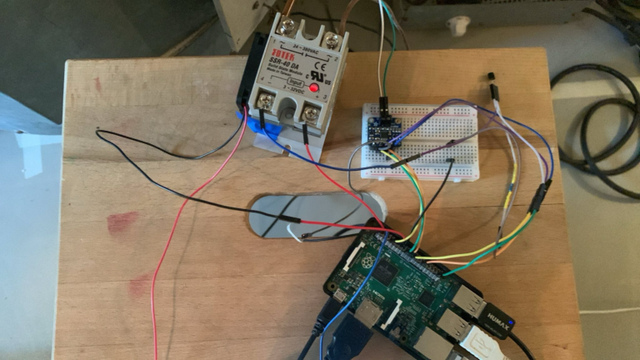
It turns out that coils of 220V heater wire are also quite powerful emitters of electromagnetic waves, and that heavy-duty temperature sensors are also excellent antenna's. So today I kludged this low-pass filter on to the temperature sensor input to get rid of the unwanted signals and now it seems to work fine..

#Thermocouple #AnalogElectronics #OtherSemiconductors #79 #SystemsThatMatter

#India - How to Make #Lime From Scratch

25/12/2018

Making Lime from Scratch - An Overview

1. Build a kiln from cob, or some other material that can stand 1000 degrees heat.

2. Collect some oyster/clam shells, or limestone (see video below).

3. Light a fire in your kiln and add your limestone/shells. Get the temperature up to between 800 and 1200 degrees.

4. Extract the shells (if using) and put them in a vat.

5. Put on protective clothing (mask, goggles, gloves, onesie etc)

6. Add warm water to the burned shells and watch the mixture bubble and froth. Be careful. Lime is caustic and can burn.

7. The longer you leave that substance slaking (submerged in plenty of water), the better quality lime you get.

"Lime. Oh lime. So versatile. So useful. But sometimes so difficult to know which kind you’re buying. You may remember my beginners' guide to different kinds of lime I penned last time. Sometimes though, all the CaOs and NHLs in the world won’t help you, because you live in a place that doesn’t regulate too carefully, and your lime turns up in mysterious dog-eared bags which inspire anything but confidence.

In that case you can always do what Gautam Singh in Mumbai did. Cut out the middle man, and make it yourself. He shared his process in our members' only Facebook Group last week, and I think it's fabulous.

" 'Unsure and concerned about of the quality of lime we were purchasing, especially for some tadelakt work, we made a small kiln to make our own lime,' says Gautam, who is still battling on with plaster work over there in Mumbai. I’ve got to hand it to him, he’s not a quitter:)

'It's specifically for tadelakt,' he says, and 'I’m happy to say it works, and wasn’t too complicated or time consuming either.' Oh...music to my ears!

How did they create their own quick lime?
First Gautam and his friends built the kiln out of cob (see above). Next, he collected a bunch of oyster and clam shells from seafood sellers. You don't crush the shells, they are left whole so they are easy to identify post burning, because the entire burned shell will be converted into Calcium Oxide or pure lime.

'Research stated the shells needed to be fired between 800-1200℃. Any less and it wouldn't have the reaction that turns it into lime, and any more would melt the shells,' he informed us.

I asked him how he measured the temperature. 'Figuring out the temperature was tricky at first, but luckily a professional #potter friend came to the rescue and we used a #thermocouple to measure the temperature for the first two trials. After that it became easier because then I knew it took between 40-60 mins to achieve that 800-1200 degrees required for my kiln.'

Initial Troubles

In the beginning Gautam thought he'd failed. But in fact it's a good example of how things are sometimes not what they appear. 'After our first firing attempt, we went through the burnt matter, extracted all the shells and put them in a pot. Then we tried adding water. But there was no reaction!'

Our pioneer thought perhaps he hadn’t fired the shells at a high enough temperature. He prepared his kiln for a second attempt. It was then he chanced upon a golden nugget of online information advising the use of warm water (not cold) to slake the burnt shells. The Mumbai team decided to try it.

'So we used the same shells, added warm water and voila! It started boiling and reacting violently,' he says."

Read more:
https://www.themudhome.com/mudbuilding/how-to-make-lime-from-scratch

#SolarPunkSunday #SustainableMaterials #Quicklime #AncientTechnologies #Science

How to Make Lime From Scratch

Lime. Oh lime. So versatile. So useful. But sometimes so difficult to know which kind you’re buying. You may remember my beginners' guide to different kinds of lime I penned last time . Sometimes...

THE MUD HOME
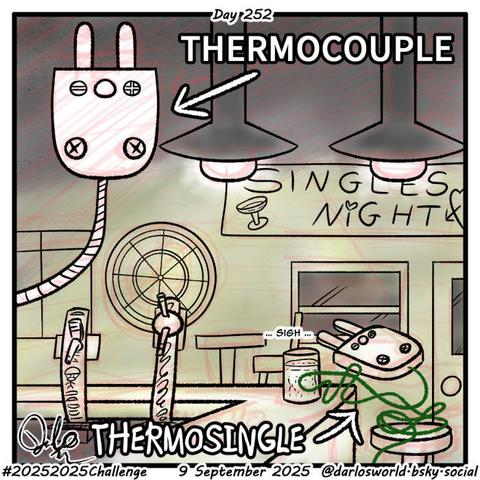
9 September 2025 - Daily Drawing Day 252
#20252025Challenge
I first heard about thermocouples at work, and instantly knew I was going to draw this thermocouple thermosingle pun bar scene. Shout out to all the single electronic temperature-sensing devices out there!
If you get this joke let me know (and let me know if you're an electrician or engineer 😂).

#thermocouple #electronics #single #puns #サーモカップル #電子 #独身 #ダジャレ #💛 #thermosingle #jokes #singlesnight #bar #electronicdevices #lonely #pub #device #電子装置 #シングル #サーモシングル #ジョーク #シングルズナイト #独身パーティー #バー #寂しい #パブ #装置 #オヤジギャグ

Watch the time lapse video of this drawing on YouTube Shorts: https://youtube.com/shorts/IRzjs7jpkkY

See the latest at https://darlosworld.bsky.social

The 2025 20-25 Challenge.

This year let’s get better at something by finding a little practice time most days, in my case drawing. - Do your activity for at least 25 minutes, at least 25 days per month.
- Use the hashtag #20252025Challenge on social media etc to track your progress
- Also use the hashtag to cheer on others.

That’s about it!

Have fun with your activities, whatever they may be!

Drawing, programming, dancing, cooking, make up, reading, languages, gardening, mastering high fives, sewing, astrophysics, vcr clock setting ...

#challengeyourself #challenge #Drawing #drawings #illustration #newyearsresolution #25minutes #xppen #clipstudiopaint #dailydrawing #イラスト #クリップスタジオ #絵 #絵画 #絵描きさんと繋がりたい #drawingoftheday #一日一絵 #art #digitalart #oc #一次創作
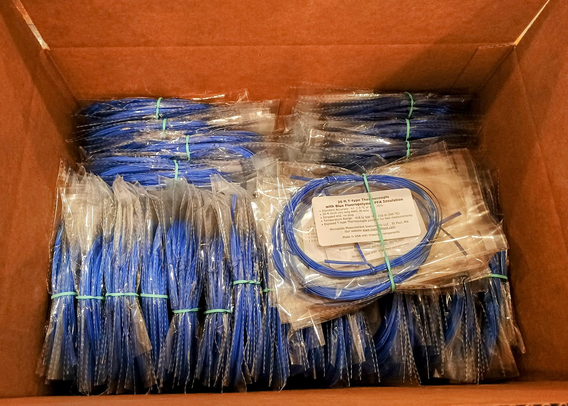
Fun #thermocouple order... 220 Type T sensors, they are 20 ft (6.1 meter) long and will be used in a large energy storage project. Basically they will monitor the temperature in a huge lithium battery that is connected to the grid and collects electrical power when wind and solar are abundant, and then provides it back to the grid at night.
#solar #renewablepower #battery #energytransition
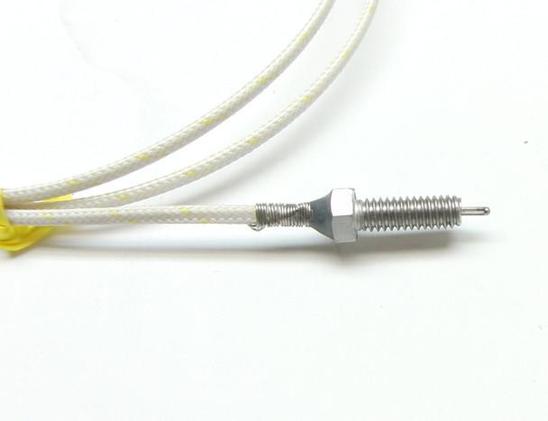
A customer contacted me and asked if I could replicate a very unusual K-type temperature sensor that was routed through a screw. It took a few days, but I was able to make a neat replica for them, and I included a strain relief that should make it much more durable.
#thermocouple #manufacturing

@Carsten

Welcome to the Fediverse, Minnesota Measurement Instruments!

#kiln #thermocouple

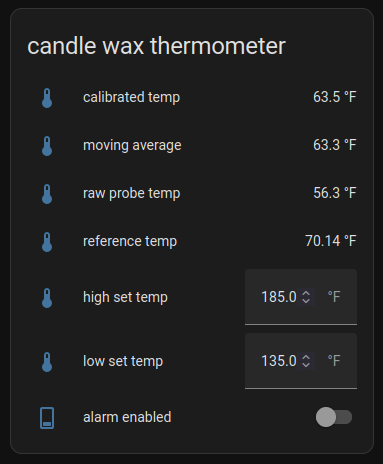
A thermometer with high and low set temperature alarms. I'm using it for melting/pouring candle wax. Probe measures -4°C in an ice bath and ~96.25°C in boiling water. I used esphome's "calibrate_linear" filter to correct readings. Kinda sorta mostly works. The whole thing needs to be put in a case, but I don't have a 3D printer.

Parts: esp32-c3, max31855, K-Type #thermocouple, passive piezo for alarm, ssd1306 oled.

yaml: https://gist.github.com/tkroo/e1934520536652a0ce8f176399ef1e79

#esp32 #esphome #HomeAssistant

Thermometer with alarms

Thermometer with alarms. GitHub Gist: instantly share code, notes, and snippets.

Gist
How Hot Is That Soldering Iron?

It is common these days to have a soldering iron where you can set the temperature using some sort of digital control. But how accurate is it? Probably pretty accurate, but [TheHWCave] picked up a …

Hackaday
Raspberry Pi controlled kiln (part 2)
In my previous post on making a raspberry pi controlled kiln I reached the point with a script running on my Raspberry PI to measure the temperature and manually switch on and off the kiln. On a first attempt I wasn't able to make the master repo
https://www.hylkerozema.nl/2024/05/04/raspberry-pi-controlled-kiln-part-2/
#Ceramic #LiveUpdates #PythonPandas #blinka #ceramic #kilncontroller #MAX31856 #Python #raspberrypi #Solidstaterelay #thermocouple
Raspberry Pi controlled kiln (part 2) – Hylke Rozema

Power for Nothing and Your Kicks for Free

We all know that you can convert heat into electricity. Usually, you do that with some form of steam, but there are other methods, too, including thermocouples. If you've ever seen something producing waste heat, you'll appreciate Penn State's work to harvest power from hot pipes. The idea is simple in theory: create a flexible thermoelectric generator that can wrap around hot pipes or other surfaces to gather otherwise lost heat. The full (paywalled) paper is also available.

The devices can produce up to 150% more power per unit area compared to other thermoelectric generators. A three-square-inch test device produced over 50 watts. Scale that up to an industrial pipe hundreds of feet long, and you could create some serious power. To accomplish this, the scientists used strips of six thermocouples and connected them for a total of 72 thermocouples. Liquid metal between layers improved the device's performance.

This isn't a totally new idea. Russia was famous for making radios in the 1950s that operated using a generator that went around the flue of a kerosene lamp. Since the Russians were pulling this off in the 1950s, converting heat into electricity is obviously nothing new. Of course, your body creates heat, too, so why not use that?

#greenhacks #energyharvesting #thermocouple

Power For Nothing And Your Kicks For Free

We all know that you can convert heat into electricity. Usually, you do that with some form of steam, but there are other methods, too, including thermocouples. If you’ve ever seen something …

Hackaday