From Digital Neofeudalism to Sovereignty: How I Built My Own Knowledge Operating System
Most of us live today in a state of digital neofeudalism. We have become digital sharecroppers: our notes, thoughts, and technical documentation are "leased" from large SaaS corporations. If Notion goes down, your knowledge disappears. If Evernote changes its terms and conditions, your data becomes hostage.
I decided to say "enough." I built a system that is 100% mine, self-documenting code, and works the way I think: nonlinear.
🧠 Knowledge Architecture: A Network Instead of a List
A traditional blog is a list. My knowledge base is a graph. I use Markdown and the Zettelkasten approach to create a network of connections. Thanks to Hugo (@gohugoio), each note knows who links to it.
How does it work?
One article contains reasons, which are the titles of separate publications. These, in turn, have backlinks like "this motivated me to...".
graph TD
A[homelab.md] -->|why?| B[digital-neofeudalism.md]
A -->|business model| C[digital-sharecroppers.md]
B -->|solution| A
C -->|motivation| A
I use transclusion (include) to inject fragments of technical documentation where they're needed. No more "copy-paste."
🏗️ Hardware: Division of roles in the ecosystem
My homelab isn't one big server. It's specialized units:
| Machine | Role | Characteristics |
| --- | --- | --- |
| R3930 | Workhorse | heavy containers, databases. |
| Wyse 5070 | Guardian | DNS (Pi-hole), Proxy, SSO (Authelia). |
| DELL GB10 | AI Accelerator Cluster | LLM. |
| Laptop | Command Center | This is where the code is written, and this is where Ansible runs. |
Why is the Gateway (Proxy/SSO) on a small Wyse? Because it's quiet, energy-efficient, and supposed to run 24/7, even when the "workhorse" is resting.
🛠️ Infrastructure as Code (Ansible)
I don't configure servers manually. Everything is defined by SSoT (Single Source of Truth) in YAML. One file describes the entire lab:
services:
  - id: "technical-docs"
    name: "Wiki"
    fqdn: "docs.lab.arpa"
    target_host: "R3930"
    is_private: false
    category: "Knowledge"
Ansible takes this list and:
Deploys the container on the appropriate host.Configures nginx-proxy on the Wyse to route traffic to R3930.Injects authorization rules into Authelia.Updates the Homepage dashboard. 🔒 Security: SSO and Custom CA
Let's Encrypt has no place on the .arpa network. I built my own Certificate Authority (Own CA) based on Smallstep.
- Authelia (SSO): One login and password (plus 2FA) to access all private services.
- Smallstep SSL: Every service in the
*.lab.arpa domain has a "green padlock." Ansible ensures that my laptop and all servers trust my Root CA.
Development Challenge: Automating SSL via the ACME protocol on my own network is pure magic. Nginx automatically requests a certificate from the local CA server. Without accessing the internet.
📊 Result: Dashboard
The end result is the Homepage – a dashboard that generates automatically. I can see every service, its status, and information about which physical hardware it currently resides on.
🚩 What's next?
My knowledge operating system is growing, but it has one weak point. If the Wyse DNS server goes down, I'm out. So in the next post, we'll cover DNS2 redundancy and data synchronization using Gravity Sync.
Homelab isn't a goal, it's a process. And you? Are you still working your tail off in the cloud?
#DigitalIndependence #OpenSource #SelfHosting #DataPrivacy #TechFreedom #BuildingTheFuture
#DigitalNeofeudalism #DigitalSharecroppers #KnowledgeOperatingSystem #Ansible #Homelab
 Aberia.site
 rhodzy
 Sub_Root
 Doug Belshaw
 MaSi
MaSi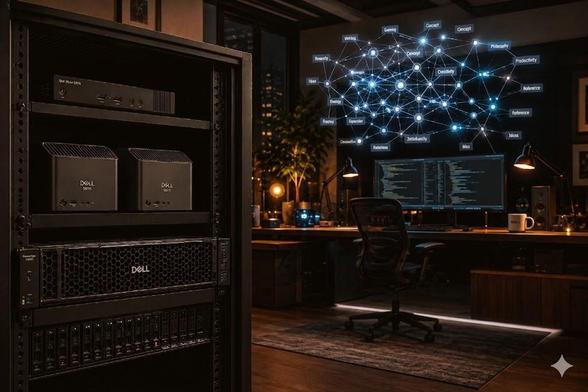
 AmnyX Messenger
 Pikapods