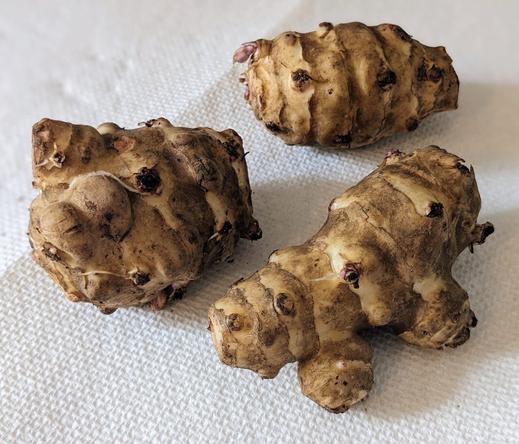
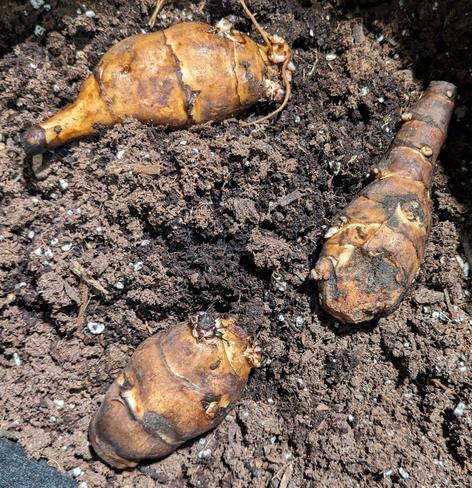
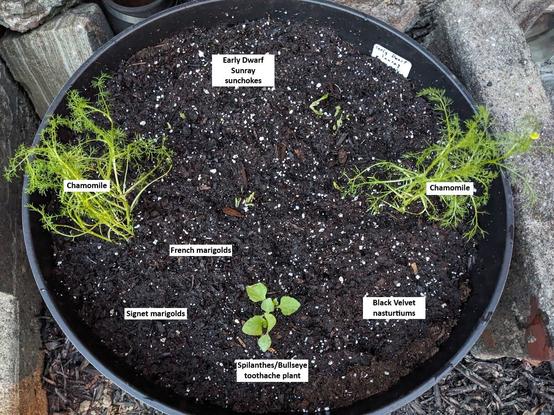
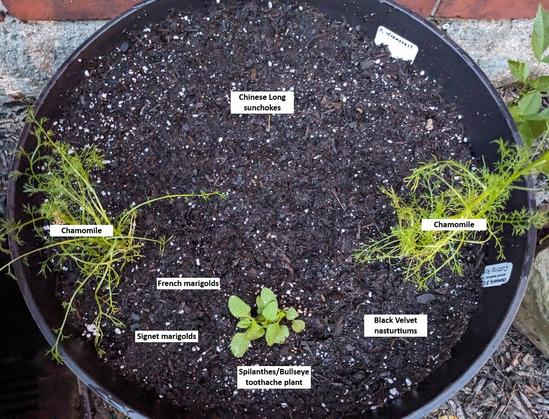
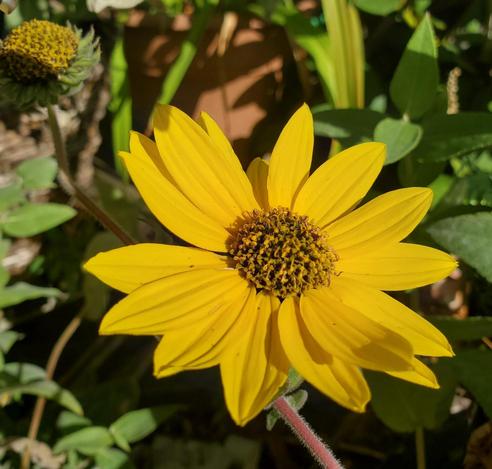
The 90F weather has drawn back a bit, so I hurried to get some things planted out in two of my half-barrels. It'll be my first time trying to grow sunchokes. If things end up being too crowded, I'll just have to transplant or thin out someone. If it feels like there's room..perhaps I'll try sneaking in some test cucamelon or pole beans to climb on the sunchokes. First variety is Early Dwarf Sunray, which is Helianthus tuberosus. Second variety is "Chinese Long," which some sources say may actually be Helianthus strumosus or a cross between tuberosus and strumosus. I'll probably never know. #nature #garden #gardening #zone6b #zone7a #sunchokes
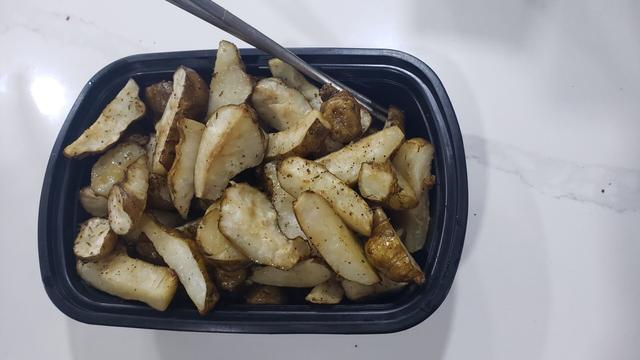
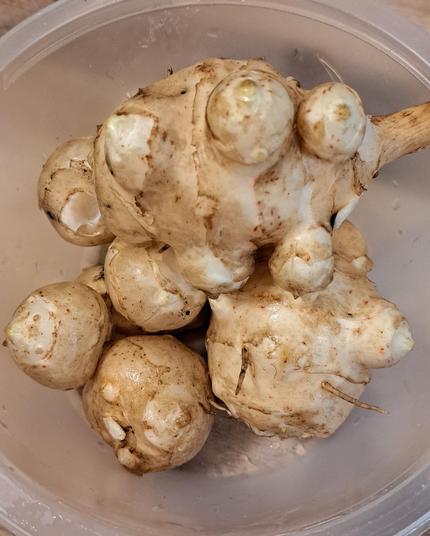
And roasted up the first batch! Nutty, crunchy, different but I like them!
#gardening #cooking #tubers #sunchokes #jerusalemartichoke

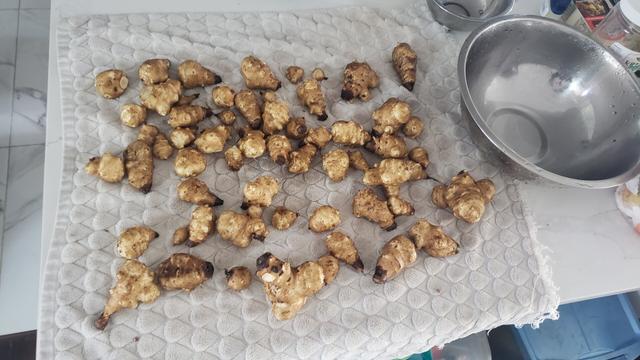
Last year I planted 27 #sunchokes #jerusalemartichokes and this morning I harvested this from just 7 of them, not counting the tubers I left to grow for this year.

I have 20 more to harvest...

I've already reached out to a bunch of neighbors to see if they want any!

#gardening

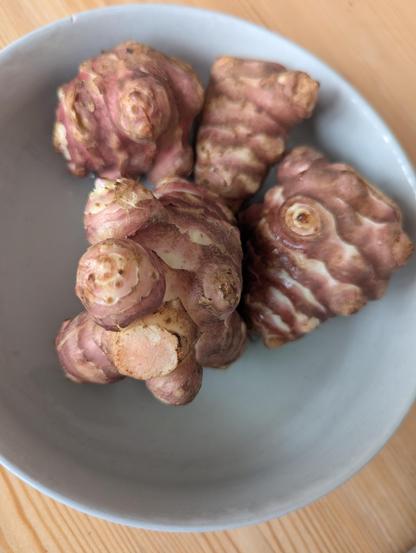
Beim türkischen Gemüsehändler gab es prächtige #Topinambur. Ich werde die nochmal einpflanzen. Es heißt eigentlich, dass die sich fast unaufhaltsam vermehren. Die haben sich nach meiner ersten Pflanzung aber kaum gehalten. Wahrscheinlich haben die Erdbewohner sie gesnackt.
#sunchokes #jerusalemartichoke
Hello world. I may have dug up slightly too many Jerusalem artichokes for one person. #HomeGrown #JerusalemArtichokes #Sunchokes

Seed for Thought

Saturday’s mail brought the first of the season’s seed catalogs. And Saturday night it snowed. The snow was just a sugar coated dusting, but it was a reminder that winter is coming—eventually—because it is forecast to be as warm as 59F/15C by next Saturday.

But today is gray and very windy and below freezing, a perfect reason to lose myself for a little while in the seed catalog. Yes, yes, I know, the garden just finished up and James picked all the collards Friday and has them fermenting—collard kraut! It’s a thing!

My internet recipe searches told me collard kraut used to be very popular across the southern United States and some people say it is even better than sauerkraut. James has ours fermenting with some garlic and crushed red pepper. I’ll let you know how it comes out.

This is the first year I’ve ever grown collards in the garden, and they’ve been a great success. Not only did they grow well, but we enjoyed eating them too. The small leaves made it fresh into salads and as they got bigger they’d get sautéed with onions and eaten as a side dish or combined with other things like tofu scramble, lentil eggs, curry, or soup. The variety I grew was “yellow cabbage” and came from a Minnesota seed company called North Circle Seeds. I asked James whether he liked the collards enough to grow them again next year, and he said that while it took him a little while to figure out how to use them and get used to cooking with them, he did indeed like them and we should definitely grow them again. Noted!

I also grew Swiss chard for the first time this year and we liked that too. I grew “bright lights” and the plant stalks and leaf vein colors ranged from golden yellow to bright red. We generally ate the leaves while they were small, chopped up in salads, which added some lovely color. The bigger leaves sometimes ended up in a stir fry. This will also make it into next year’s garden. Yum!

Tasty and nutritious!

It’s sunchoke digging time! I dug up the first bowl Saturday afternoon just from one small area in the chicken garden. There are sunchokes in the chicken garden because last year I was silly enough to plant two roots along the outside of the chain link fence thinking—actually I don’t know what I was thinking. At the end of last season I dug up half a bowl of huge roots and thought, there, I’ve got them all. Yeah, right.

This year I had even more sunchokes growing along the fence outside and inside the chicken garden. So I dug and I dug and I didn’t worry about pulling out runner roots I came across because I am sure in spring I will discover that they have spread even more.

The sunchoke patch in the main garden is enormous. There will be more bowls to come as James has time to preserve them and I have time to dig and as long as the ground is not frozen. In spring when the ground thaws I will be able to dig up more, and there will be more, because I will find out as they pop up where all the runner roots have gone to this growing season. It’s a good thing we like them.

My turn for Reaping What She Sows: How Women are Rebuilding Our Broken Food System by Nancy Matsumoto came up on Friday. So far I’ve read the first chapter, “Black Mutual Aid, From the Rural South the Urban Northeast,” and it is fantastic.

As with everything in U.S. history, Black farmers have been, and continue to be, discriminated against. You can read a very good and succinct history in this September 2019 Atlantic article (gift link), The Great Land Robbery: The shameful story of how 1 million black families have been ripped from their farms.

Matsumoto tells pieces of this history in her storytelling about a number of women farmers who have created cooperatives, training and helping Black farmers acquire land, seed, and fair prices through a cooperative distribution network. The women and their stories are inspiring and full of lessons on how to support regenerative farming outside a white-supremacist agri-capitalist system.

Matsumoto is familiar with cooperatives. Her Japanese grandparents were interred during World War II and her grandfather helped create a cooperative network in the internment camps. This network became the second largest consumer co-op in the United States. Given the political and economic situation in the United States currently, I suspect we will be seeing more cooperatives and mutual aid societies popping up all over the country in the coming years.

Throughout history women have been the seed keepers, carefully saving and preserving seeds from season to season and generation to generation. A few years ago I read a wonderful novel called The Seed Keeper by Diane Wilson. It is the story of a current day Dakota woman who is gifted a cache of seeds saved by her ancestors when they ran from being attacked by U.S. troops. It is a story of healing and renewal. I was reminded of this novel while reading the first chapter of Reaping What She Sows because one of the women she profiles is a seed keeper and works for Truelove Seeds, an heirloom seed company that offers culturally important seeds.

Of course I had to look at their offerings, and wow! If you want to read more about the company, The Sierra Club has a great article about them, The Preservation of Culture Begins With a Seed I am definitely going to try and grow green striped cushaw squash! And they also have Korean hong-gochu peppers so I can make kimchi and even collard-chi next year.

The next chapter of the book is about rebuilding the grain economy. Looking forward to learning even more!

While I am on the subject of seeds, I have been a fan of Baker Creek Heirloom Seeds and bought seeds from them many times through the years. But in the last few months I’ve found out that as wholesome as they advertise themselves to be, this is not the case. In 2019 they invited a white supremacist to speak at their spring planting festival. After much uproar, they uninvited him, but issued no statement of apology or anything that I was able to discover. I have also heard that they steal seeds from indigenous peoples and then rename them and don’t acknowledge where they really came from, though I am unable to find direct confirmation of that. However, just last year the tomato they had on the cover of their catalog turned out to be a recently released GMO variety they sold as non-GMO. They said their seed came from France and they tested it and the results were inconclusive. Nonetheless, they pulled it from their stock and destroyed all the seeds.

Along with just discovering Truelove Seeds, I learned a few months ago about Native Seed Search and there is also Bertie County Seeds I just found out about. I generally buy seeds from Fedco who tell you exactly where the seeds come from (corporate grower, independent farmer, etc) and also credit and pay indigenous communities for their seeds. There is also Seed Savers Exchange. And then, as I mentioned earlier, North Circle Seeds, a small independent Minnesota seed company that sells varieties that will grow in my climate.

I guess I am getting a lesson in seed keeping and seed companies that I hadn’t thought much about before. Seeds are more than hybrid, open-pollinated, heirloom, GMO, organic. It’s important to know their origins and to make sure the people who have stewarded them are acknowledged and compensated. For some reason I always believed this was the case, but it turns out to be otherwise.

#collardKraut #collards #cooperatives #firstSnow #NorthCircleSeeds #seedCatalogs #seedKeepers #seedSaving #seeds #sunchokes #swissChard #TrueloveSeeds

Jerusalem artichoke also known as sunchoke is an amazing root vegetable which is not from Jerusalem or an artichoke. It is actually related to the sunflower family and native to central-eastern North America
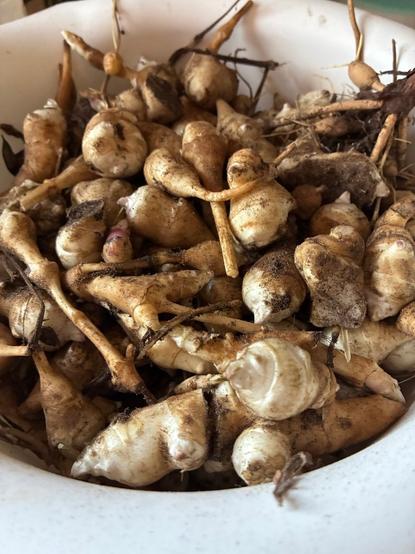
All of this (7lb) is a result of two little tubers that were too small for me to notice them that were left in the soil
#urbanfarm #jerusalemartichoke #sunchokes
https://www.instagram.com/p/DPHJMhWkTHW/?igsh=MXR6b2owaTQwaTRoNQ==
PHD Farm on Instagram: "Jerusalem artichoke also known as sunchoke is an amazing root vegetable which is not from Jerusalem or an artichoke. It is actually related to the sunflower family and native to central-eastern North America All of this (7lb) is a result of two little tubers that were too small for me to notice them that were left in the soil #urbanfarm #jerusalemartichoke #sunchokes"

0 likes, 0 comments - phd_farm on September 27, 2025: "Jerusalem artichoke also known as sunchoke is an amazing root vegetable which is not from Jerusalem or an artichoke. It is actually related to the sunflower family and native to central-eastern North America All of this (7lb) is a result of two little tubers that were too small for me to notice them that were left in the soil #urbanfarm #jerusalemartichoke #sunchokes".

Instagram

Eat Your Weeds

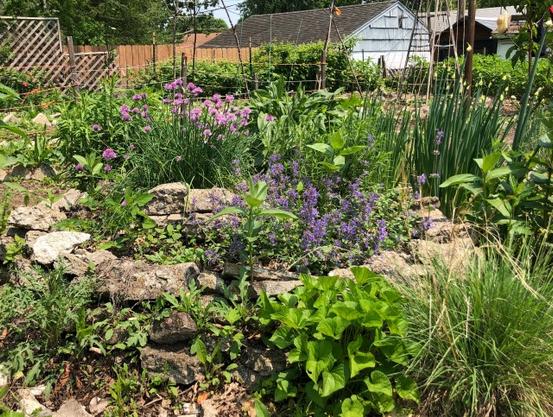
Chives and catmint blooming in the herb spiral

Hello friends, it’s been a minute. When it’s between the garden and sitting down to write a post about the garden, the garden wins every time. Priorities!

Everything but for a few still too small to plant out perennials started from seeds is finally planted, which means the work has shifted to harvesting and maintenance. And wow, is there a lot of maintenance to do thanks to fairly regular rainfall and the occasional blast of heat. It’s a good thing we like to eat our weeds in this house! I use weeds broadly here since I have feral arugula all over, walking onions all over, sochan (aka yellow cone flower) in abundance, also violets, nettles, and actual plants considered weeds—lamb’s quarters, wood sorrel, and creeping bellflower. So many spring greens for salads and stir fries, soups and pasta. 

The newest weed to the edible lineup is the creeping bellflower. I have it growing all over underneath the apple trees in the front yard. When it first appeared many years ago I didn’t know it was an invasive weed. I’ve seen it in yards all around town and it gets pretty purple flower stalks on it. Since I was having trouble getting plants to grow in the shade beneath the apples trees, I let it do its thing. For several years. And then I learned what a horrible weed it is.

It spreads by seed and roots and once it is established, it is impossible to get rid of unless you manage to remove every last bit of root. I no longer allow it to flower, and the stalks are easy to pull out, but pulling out the stalks doesn’t hurt the plant because of the insidious roots lurking everywhere.

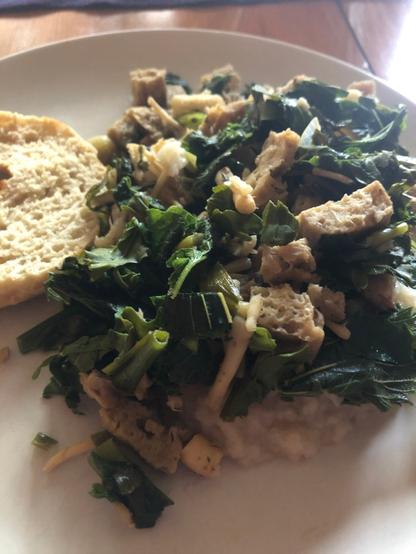
Last fall, I learned the stuff is edible, both greens and roots. So why not give it a try since I have plenty? The roots are not big and are harder to get at than I expected. I probably spent about 30-45 minutes digging around for a kind of small payoff. I also picked greens. James, ever the trooper, sautéed the roots and greens along with some nettle, arugula, walking onion, and seitan and we had them for dinner over mashed sunchokes (I can at this point, count these as garden weeds too). I don’t think I will ever grow potatoes again because mashed sunchokes turn out to have a potato-y flavor, though they aren’t very starchy so lack a bit of “fluff.” If you want to learn all about sunchokes, I just listened to an episode of a new to me podcast today (The Poor Prole’s Almanac), Exploring the Many Names and Tales of the Sunchoke.

Our patch of wild ginger has also grown pleasingly large, and I dug up one of the little roots for the first time to try in the dinner. Wild ginger is native to North America and loves the shade. It is not the big rooted tropical ginger you buy at the grocery. These roots are small—rhizomes actually—and they do have a mild ginger flavor that is kind of earthy with a hint of pepper. You may have heard that wild ginger is toxic. Well yes, it does contain a toxin. However, I’d have to eat a whole lot of it, like a pound or more, for it to have any sort of affect, and really, that’s not going to happen. Everything in moderation!

Weed dinner with homemade bagel

So how did it all taste? Delicious!

If things keep on as they have been, it is going to be a banner year for black raspberries! I am so very excited. After the drought a few years ago they really suffered and have been making a slow climb back to fruitful. Well, it looks like this year they have made it! My mouth is watering in anticipation.

The cherries are doing well too. And, I’m afraid I am going to jinx it, but it appears I will be getting plums this year! There are quite a few that have reached olive size already. I am over the moon about this. Please think good plumy thoughts!

The chokeberries are also covered in little green fruit. And the clove currant likewise. I have two freezer bags full of rhubarb. Nom nom nom! My heart is so happy! And my mouth will be too.

The roses are covered in flowers at the moment. I picked a jar of petals, some petals from the two peony flowers that bloomed this year, and thawed out the rose hips I put in the freezer and forgot about last fall. James then undertook to make jam. I had rose jam on toast with some spiced chai for an afternoon snack. Divine!

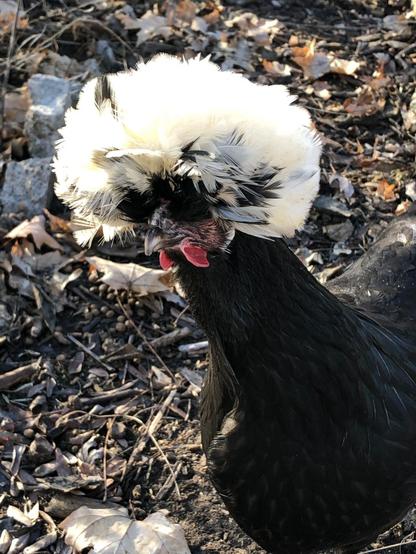
Can hardly see a thing with that hairdo

The chickens are always disgruntled about not being allowed in the big garden, but they are quite pleased that we moved the compost bins out next to the coop. Sia especially loves to climb on top and mine for gold. When I am out in the garden she alternates between the compost bin and standing at the gate complaining loudly. Sometimes she stands on the compost pile, looks at me over the fence, and complains. But she can’t help but like me because we’ve got a treat thing going.

When I find a beetle, grub or cutworm I carry it over to the gate and yell chickens! in a sing songy voice. Sia rockets over from wherever she may be because she knows there is a treat at hand. Because of her bouffant, she can’t look up to see me drop the bug, but stands at the gate looking down at the ground in front of her. I drop the bug and she sees it when it hit the ground—most of the time—and gulps it down. It’s only Sia who comes running to the gate when I call. I’ve tried calling her by name but she doesn’t respond. Clearly I’ve established a recognizable treat call and I am now required to stick to it. Chic-ken!

Today I played garden statue while a young robin hopped around near me looking for insects. He must be able to hear them under the ground because he never scratched like the chickens do, but would hold still then stab his beak into the ground and pull out a cut worm or earthworm. It was pretty amazing to watch and I felt so honored that he hunted around for quite some time while I stood just a few feet away.

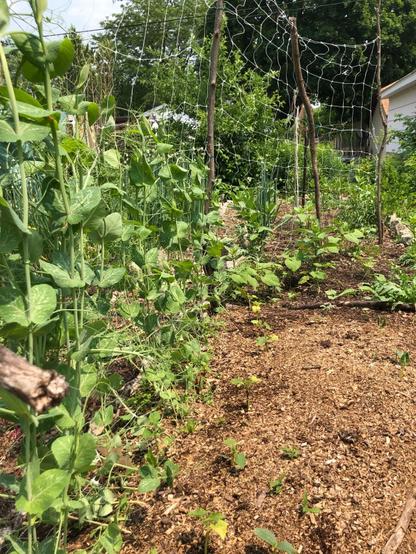
The “volleyball net” with snap peas, cucumber, and pole beans

A week or so ago I was eating dinner and looking out the sliding glass door into the garden when a big crow swooped through with something in their claws and landed on my neighbor’s garage roof. That’s when I got a good look at what the crow had—a baby rabbit! I briefly felt bad for the rabbit, but then was glad there will be one fewer of them testing my anti-rabbit garden defenses. Soon there were a two other crows wanting to enjoy some rabbit and a bird—possibly a robin—who began dive bombing the crows trying to get them to leave. It was all a big ruckus. Finally the crow with the rabbit decided they had had enough and took off with their dinner, followed by the other crows and the poor parent bird, who obviously had a nest in the tree next to the garage, could relax.

When I mentioned the ruckus to someone the next day he was surprised to learn that crows eat meat. And then he was upset about the crow eating a baby rabbit. He said he found it disturbing when animals eat other animals (clearly he didn’t grow up watching nature shows on TV or reading nature books). I said, well you are an animal and you eat other animals and don’t find that disturbing so why would you be bothered by other animals eating each other? From the look he gave me I had clearly just rocked his world. Finally he managed to mutter, well I never thought of it like that before.

Speaking of crows, we have three adolescents hanging around. They were all in the maple tree squabbling but they didn’t have their grown up crow voices yet and James and I had to look up the tree to see who was making the noise. And then we laughed and laughed. Their voices are now starting to change. Sometimes they manage a big crow caw before their adolescent voice takes back over. It’s like when boys hit puberty and their voices change, only it’s crows, and it is utterly delightful.

That’s it for today. I will try to catch up with all the kind comments folks have left on previous posts as soon as I can!

Reading

So many good books!

#arugula #creepingBellflower #crows #nettles #roseJam #sunchokes #walkingOnions #weeds #wildGinger
@MCDuncanLab
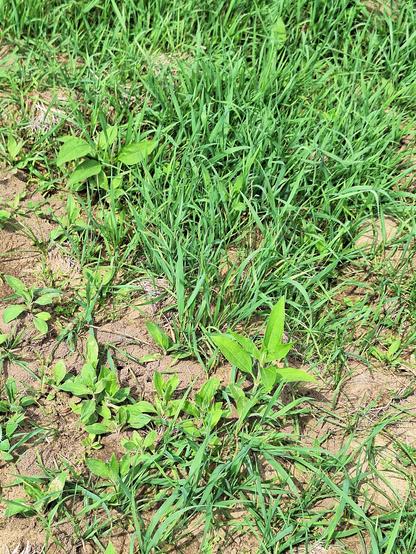
I'm hoping there's some of those sunchokes you gave me among all these weeds!
And also hoping they can stand a lot of competition!

#gardening #sunchokes #eatwhatyougrow #eattheweeds #permaculture