#WhatIs #Biology #Biochemistry #MolecularBiology #sflorg
https://www.sflorg.com/2025/11/wi11222501.html
Extreme environments are coded into the #genomes of the organisms that live there https://theconversation.com/extreme-environments-are-coded-into-the-genomes-of-the-organisms-that-live-there-219072
Environment and #taxonomy shape the genomic signature of #prokaryotic extremophiles https://www.nature.com/articles/s41598-023-42518-y
"The expectation was that all the clusters would be along taxonomic lines: #bacteria grouped with bacteria, and #archaea grouped with archaea. To our great surprise, this was not always the case... The only obvious commonality was that they were heat-loving #extremophiles."
"We propose that at least part of the #pangenome can be understood as a set of #genes with relationships that govern their likely cohabitants, analogous to an ecosystem’s set of interacting organisms. Our findings indicate that intragenomic gene fitness effects may be key drivers of #prokaryotic #evolution, influencing the repeated emergence of complex gene–gene relationships across the pangenome."
#Scientists unravel #symbiotic secrets of #prokaryotic community living in host #amoeba https://phys.org/news/2023-08-scientists-unravel-symbiotic-secrets-prokaryotic.html
#SciComm about new #ISEPpapers:
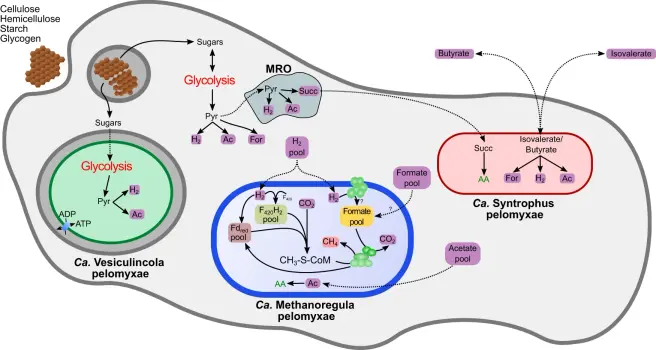
Hydrogenotrophic #methanogenesis is the key process in the obligately syntrophic consortium of the #anaerobic ameba #Pelomyxa schiedti https://www.nature.com/articles/s41396-023-01499-6 #protists #bacteria #microbes #symbiosis #amoebae #archaea #symbiosis #genomics
In a new study, researchers from the Faculty of Science of Charles University, in collaboration with researchers from Max-Planck Institute for Terrestrial Microbiology and European Molecular Biology Laboratory from Heidelberg, have delved into the intricate partnership between anaerobic amoebae from the genus Pelomyxa and their prokaryotic companions. Pelomyxa, known for their unique symbiotic relationships with multiple prokaryotic endosymbionts, has long mystified scientists regarding the role these symbionts play in their host's metabolism.
"Here, using cryoelectron microscopy, we describe the atomic structures of two extracellular #cytochrome #nanowires (ECNs) from two major orders of hyperthermophilic #archaea present in deep-sea hydrothermal vents and terrestrial hot springs...The detection of ECNs in archaea suggests that filaments containing closely stacked hemes may be a common and widespread mechanism for long-range #electron transfer in both #prokaryotic domains of life."
#Metabolism is not the limiting factor in #prokaryotic #endosymbiosis, shows study.
https://phys.org/news/2023-04-metabolism-limiting-factor-prokaryotic-endosymbiosis.html
"One of the great mysteries of biology," says Eric Libby, former SFI Postdoctoral Fellow, now an associate professor at the Integrated Science Lab (IceLab), Umeå University in Sweden, "is eukaryogenesis, or how eukaryotes arose." Scientists consider this to be a period of major evolutionary transition, critical to our understanding of the history and evolution of life on Earth.
Genetic and Structural Diversity of #Prokaryotic #Ice-Binding Proteins from the Central #Arctic Ocean
Ice-binding proteins (IBPs) are a group of ecologically and biotechnologically relevant enzymes produced by psychrophilic organisms. Although putative IBPs containing the domain of unknown function (DUF) 3494 have been identified in many taxa of polar microbes, our knowledge of their genetic and structural diversity in natural microbial communities is limited. Here, we used samples from sea ice and sea water collected in the central Arctic Ocean as part of the MOSAiC expedition for metagenome sequencing and the subsequent analyses of metagenome-assembled genomes (MAGs). By linking structurally diverse IBPs to particular environments and potential functions, we reveal that IBP sequences are enriched in interior ice, have diverse genomic contexts and cluster taxonomically. Their diverse protein structures may be a consequence of domain shuffling, leading to variable combinations of protein domains in IBPs and probably reflecting the functional versatility required to thrive in the extreme and variable environment of the central Arctic Ocean.
When can syntrophic microbial cooperation win over selfish cheaters? https://ecoevocommunity.nature.com/posts/when-can-syntrophic-microbial-cooperation-win-over-selfish-cheaters
Eco-evolutionary modelling of microbial #syntrophy indicates the robustness of cross-feeding over cross-facilitation https://www.nature.com/articles/s41598-023-27421-w
Most #prokaryotes rely on syntrophic partners, but they rarely evolve to full #endosymbiosis. If #mitochondria have originated from a syntrophic #symbiosis, a burning question arises: Why aren't there more #prokaryotic syntrophies that turn into endosymbiosis?
Most prokaryotes rely on syntrophic partners, but they rarely (if ever) evolve to full endosymbiosis. If mitochondria have originated from a syntrophic symbiosis, a burning question arises: Why aren't there more prokaryotic syntrophies that turn into endosymbiosis?
#Microbe filter feeders
This recent research explores how mesh feeding #zooplankton are able to feed directly on #prokaryotic #microorganiisms and suggests #Prochlorococcus (#Cyanobacteria) may be able to evade #predation.
Find out more in Environmental Microbiology on:
https://ami-journals.onlinelibrary.wiley.com/doi/full/10.1111/1462-2920.16334