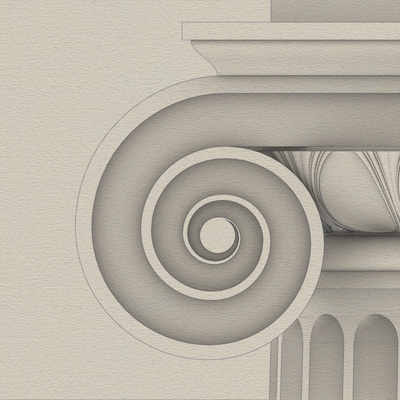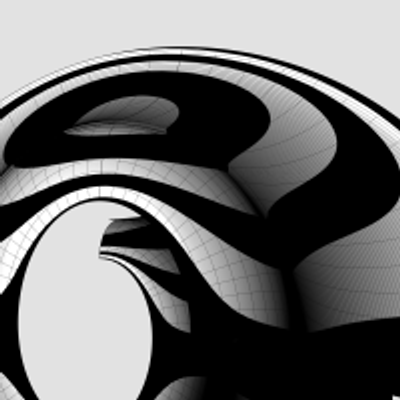
#ModernIonicCapital #Volute Construction

As mentioned in https://pixelfed.social/p/Splines/807933255910367093, we mentally rotate the floor plan of the modern #IonicCapital 45° so that the volute #spiral curves lie flat on the XZ plane.

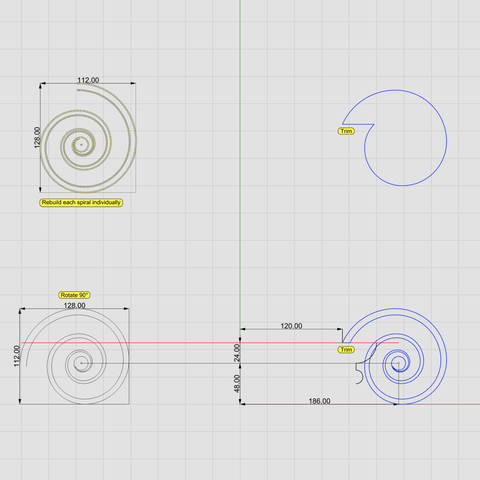
The top-left diagram shows the original volute spirals from https://pixelfed.social/p/Splines/800383518517869430. If you haven't already rebuilt them from disjointed arcs to seamless #NURBS curves as described in https://pixelfed.social/p/Splines/794199123072358090, do so now. Explode the whole spiral into constituent arcs, select all arcs for the outer spiral and join them separately, and repeat this step for the inner spiral. Then, rebuild both spirals with 256 segments each.

Volute spirals for the classic and modern variants are the exact same size, but the ones in the modern version appear smaller. That's an optical illusion because the spirals are rotated 90° in the modern version as shown in the bottom left diagram.

The bottom right diagram shows the placement of the volute spirals relative to the #profileCurves of the lower portion of the modern capital. The #voluteEye is slightly above and far to the right of the #astragal profile in the modern version compared to the classic version.

At this point, we make two copies of the volute spirals and trim them to the top of the #ovolo. In one copy we only trim away the outermost arms of the spirals while maintaining the inner spirals, as shown in the bottom right figure. In the other copy, we trim away the inner spirals as shown in the top right image.

The bottom right figure in https://babel.hathitrust.org/cgi/pt?id=mdp.39015031201190&view=1up&seq=142 shows the eye 6.5 parts (52 units) from column shaft. That's not an error, but poor documentation. See floor plan in https://pixelfed.social/p/Splines/807782440025967685 where x = 198 on the square is homologous to x = 250 on the circle. To reconcile, scale 52 by 250/198 = 65.656, or 66, and offset by 120 to get 186 units.
Splines (@[email protected])

Left side of this diagram shows the #profileCurves for the cap of #ModernIonicCapital from the front. The right side shows a perspective view of the cap surfaces obtained by revolving the profile curves about their respective axes and after some of those have been trimmed away The measurements for the floor plan of the modern ionic capital are given in https://pixelfed.social/p/Splines/807782440025967685 with further links to relevant pages in #Scarlata's book at the bottom. I won't bore you with the bottom portion of the modern #capital because it is very similar to that of the classic capital shown in https://pixelfed.social/p/Splines/792124787573855518. A significant difference is that the bottom #ovolo is shorter, with a total height of 32 units instead of 40 For the cap, we need two identical copies of a single profile curve that is 30 units wide and 48 units tall. The curves marked by A and B in the diagram are oriented in the same direction and are spaced 100 units from each other. The bottom of profile curve A lines up with the neck of the #columnShaft at 120 units from the column axis. The revolution axis for this curve is located at 416 units from the column axis at the center of the largest circle in the floor plan. We #revolve profile curve A full circle about its revolution axis. Then, we #rotate the resulting surface about the column axis to get 4 identical copies. We revolve profile curve B full circle about the column axis. Then, we trim the resulting surface along with the 4 others at each intersection to get the side and corner surfaces for the cap of the capital. We #join the trimmed surfaces, cap #planarHoles to convert them into a closed solid, and verify that the resulting solid is #airtight with no #nakedEdges and no #nonManifoldEdges. The cap is in the correct final orientation. The volutes will be at 45° angles, but when we construct them, it will be easier to rotate the whole plan 45° so that the #volute #spiral is on the XZ plane.
Pixelfed
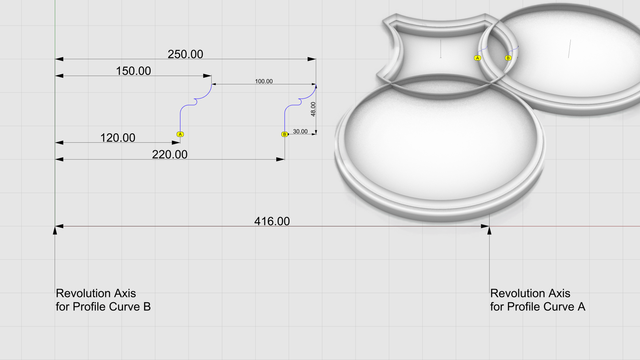
Left side of this diagram shows the #profileCurves for the cap of #ModernIonicCapital from the front. The right side shows a perspective view of the cap surfaces obtained by revolving the profile curves about their respective axes and after some of those have been trimmed away

The measurements for the floor plan of the modern ionic capital are given in https://pixelfed.social/p/Splines/807782440025967685 with further links to relevant pages in #Scarlata's book at the bottom.

I won't bore you with the bottom portion of the modern #capital because it is very similar to that of the classic capital shown in https://pixelfed.social/p/Splines/792124787573855518. A significant difference is that the bottom #ovolo is shorter, with a total height of 32 units instead of 40

For the cap, we need two identical copies of a single profile curve that is 30 units wide and 48 units tall. The curves marked by A and B in the diagram are oriented in the same direction and are spaced 100 units from each other.

The bottom of profile curve A lines up with the neck of the #columnShaft at 120 units from the column axis. The revolution axis for this curve is located at 416 units from the column axis at the center of the largest circle in the floor plan.

We #revolve profile curve A full circle about its revolution axis. Then, we #rotate the resulting surface about the column axis to get 4 identical copies.

We revolve profile curve B full circle about the column axis. Then, we trim the resulting surface along with the 4 others at each intersection to get the side and corner surfaces for the cap of the capital.

We #join the trimmed surfaces, cap #planarHoles to convert them into a closed solid, and verify that the resulting solid is #airtight with no #nakedEdges and no #nonManifoldEdges.

The cap is in the correct final orientation. The volutes will be at 45° angles, but when we construct them, it will be easier to rotate the whole plan 45° so that the #volute #spiral is on the XZ plane.
Splines (@[email protected])

Plan for the #ModernIonicCapital If the design in https://pixelfed.social/p/Splines/807569519962747338 looks daunting, let me assure you it is far simpler than the work that went into the reconstruction of just the #scroll for the #classicIonicCapital. Be sure to check out #MileStone4 at https://pixelfed.social/p/Splines/795361973789834465. With the modern #IonicCapital, the designers went back to the basics of using just straight lines and circular arcs to define the geometry of the essential elements of the capital. No #braids, #keystones, or #modillions, and no #helix curves or #sinusoids. We start the floorplan for the modern ionic capital with a circle of radius 5/6 of µ (120 when µ = 144) which marks the neck of the #columnShaft. Tangent to this circle is a large circle of radius 296 units centered on the X axis exactly 416 units from the column axis. This is the circle that marks the curve of the #abacus, which is always tangential to the column shaft at the neck. This circle also marks the curved faces of the interior portion of the #volute wedge. Without the raised volute spirals, the interior wedge appears flush with the abacus as they follow the same circular arc. Concentric to this large circle is another circle with a radius of 280 units to mark the extent of the raised volute spirals which are 16 units thick. Another concentric circle of radius 266 units marks the outer edge of the top of the capital. The gap between the outermost large circle and the innermost concentric circle is 30 units, and that is reflected in another pair of circles centered on the column axis with radius of 250 units and 220 units to define the four corners. The capital footprint fits in a square 396 units wide — or 24.75 parts horizontally from axis, per #Scarlata in https://babel.hathitrust.org/cgi/pt?id=mdp.39015031201190&view=1up&seq=45. Use this with the sketch in https://babel.hathitrust.org/cgi/pt?id=mdp.39015031201190&view=1up&seq=142

Pixelfed
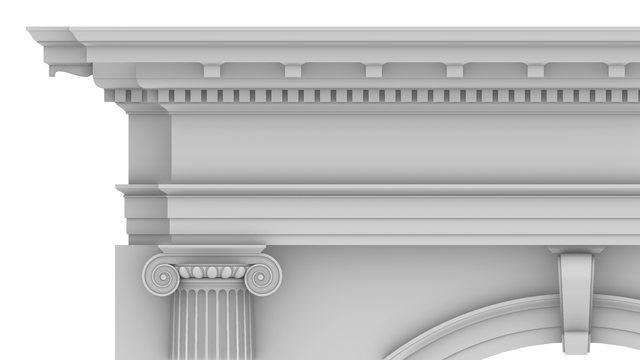
#ModernIonicEntablature with #modillions and #dentils adapted for #arcadeIntercolumnation.

This image shows modillions across the top of the entablature, including modillions visible on the side wall. The dentils are below the modillions and are a bit shorter than in the classic variant.

As with dentils, a #modillion must be centered on a column axis. In the front, there are two modillions directly above the two columns and eight other modillions equally spaced between them. The number is always 10. So the spacing is different for an #arch with no #pedestals.

This image also shows a skinnier #keystone. Its thickness is half that of the one shown in https://pixelfed.social/p/Splines/804548474524642209 but all other measurements remain the same. There is never a modillion directly above the keystone.

The #cymaReversa and #fillet above the keystone have #profileCurves identical to those in the #capital but the top is a square that is only µ x µ units. The top slab is centered front to back on the face of the arch.

In this image, the modern entablature is shown with the classic capital, but it goes really well with the #modernIonicCapital. As I mentioned in https://pixelfed.social/p/Splines/791065657488081419, the classic variant of the column capital has parallel flat #volute slabs only visible from the front and back, but not from the sides. Because of its lack of radial symmetry, the capital does not look as satisfying when viewed from the side, especially in a #colonnade, as seen in https://pixelfed.social/p/Splines/803089629244302486.

The modern variant has curved volute faces on all four sides with pointed ends at all corners and optimized for use in a corner column, but not limited to that. The modern #IonicCapital is the last remaining piece in our systematic look at the complete #IonicOrder.

This concludes our look at the entablature, both classic and modern, and both for #simpleIntercolumniation, or #Architravato, and #arcadeIntercolumniation.
Splines (@[email protected])

#Arch with #Ionic #Entablature and #Keystone Detail The #dentils arrangement we saw in https://pixelfed.social/p/Splines/791013152244518907 goes well with the classic entablature #profile we saw in https://pixelfed.social/p/Splines/790888454384861893, and they both go well with #simpleIntercolumniation, also known as #architravato. However, with arches, the entablature profile has to be adjusted a bit so that the dentils arrangement is as shown here. The shape, size, and gap between individual dentils remains the same, but a crucial difference is that the dentils at the #outer corners touch each other. As I mentioned in https://pixelfed.social/p/Splines/803615973439041638, in #arcadeIntercolumniation, the entablature is repeated on the wall behind the half-column. It doesn't end at the columns and has two "outside" corners and one "inside" corner. While the dentils at the outer corners touch each other, there is a single dentil in the inside corner that is shared by both walls. A bedrock principle of dentils (like that with #flutes and with eggs in the #EggsAndDarts motif) is that when viewed directly from the front or the sides, a dentil must be centered on the column axis. It is this principle that forces us to adjust the profile of the entablature in arcade intercolumniation giving us the arrangement shown here. The image also shows the detail of the decoration in front of the #keystone. The most easily recognizable component of that is the large #volute, which is the exact same size as the ones on the #capital. The smaller volute is exactly half the size of the larger one. It is mirrored, rotated and put within a bounding rectangle whose height is exactly 2µ (288 units). The channels of both volutes are bridged with #sinusoids derived from half turn of #helix curves that have been flattened. This motif in the keystone, where volutes of different sizes are combined with sinusoids is very common. It will be seen in the #modillions of the #modernEntablature.

Pixelfed

⬆️ #IonicPedestal #3DModeling #SurfaceExtrusion

Ensure that all #ProfileCurves segments are joined into one curve and extrude it along the right side of the pedestal to a little over the maximum distance the curve projects from the column axis.

In this case, the maximum projection is 280 units for the top #fillet of the #pedestal #cap. So, extending it to 300 on both sides for a total length of 600 units should be sufficient.

This shows a perspective view of the outside surface before mitering

⬆️ #IonicPedestal #3DModeling #ProfileCurves

Top-right portion of profile curves for #Ionic Pedestal without dimensions, but still showing the centers for all arcs.

⬆️ #IonicPedestal #3DModeling #ProfileCurves

Top-right portion of profile curves for #Ionic Pedestal. Details in Alt text.

When µ = 288, the pedestal #Cap is 72 units tall. The #fillet and #cavetto below that are part of the #Dado.

The #Ovolo is convex (opposite of cavetto). Both Ovolo and #Corona are 24 units tall.

The corona has a lip that is not visible from front. The function of the lip is not to help you lift the pedestal and move it around but to dissipate water dripping from the top.

⬆️ #IonicPedestal #3DModeling #ProfileCurves

Bottom-right portion of profile curves for #Ionic Pedestal without dimensions, but still showing the centers for all arcs.

Notice that the center for the #reed is 2 units to the right of the center for the top arc of #CymaRecta.

The two gaps to the left of the reed MUST be closed if you want your models to be airtight for #3DPrinting. If you forget, the model might render fine but the model will have #nakedEdges.

⬆️ #IonicPedestal #3DModeling #ProfileCurves

Bottom-right portion of profile curves for Ionic Pedestal. Details in Alt text.

Starting from bottom, the #plinth, #fillet, #CymaRecta, and #reed belong to the #Basement.

The fillet and #cavetto (circular arc) above those belong to the #Dado.

The cyma recta is 40 units wide and 24 tall. So the arcs for that are cut from ellipses.

A refined variation of cyma recta uses half turn of a helix instead of 2 elliptical arcs and will be presented later.

⬆️ #IonicPedestal #3DModeling #ProfileCurves

Profile curves for Ionic Pedestal shown in blue.

All profile curves are straight lines or 2nd degree (circular or elliptical arcs) and are planar on the XY-plane.

Although you could zoom in and get the size of each segment of the profile curve using the grid lines which are 8 units apart, you don't have to.

The top-right and bottom-right portions of the profile curve are described in detail in the next few posts along with sizes and variations.

⬆️ #IonicPedestal #3DModeling

>> Using µ = 288… pedestal height would be… 864 units.

The pedestal is the easiest to construct and requires only a rudimentary knowledge of geometry.

You only need to draw straight lines and arcs for the #profileCurves in 2D space (Front view), extrude the curves in 3D space, miter cut the ends at 45° (Top view), then rotate the mitered extrusion along the central #columnAxis at 90° intervals, making copies as you go.

Finally, you join and cap the extrusions.