Civil Discourse – It’s The Cynicism – Joyce Vance

It’s The Cynicism

By Joyce Vance, Jan 17, 2026

It seems to be everywhere you look, across the political spectrum. Far too many people don’t believe in anything anymore. They’ve lost faith in everything: our institutions, our values, and even each other. We’ve become a country of cynics.

One of the first posts I saw this morning on social media was about a well-documented instance where a Minnesota family’s six children were hospitalized after their minivan filled with smoke and tear gas fired by federal agents. Below the news report, someone had dismissed it in the comments: “I don’t believe it.” That was it. No explanation, nothing that cast doubt on the reporting. Just a rejection.

A little bit further down, someone had written about diminishing confidence in the Justice Department. A commentator wrote, “Did anyone believe in that anyway?”

We have become a nation of skeptics, of cynics. We are jaded. It’s all around us.

In her essay, Truth and Politics, Hannah Arendt wrote, “The result of a consistent and total substitution of lies for factual truth is not that the lie will now be accepted as truth and truth be defamed as a lie, but that the sense by which we take our bearings in the real world—and the category of truth versus falsehood is among the mental means to this end—is being destroyed.”

The President spews lies so constantly and so casually that it’s easy to understand how people can lose their bearings. It’s an assumption that Trump lies, not something unusual. That’s the President of the United States!

One manifestation of the lies we’ve become so inured to is the destruction of confidence in our elections. Trump has lied for so long about voter fraud, about non-citizens voting (the evidence does not back that claim up), about voting machines, about stolen elections, that it has permeated the national consciousness and even when people see through the lies, a miasma of distrust for the entire process remains. And of course, it’s not just elections.

Who benefits from a loss of faith in our institutions and in our ability to come out on the other end of this national nightmare with an intact republic? It’s not hard to see. It’s the man who enjoys upsetting the balance of power guarded by NATO because he wants to own Greenland. The man who tears down the East Wing. The man who won’t release the Epstein Files.

At this stage, Trump no longer cares if people believe his lies. He just needs the chaos they generate and the absence of shared truths, shared facts, in our country. People who can no longer discern what’s true from what’s false lose their moral compasses, like the agents who are now shooting at the people they took an oath to protect and serve. It all benefits a leader who wants to take authoritarian control of a democracy.

Giving up your belief in how things should be is dangerous.

I’m not suggesting everyone should have blind faith in our institutions, far from it at this point. But we need to be aware of what’s broken and needs mending without getting stuck on it. Instead of succumbing to cynicism, let’s stay focused on what we can do, even the small things.

Be kind, share joy. Register to vote and make sure everyone around you does, too. We know what this is going to take, but we have to stop the spread of cynicism around us. We’ve come too far in the last year to accept Trump’s success as inevitable.

In the coming week, we will mark the one-year anniversary of the second Trump administration. Find your own way to protest it. Donate to a food bank. Help a neighbor out, or help someone you’ve never met but have empathy for. Sign up to work at a polling place, or decide to run for office. There is so much that we can do. What we cannot afford to do is to let a man who thinks of no one but himself win.

Editor’s Note: Read the rest of the story, at the below link.


Continue/Read Original Article Here: It’s The Cynicism – Civil Discourse with Joyce Vance

It’s The Cynicism by Joyce Vance

Read on Substack #BeKind #CivilDiscourse #Cynics #Institutions #ItSTheCynicism #Jaded #JoyceVance #LossOfFaith #OneYearOfTrump2ndTerm #PoliticalSpectrum #Politics #ShareJoy #Substack #TrumpSpewsLies #WorseThan1stTerm

Joyce Vance | Substack

Former federal prosecutor. MSNBC legal contributor. Law Professor. Writes with chickens & knitting at hand. Author of Civil Discourse on Substack. My first book, Giving Up Is Unforgivable: A Manual For Keeping A Democracy, is a NYT bestseller!

Conservative means the person doesn't want to change its emotional setup and thinks humans can reach a future with the same old one ruler patriarchal ideas.

Leftists know the old emotional setup is dangerous and unsuitable to a modern way of living. But they have no other emotional setup in store themselves. What they have is a ideological knowledgebased framework that allows for survival in a modern state.

They don't realize how unsatisfying life without meaningful corresponding emotional setup is. That's why they appear arrogant and perhaps are because they tend to despise feelings in general.

Human life is always based on feeling. Just ask modern marketing folks. We decide emotionally and they let our head create a explanation why that was a rational decision.

Liberals are somewhere between left and conservative.

Leftists cannot go on making fun of feelings.

They need to be brave enough for a new human way.

With true individuality and commitment to a state that guarantees freedom and justice.

I just wonder how conservatives can hold on to that version reality. So ignorant. After all the suffering it has given us

#emotionalsetup #politicalspectrum

Invisible Chains

YouTube

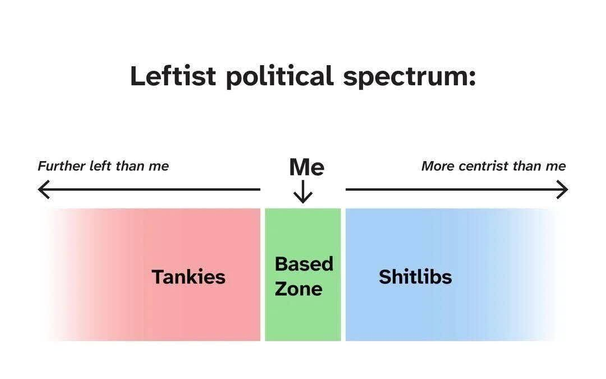
New political taxonomy:

Left wing: Social conscience, Economic conscience, Ecological conscience - pick one

Far left: Pick two

Center: Wants to do things everyone knows is bad. Tries hard to justify the unjustifiable.

Right wing: Corrupt leaders who gain votes through dishonesty.

Nazis: Corrupt leaders who gain votes through fomenting hatred, plus dishonesty

#changeMyMind #politics #politicalSpectrum

Discover the 3 political archetypes shaping American politics. Which one are you? #AmericanPolitics #PoliticalSpectrum
Read more: https://ndpost.org/uncategorized/understanding-the-three-political-archetypes-shaping-american-politics/
Understanding the Three Political Archetypes Shaping American Politics

Understanding the Three Political Archetypes Shaping American Politics American politics can be broadly categorized into three distinct archetypes, each representing

ND POST
No matter where #anyone falls on the #PoliticalSpectrum
It is in our collective #BestInterest to egg on a feud between #Musk and #HisEminence
He’s trying to take you down!
7. #Collaboration and #Compromise: The ability to work with others across the #PoliticalSpectrum and find #CommonGround for #EffectiveGovernance or policy. This doesn’t mean giving up #CoreValues but balancing them with #PragmaticSolutions.
3. #Pragmatism: An emphasis on workable #PracticleSolutions rather than #Ideological purity. People who follow #PurpleLite tend to focus on what works in practice, even if it means blending ideas from across the #PoliticalSpectrum.

Left and Right are Pointless for Politics

One of the most common phrases that comes up when I hear people talking politics is Left and Right. ‘They’re far left’, ‘they’re extreme right’, ‘I’m a centrist’. I think that these ideas have not only run their course, but now they’re pointless and devoid of any meaning to political discourse.

Left and Right come from french politics at a time when that country underwent a lot of upheaval – the revolution, many centuries ago. That country, the world, and society as a whole, has changed a lot since them. In many places these same terms have wildly different meanings and interpretations, and in recent political discourse historical conventions have often been ignored or terms like this mis-used to the point that they don’t have much meaning.

The traditional view of left and right in many European countries is a totally different spectrum to the left and right as used within American politics1. Centrist political movements with broad appeal can have wildly different motivations that the typical left/right spectrum cannot capture, despite often being assigned to one side – For example, should we assign environmental activism to the left or right when a majority of people in a society are concerned with the impact of climate change? Should we continue to describe a party like the UK’s Labour as left when many of it’s policies have shifted from it’s founding values, in a country where there isn’t really a viable socially progressive alternative? What impact does a figure like Trump have when he calls his opponent ‘radical left’, when by much of the world’s standards Harris is moderate?

I think it is still true that many people would identify with a left and a right, but my feeling is that is more because we continue to ascribe importance to that spectrum, rather than an intrinsic truth that people fit somewhere on it. If we started using different terminology, people might describe themselves differently.

I can also understand from an editorial standpoint that spinners, journalists, and broadcasters would want something simple to be able to describe the state of politics, and the left-right spectrum has for so long fit that role that changing may seem like a huge upheaval for not much return. But for me the role of the news is to inform people, and to be as objective as possible understanding that everyone has underlying biases. By using a more diverse range of political indicators, more objective language, words which have clearer meaning and so are more difficult to corrupt, I think we would all be in a much better place.

Going beyond a one dimensional spectrum, how could we look at politics? I have often seen two-dimensional planes used. The advantage of these is that they still clearly display the relations of different political ideas and movements in relation to each other, and you can tailor the axes depending on what issues you want to discuss. These axes can be more concrete than vaguely define left/right. Such as Authoritarian-Libertarian mapped against Conservative-Progressive, which I think as a starting point would be a good drop-in replacement for the frequently used left/right. 2-Dimensional frameworks also make it more difficult to employ us-vs-them rhetoric, and divide and conquer tactics like that are very harmful to politics.

We should also do more to separate different policies when running comparisons. For example, when classifying a movement that is economically libertarian and progressive, that does not necessarily mean these same actors are socially libertarian and progressive. In many cases, the exact opposite is true. Both one and two dimensional scales can fail to capture this.

But this leads to a difficult challenge. Do you then move to 3 dimensional analyses, which risk becoming convoluted and unhelpful during discourse? Do you use 2-dimensional descriptions for each and every policy area, which risks becoming difficult to analyse and compare concretely?

I’m not a political scientist so I don’t know the answer, but I do know that we need something better than right left. And for me, if journalists, pundits, commentators and regular people started using different and more objective descriptions, no matter what they are, that is a step in the right direction.

Wikipedia has a nice summary of some alternatives. Which do you like? Please leave a comment.

  • All of this makes American election cycles particularly annoying to us non-Americans. ↩︎
  • https://lonm.vivaldi.net/2024/09/13/left-and-right-are-pointless-for-politics/

    #journalism #LeftVsRight #PoliticalSpectrum #politics #Politics

    Public opinions and social trends, Great Britain - Office for National Statistics

    Social insights on daily life and events, including estimates from the Opinions and Lifestyle Surveys (OPN) relating to the biggest issues facing society today.