| truthaholics
UK at a Crossroads with Starmer’s Exit: Welfare, Warfare, and the End of Managed Politics?
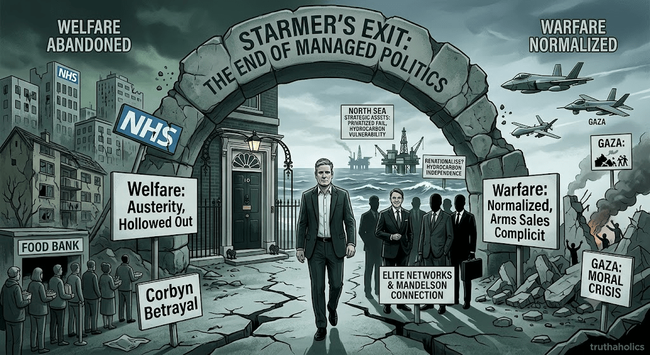
Keir Starmer’s resignation is not just the fall of one leader; it is the collapse of a political model. Labour abandoned welfare politics, normalised warfare politics, and lost legitimacy by looking morally evasive at home and complicit abroad.¹ ² The deeper backlash reflected not one issue but a post-COVID mood of austerity fatigue, immigration anxiety, supply-chain insecurity, and a cost-of-living crisis intensified by inflation.³ ⁴ ⁵ It also sits within the wider disillusionment that followed a decade of Brexit politics: people were promised control, pride, and renewal, but were left with division, stagnation, and a sense that no one in power was telling the truth plainly.² ³ ⁴ The plain economic lesson many voters draw is simple: only fix what is broken, or risk breaking what is still working.
The collapse also exposed a geopolitical credibility gap. Starmer’s government looked aligned with US hegemony while posturing against Russia, even though Britain’s own energy vulnerability made that stance feel strategically self-defeating.⁶ ⁷ If Britain wants real resilience, the debate must now include hydrocarbon independence, including whether strategic North Sea assets should be renationalised rather than left to Thatcher’s privatised legacy.⁷ ⁸ The practical answer to post-Brexit drift is not nostalgia, but competence: rebuild industrial capacity, secure supply chains, invest in energy, and stop treating sovereignty as a slogan rather than a policy.
Starmer’s betrayal of Corbyn
Starmer’s rise began with a break from Corbynism that was not just ideological but disciplinary. He helped dismantle the movement energy that had briefly made Labour look like a vehicle for welfare, anti-austerity politics, and pressure from below.⁹ Earlier critiques of Labour’s internal hollowing-out captured the result: the party kept the language of social justice while stripping out much of the substance.¹⁰
That mattered because it left Labour easier to control but harder to trust. The Corbyn rupture was not a side issue; it was an early stage in the collapse of Labour’s emotional and political coalition.⁹ ¹⁰
Gaza and the credibility gap
Gaza turned that hollowing-out into a public moral crisis. The government answered civilian slaughter with caution, legalism, and partial measures that many saw as too late and too limited.¹¹ ¹² Gaza became the ghost of Starmer’s leadership, haunting every claim he made about values, legality, and restraint; the bloodshed of innocents never sleeps.¹² ¹³
The deeper problem was constitutional as well as moral: Britain continued arms-related relationships, surveillance cooperation, and diplomatic cover while trying to suppress dissent at home, turning policy into managed contradiction.¹³ ¹⁴ Starmer’s human-rights past only sharpened the hypocrisy.¹¹ ¹⁵
Elite networks
The Mandelson connection reinforced the sense that Labour had become too comfortable inside elite circuits and in hock to the Epstein class. Mandelson symbolised a political culture of lobbying, influence, and insider choreography.¹⁶ That helped convince many voters that politics was being done for established networks rather than ordinary citizens.¹⁷
Welfare not warfare
The phrase that best captures the broader failure is still welfare not warfare. Starmer’s collapse reflects the cost of prioritising caution abroad, control at home, and elite reassurance over security, housing, pay, and public services.¹⁸ The same logic runs through domestic deprivation and foreign-policy complicity: managed consent over democratic energy, procedural legitimacy over moral seriousness.¹⁸ ¹⁹
Under the replacement
The prognosis under Starmer’s replacement is mixed unless Labour changes substance, not just style. A new leader may restore discipline, but discipline is not legitimacy, and a cosmetic reset will not fix years of betrayal, moral evasion, and elite insulation.²⁰ If the successor also fails to put voters first above foreign and corporate conflicts of interest, Labour will remain vulnerable to abstention, protest voting, and deeper detachment.⁴ ¹⁸
Andy Burnham is the most plausible successor in the public imagination, but his prospects are conditional. Having just won a Commons seat, he would need to clear the party’s internal hurdles, and then survive the pressures of a leadership contest; even then, his recent migration comments suggest a pragmatic drift that may reassure some voters while leaving others unconvinced.²¹ ²² He looks less like a clean break than a possible reset within Labour’s existing constraints.
The danger is that this vacuum does not stay empty: it creates space for the far-right to frame anger, insecurity, and betrayal in nationalist and authoritarian terms. When mainstream politics fails to answer austerity fatigue, cost-of-living pressure, migration anxiety, and geopolitical humiliation with credible solutions, it leaves disillusioned voters vulnerable to scapegoating rather than repair.
Still, there is a route back. Labour could restore material credibility through action on living costs, housing, public services, and industrial resilience, alongside a clearer break from elite capture and policy drift. It would also need a more honest foreign policy that prioritises democratic accountability, energy security, and peace over reflexive alignment with outside powers. And after a decade of Brexit disillusionment, politics should stop selling grand narratives and start delivering visible competence, honest trade-offs, and practical improvements people can feel.
Footnotes
¹ BBC News, ‘Keir Starmer announces resignation as prime minister and Labour Party leader’ (22 June 2026), https://www.bbc.co.uk/news/articles/cdxd00lg599o
² BBC News, ‘Prime Minister Keir Starmer’s resignation speech in full’ (22 June 2026), https://www.bbc.co.uk/news/articles/c621nnq4pm7o
³ BBC News, ‘Starmer considers political future as pressure to quit mounts’ (21 June 2026), https://www.bbc.co.uk/news/articles/cn8k1my75gno
⁴ BBC News, ‘Starmer tells BBC “I’ll be PM this time next year”’ (4 January 2026), https://www.bbc.com/news/articles/clygv1ngynjo
⁵ BBC News, ‘Why are UK prices still rising?’ (20 January 2026), https://www.bbc.co.uk/news/articles/c17rgd8e9gjo
⁶ TNI, ‘The living legacy of privatisation in the United Kingdom’ (4 December 2024), https://www.tni.org/en/article/the-living-legacy-of-privatisation-in-the-united-kingdom
⁷ Reuters archive, ‘British economy between a rig and a hard place’ (19 October 2009), https://www.reuters.com/article/us-northsea-britain/british-economy-between-a-rig-and-a-hard-place-idUSTRE59J01G20091020/
⁸ UPI Archives, ‘Thatcher to sell North Sea assets’ (20 October 1981), https://www.upi.com/Archives/1981/10/20/Thatcher-to-sell-North-Sea-assets/4467372398400/
⁹ Declassified UK, ‘How Keir Starmer conned the British electorate’ (12 October 2025), https://www.declassifieduk.org/how-keir-starmer-conned-the-british-electorate/
¹⁰ Labour internal democracy / Corbyn inheritance commentary, 2025–2026
¹¹ Declassified UK, ‘Labour allowed dozens of arms exports to Israel after weapons sanctions’ (11 December 2024), https://www.declassifieduk.org/labour-allowed-dozens-of-arms-exports-to-israel-after-weapons-sanctions/
¹² Declassified UK, ‘Keir Starmer’s 100 spy flights over Gaza in support of Israel’ (2 October 2024), https://www.declassifieduk.org/keir-starmers-100-spy-flights-over-gaza-in-support-of-israel/
¹³ AOAV / Declassified UK, ‘Britain sent over 500 spy flights to Gaza’ (27 March 2025), https://aoav.org.uk/2025/why-did-the-uk-government-withheld-details-of-raf-spy-flights-as-expose/
¹⁴ AOAV, ‘RAF surveillance flights over Gaza reach 577: AOAV update’ (4 July 2025), https://aoav.org.uk/2025/raf-surveillance-flights-over-gaza-reach-577-aoav-update/
¹⁵ Gaza and protest reporting, 2024–2025
¹⁶ Peter Mandelson profile and commentary in mainstream political coverage, 2024–2026
¹⁷ Elite capture / New Labour / public trust commentary, 2025–2026
¹⁸ Welfare-not-warfare commentary & ongoing truthaholics prognosis 2025–2026
¹⁹ UK Election Analysis, ‘2024: the great election turn-off’ (14 July 2024), https://www.electionanalysis.uk/uk-election-analysis-2024/section-7-news-and-journalism/2024-the-great-election-turn-off/
²⁰ Labour succession analysis commentary, 2026
²¹ BBC News, ‘Burnham says he would seek to enter any Labour leadership contest’ (4 June 2026), https://www.bbc.co.uk/news/articles/cp9p9z31rr1o
²² BBC News, ‘UK net migration needs to fall further, says Andy Burnham’ (22 May 2026), https://www.bbc.co.uk/news/articles/cjdp9zjdj0mo

 Osna.FM
 Hermetic Library
 Hermetic Library
 Andrew 🌻 Brandt 🐇

 N-gated Hacker News
 Hacker News
 getmisch