The second QA team basically serves to evaluate how well the first QA team is doing; if the first QA team keeps missing defects, fire them. Now, that second QA team has little incentive to produce that outcome for their friends. So maybe they don’t look too hard; after all, the first QA team missed the defect, it’s not unreasonable that we might miss it too.
#Microservices got a bad name because they were too micro; in the original terminology, a “micro” service was exactly the right size for a “two pizza team” to build and operate on their own. With AI, maybe it's one pizza and some tokens.
This about #aiagents for #peerreview besides the #codereview they do #vibecoding
#tailscale
https://tailscale.com/blog/modules-monoliths-and-microservices
https://apenwarr.ca/log/20260316
Modules, Monoliths, and Microservices: A Systems Design Perspective

Learn what are microservices, when are microservices beneficial and how module boundaries impact software design.

Ah, the prestigious #ICML, bravely tackling the earth-shattering crisis of AI-assisted reviews by rejecting a whopping 2% of papers! 🤖📄 Clearly, the #integrity of peer review hangs by a thread, as program chairs valiantly protect us from the existential threat of Large Language Models daring to assist. 😂 Bravo, ICML, for saving us from this apocalypse!
https://blog.icml.cc/2026/03/18/on-violations-of-llm-review-policies/ #AIreviews #PeerReview #LargeLanguageModels #HackerNews #ngated
On Violations of LLM Review Policies – ICML Blog

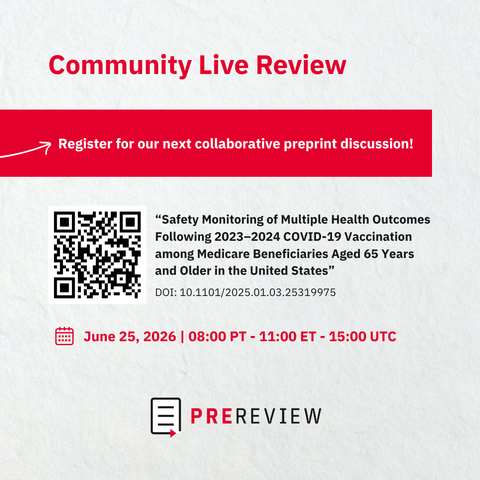
Translate Science is launching a PREreview Club! We hope that will create opportunities for us to get to know more of you from our Mastodon community. Learn more in the blog post and sign up to stay informed about upcoming events:

https://transci.hypotheses.org/220061

https://nextcloud.translatescience.org/apps/forms/s/dqJYTY6HLYnKk6pDk6dpBi8g

#preprints #openScience #peerReview

Translate Science is launching a PREreview Club!

Who is Translate Science? We’re an all-volunteer community of interest for people interested in multilingual open science. We explore the topic from a wide variety of perspectives. Learn more at our website. What is a PREreview Club? PREreview Clubs publish open peer reviews of preprints, providing constructive feedback while collaborating around a shared interest. Learn […]

Translate Science

Follow the outputs of the PREreview + Continuous Science Foundation Modular Peer Review Working Group in real time 🙌

Session 2 was all about identifying reviewable components from multiple stages of research, and associating them with different signals or evaluation functions.

⏩ Now, participants have selected five working sub-groups for deeper exploration through June. Stay tuned as ideas, insights, and approaches take shape.

https://articles.continuousfoundation.org/articles/modular-peer-review/session-2

#OpenScience #ModularScience #PeerReview

Modular Peer Review Working Group

A working group hosted by Continuous Science Foundation (CSF) and PREreview exploring how peer review can evolve in a modular publishing ecosystem.

Kimon Fountoulakis (@kfountou)

논문 저자들이 리뷰어가 AI를 사용했는지 탐지하기 위해 논문 본문에 숨은 지시문(hidden instructions)을 넣는 사례를 관찰했다는 내용입니다. 이러한 지시문은 AI가 특정 문장을 반드시 포함하도록 유도해 AI 사용을 밝히게 하려는 의도이며, 때로는 그 문장이 인간에게도 타당한 문장인 경우가 있어 문제와 모호성을 동시에 제기합니다.

https://x.com/kfountou/status/2033366744358600883

#ai #peerreview #aidetection #research #ethics

Kimon Fountoulakis (@kfountou) on X

Authors seem to add hidden instructions in their papers to detect whether a reviewer used AI for their review. These instructions are designed to force the AI to include a specific sentence. I have noticed examples where the sentence is actually reasonable, one that any human

X (formerly Twitter)

---

And follow the authors Sukannya Purkayastha, Nils Dycke, and Iryna Gurevych from the Ubiquitous Knowledge Processing Lab (UKP Lab), Technische Universität Darmstadt and National Research Center for Applied Cybersecurity ATHENE, as well as Anne Lauscher from the Data Science Group, University of Hamburg.

See you this week in Rabat 🕌! #EACL2026

#EACL2026 #PeerReview #ScientificPublishing #AIforScience #LLMs #DialogueSystems #Evaluation #ResearchIntegrity #NLP #MachineLearning #UKPLab

This #PeerReview came back

Manuscript c4,000 words
My 2nd Review c3,500 words
and c600 word #Rstats simulation code to illustrate the main point.
6hrs

Paper remains in a key area of my methodological work, but I still think that the applied methods do not deliver the results the author team aims for. And limited responses to that from the team in the revisions.

https://mastodon.social/@jrboehnke/115684749274397350

"While economists pride themselves on the robustness of their seminars, what actually matters is publication in just five journals. The editors have immense power. Peer review is closed and anonymous. Virtually nothing is ever retracted. Post-publication peer review is minimal. Instead, my experience suggests that there is a culture of not publicly criticizing anything that has been published. If you do, you are viewed as too aggressive, possibly due to some kind of personality defect. Meanwhile, the original authors can use their right to reply for deflection and ad hominem attacks. The fear of upsetting one’s superiors is palpable.

The machines will perhaps bring about some changes. They are massively useful for replication. Without asking a robot to explain it to me repeatedly as if I were a five-year-old, I never would have understood the SCM or Borusyak et al.’s critique of Autor et al.; I never would have done all the coding my replications required; I never would have been able to search for errors in German-language source materials. The cost of doing replication studies has dropped dramatically, even if the institutions and the culture of economics are still hostile to them. Perhaps the system will catch up.

Ultimately, however, human experts are still needed to determine the truth. "

https://thepoorrichworld.substack.com/p/reflections-on-my-adventures-in-replication

#Economics #SocialSciences #Replication #PeerReview #AcademicPublishing

Reflections on My Adventures in Replication

My attempts to demonstrate the problems in the knowledge production system have led me to a Damascene conversion on the need for peer review

The Poor Rich World
If you have a manuscript ready to submit to a peer reviewed journal in Public Administration, I’m willing to give it a collegial review before you submit to the journal. Practitioners are especially welcome. I’ll recuse myself if it comes to a journal I edit or review for. #PeerReview #PublicAdministration
Gaming the peer review system: Evidence for a review mill in medicine highlights the need to ensure reviewer integrity – InfoDoc MicroVeille