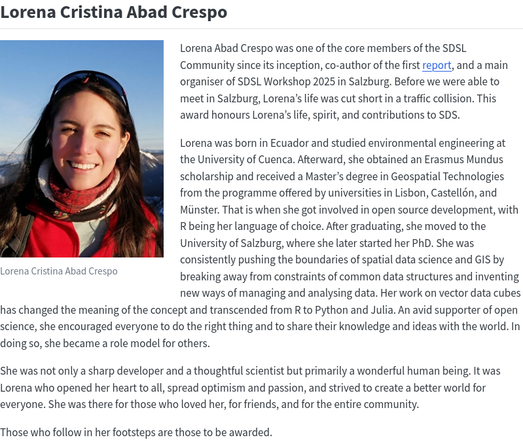
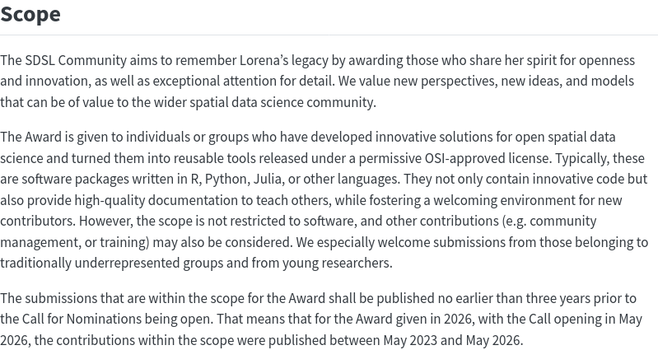
Nominations are now open for the Lorena Abad Crespo Award for Innovation in Spatial Data Science! 🎉
Know someone doing outstanding work in spatial data science, GIS, or geocomputation? Nominate them here: https://spatial-data-science.github.io/award.html
Please share widely!
Only a few days left to sign up! ⏳
On May 20 at 12 PM, the Lund Biomedicine ReproducibiliTea journal club is hosting a very special event in collaboration with ReproducibiliTea Copenhagen!
For updates and to sign up, visit the Lund Biomedicine page:
#ReproducibiliTea #OpenScience #ResearchReproducibility #AcademicCommunity #ScienceCommunication #EarlyCareerResearchers #OpenResearch
Why Are Lifeless Planets Desolate? Life as the Emergent Knot of Environmental Activity
https://zenodo.org/records/20129830
Life emerges when interactions persist long enough to reinforce and reorganize themselves. Here, I propose relational persistence (R) as a conceptual measure of an environment’s ability to sustain interactions beyond dissipation, summarizing five factors—encounter, maintenance, memory, reinforcement, and network expansion—that together determine whether chemical and physical relationships can accumulate into a self-maintaining organization. When these factors collectively exceed a threshold (R > 1), interactions become persistent, enabling the transition from transient chemistry to lifelike structure. This essay proposes a conceptual framework for understanding the emergence of life, rather than a quantitative model, and from this perspective, lifeless planets remain barren not because they lack chemical activity, but because their environments fail to sustain persistent relationships. This relational view suggests experimentally and observationally testable avenues in prebiotic chemistry and astrobiology, including enhanced network lifetimes, pattern retention, and emergent organization in structured, cyclic, and gradient-rich environments. Life may thus be understood as the first system in Earth’s history in which R exceeded 1—the first environment capable of sustaining and extending its own relationships.
“Molecules form there — but when does that become life?”
Environmental Structure and Biological Agency: A Perspective on Directionality in Living Systems
https://zenodo.org/records/20129867
#nature #originoflife #consciousness #ecology #openscience #neutrino
Life is typically explained in terms of molecular mechanisms, yet such accounts often overlook the deeper physical structures that make biological organization possible. I propose Environmental Structural Science, a conceptual framework in which biological organization emerges within layered environmental constraints extending from quantum fluctuations and interfacial electric fields to geochemical gradients and broader cosmological asymmetries, including matter-biased conditions potentially linked to neutrino-related asymmetry. These environmental layers generate directional conditions that bias chemical and organizational pathways long before life appears. Within this framework, life emerges as a self-maintaining “knot” formed through the convergence of multiple environmental constraints and flows. Consciousness is discussed as a possible higher-order extension of recursive environmental integration. Rather than proposing a unified physical theory of life and mind, this perspective emphasizes how multi-scale environmental structures may shape the emergence, stabilization, and persistence of biological agency.
RE: https://drupal.community/@SymfonyStation/116583013069445456
"Open Science
This app was created for researchers, academics, and open science communities. It was one of Bonfire's first projects and includes features for sharing publications and discussions around scientific work.
And it demonstrates the flexibility, customizing potential, and componentization capabilities of the platform. Thus, it has the most features out of the box."
Environmental Structurology: behaviour as interaction between mind and environmental structure
https://zenodo.org/records/20222178
Environmental Structurology is a conceptual approach that examines how human consciousness and behaviour emerge through interaction with environmental structures. Rather than viewing behaviour as a product generated solely inside the brain, this perspective considers action as the result of dynamic relationships between organisms and their environments. Environmental Structurology forms part of a broader framework called Environmental Structural Ecology, which investigates how environmental structures influence biological, cognitive, and social processes.
Environmental Structural Ecology: A Reconfiguration Theory of Environmental Phenomena
https://zenodo.org/records/20222103