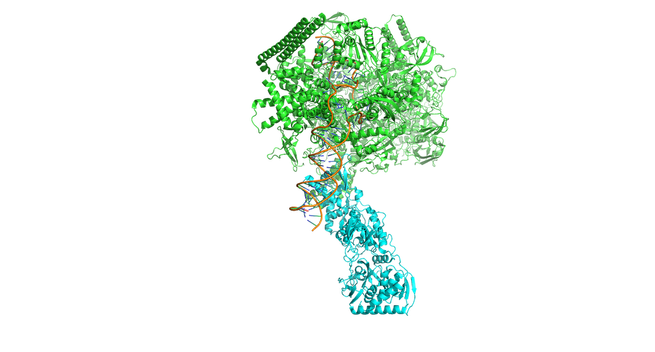
How do mycobacteria assemble their highly impermeable outer cell envelope?

In their new bioRxiv preprint, the group of Sebastian Geibel of our LED3 hub has addressed an important aspect of this question. Using cryoEM, they elucidated the structure of two long-chain acyl-CoA carboxylase (LCC) complexes that are key to mycolic acid and complex lipid biosynthesis.

Congratulations to all authors!

https://www.biorxiv.org/content/10.64898/2026.02.06.704326v2

#Chemistry #DrugDiscovery #cryoEM #structure #Mycobacteria #Tuberculosis

It has taken a lot of effort by Abhipsa Sahu to complete her work on the Lcp enzyme family involved in Mycobacterial cell envelope synthesis, but it has resulted in a splendid article.
https://link.springer.com/article/10.1186/s12866-026-04722-4

#Microbiology #Mycobacteria #CellEnvelope #smegmatis

Impairment of two non-essential LytR-cpsA-psr (Lcp) cell wall ligases decelerate cell wall assembly in Mycolicibacterium smegmatis - BMC Microbiology

The LytR-CpsA-Psr (Lcp) family of proteins are highly abundant amongst actinomycetes and Gram-positive bacteria, and known to exist as multiple paralogs in

SpringerLink
New publication: Expansion of aerobic #methanotrophy to the phylum of #Actinomycetota and its environmental implications. #biodiversity #mycobacteria #methane
https://doi.org/10.1128/aem.01334-25
Expansion of aerobic methanotrophy to the phylum of Actinomycetota and its environmental implications | Applied and Environmental Microbiology

The climate crisis is one of the most imminent threats to humanity and all life on our planet. Methane is not only the second most potent greenhouse gas (GHG) and is responsible for approximately 31% of GHG-induced global warming since the start of the industrial revolution (1) but is also the most rapid increasing GHG in the atmosphere (2). The latter is likely caused by increased microbiological production of methane from, e.g., wetlands (2). This fact stresses the importance of methanotrophic microbes that can degrade methane with and without oxygen (3, 4) and thereby fulfill a crucial role in our global climate.

Applied and Environmental Microbiology
Excited for today's symposium "A Dutch Perspective on Mycobacterial Infections" at the Faculty of Science of Leiden University. I am am looking forward to learning a lot about tuberculosis research in the talks and poster session.
#TB #Mycobacteria #Antibiotics https://www.universiteitleiden.nl/en/events/2025/03/a-dutch-perspective-on-mycobacterial-infections
Symposium: A Dutch Perspective on Mycobacterial Infections

On the 24th of March 2025, World TB day, we organize a symposium to connect the Dutch scientific community working on mycobacterial infections. We will cover all aspects of tuberculous or non-tuberculous mycobacterial infections with topics ranging from basic science to drug development, vaccines,…

Leiden University
Excited for today's symposium "A Dutch Perspective on Mycobacterial Infections" at @leidenscience.bsky.social. I am am looking forward to learning a lot about tuberculosis research in the talks and poster session. #TB #Mycobacteria #Antibiotics www.universiteitleiden.nl/en/events/20...

Symposium: A Dutch Perspective...
Leiden Science (@leidenscience.bsky.social)

Faculty of Science | University of Leiden | Discover our research, education & events | Meet the amazing people who work and study with us 🚀🔬📚 #Science #Biodiversity #Sustainability #AI #DrugDiscovery #DrugDevelopment #ComplexNetworks #Quantum #Space

Bluesky Social

A potential target for myobacteria: a publication highlight from Meharry Medical College Ph.D. candidate KeAndreya Morrison featuring a new article from the laboratory of @WeberBan_Lab of ETH Zurich.

Read more here: https://buff.ly/3c27V2w

#SBGrid #MycoBacteria #CryoEM

A potential target for myobacteria - SBGrid Community News - Medium

This publication highlight is part of the SBGrid/Meharry Medical College Communities Project, focused on science education and demonstrating how structural biology and preclinical science connect to…

SBGrid Community News
Zum 5. Mal fand am Freitag das DANish-GERman (DanGeRoUS) #Mycobacteria Club Treffen am FZB statt. Bei dem Treffen, an dem Expertinnen & Experten aus aus Dänemark, Schweden, Rumänien, Moldau, Korea & Deutschland teilnahmen, wurden klinische Fälle von #NTM und #TB-Erkrankungen präsentiert & diskutiert.
Vielen Dank an alle Teilnehmenden für dieses großartige Meeting!
#Fungi & #mycobacteria are both found in sphagnum peat bogs. This study screens bog fungi for inducible #antitubercular activity, identifying 3 distinct natural products that induce a thiol stress response in Mycobacterium #tuberculosis #PLOSBiology https://plos.io/3P3zEMJ
Environmental fungi target thiol homeostasis to compete with Mycobacterium tuberculosis

Both fungi and mycobacteria are found in sphagnum peat bogs where they compete in an acidic, nutrient-poor microenvironment. These authors screen isolated bog fungi for inducible antitubercular activity and identify three distinct natural products that target thiol homeostasis and induce a thiol stress response in Mycobacterium tuberculosis.

#Harmonine is a defense compound produced by the #Asian #ladybeetle #Harmoniaaxyridis
It is an important factor in beetle #immunity and has #BroadSpectrum #antimicrobial #activity #inhibiting the growth of #mycobacteria and demonstrating #multistage #antimalarial activity
The Asian lady beetle uses harmonine as a general hygiene measure, but switches to an effective defense strategy based on dozens of peptides when threatened

https://www.ncbi.nlm.nih.gov/pmc/articles/PMC3297383/

https://www.mpg.de/7246516/Asian-lady-beetles

Harmonine, a defence compound from the harlequin ladybird, inhibits mycobacterial growth and demonstrates multi-stage antimalarial activity

The harlequin ladybird beetle Harmonia axyridis has been introduced in many countries as a biological control agent, but has become an invasive species threatening the biodiversity of native ladybirds. Its invasive success has been attributed to its vigorous ...

PubMed Central (PMC)