Suillus wasatchicus

https://www.mushroomexpert.com/Suillus_wasatchicus.html

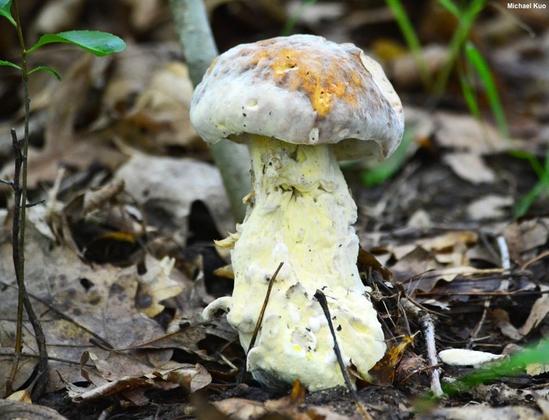
Ecology: Mycorrhizal with ponderosa pine; growing scattered or gregariously in monsoon season (late July through early September); originally described from Utah; widespread in the southern Rocky Mountains. The illustrated and described collections are from Colorado.

Cap: 3-10 cm; convex becoming broadly convex; sticky when fresh; bald; bright golden yellow to dull yellowish or nearly whitish; the margin often featuring a thin, whitish, sterile zone, especially in young specimens.

Pore Surface: Pale orange when young, becoming orangish yellow and eventually brownish yellow; with abundant orangish to pinkish or cinnamon glandular dots throughout development; 2-3 angular pores per mm; tubes to 8 mm deep.

Stem: 3-5 cm long; 1.5-3 cm thick; stout; more or less equal; dry; yellowish to bright yellow at the apex, whitish to brownish below; with conspicuous, cinnamon glandular dots that frequently become large and elongated with maturity, resulting in smears and lines; without a ring.

Flesh: Whitish in cap; pale yellow in stem; not staining on exposure.

Odor and Taste: Not distinctive.

Chemical Reactions: Ammonia pink on cap surface; pink on flesh. KOH dark purple on cap surface; purple on flesh. Iron salts negative on cap surface; blue on flesh.

Spore Print: Cinnamon brown.

Microscopic Features: Spores 6-9 x 3-3.5 m; boletoid-fusiform; smooth; hyaline in KOH; inamyloid. Basidia 18-25 x 3-5 m; subclavate; 4-sterigmate. Cystidia in gelatinized, brown bundles; often poorly defined individually; 40-90 x 6-8 m; clavate, subfusiform, or subcylindric; smooth; thin-walled; brown in KOH. Pileipellis an ixocutis; elements 2.5-5 m wide, smooth or a little encrusted, hyaline in KOH.

#mushrooms #fungi #mycology #shrooms #mushtodon #sporespondence #floraspondence
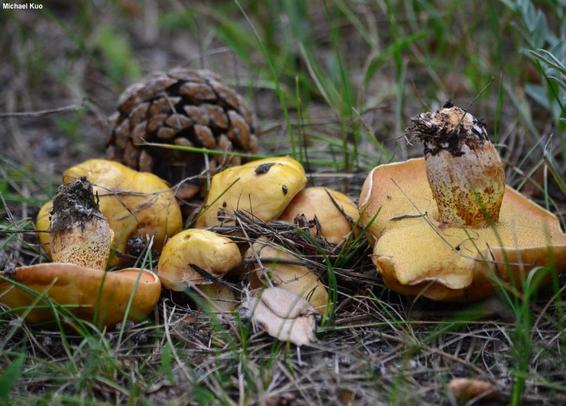
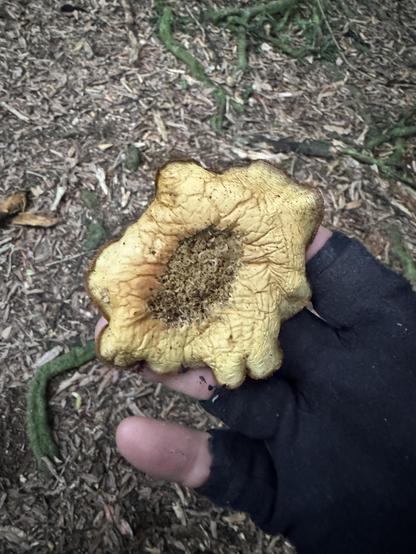
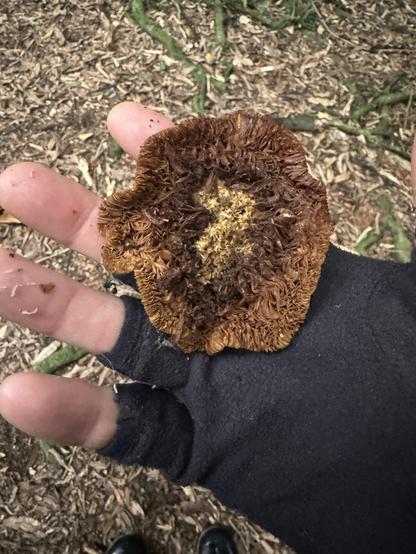
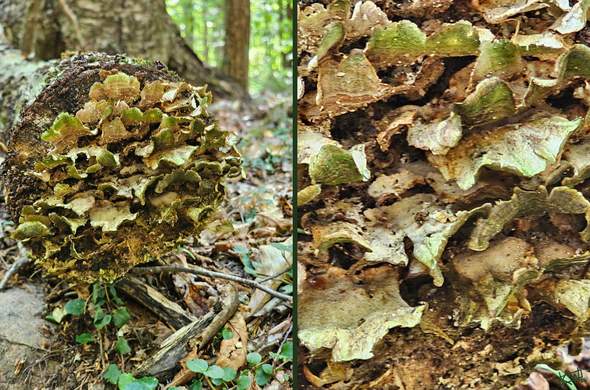
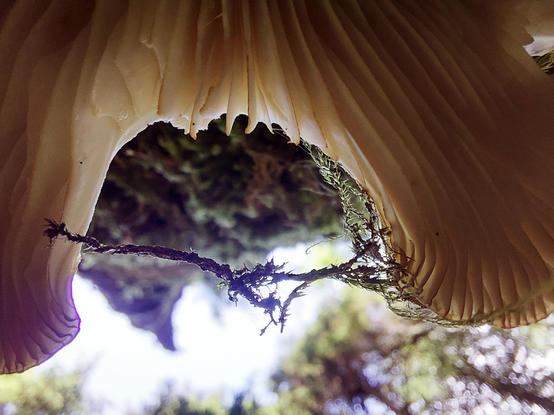
one of the very up high mushroom caps fell off almost intact (but weatherbeaten) #mushtodon

Hypomyces chrysospermus

https://www.mushroomexpert.com/Hypomyces_chrysospermus.html

Ecology: Parasitic on various species of boletes; summer and fall, or over winter in warm climates; originally described from France (Tulasne & Tulasne 1860); widely distributed in Eurasia and in North America; also recorded in Central America and Oceania. The illustrated and described collections are from Illinois and Ohio.

Fruiting Body: A mold-like covering that spreads across the bolete, eventually covering it entirely; white and tissue-like at first, becoming powdery and golden yellow, and, eventually, crustlike and brown to reddish brown.

Microscopic Features: Aleuriospores 16-22 m including ornamentation; globose; echinate with spines about 1 m long; thick-walled; golden yellow in KOH. Conidia 11-20 x 4-8 m; ellipsoid or irregularly ellipsoid; smooth; hyaline in KOH. Subicular hyphae 2-5 m wide, septate, smooth, hyaline in KOH.

#mushrooms #fungi #mycology #shrooms #mushtodon #sporespondence #floraspondence

Bolbitius coprophilus

https://www.mushroomexpert.com/Bolbitius_coprophilus.html

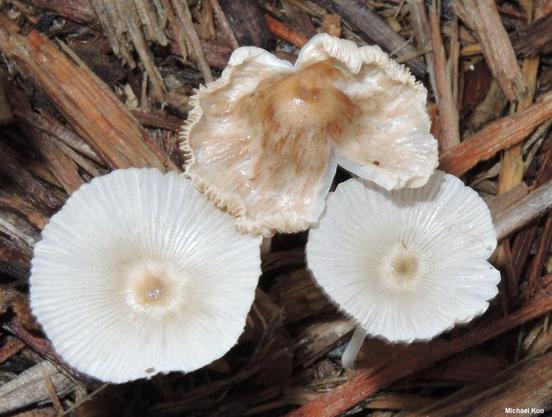
Ecology: Saprobic, decomposing dung or nitrogen-rich mulch; usually found in urban settings; growing alone or gregariously; summer and fall (and over winter in warm climates); originally described from New York (Peck 1894); widespread in Europe and in North America. The illustrated and described collection is from Illinois.

Cap: 2.5-6 cm; egg-shaped to broadly conic at first, becoming broadly bell-shaped to broadly convex and eventually flat or depressed; whitish to pinkish when young, soon becoming pinkish to pale grayish brown; sticky when fresh; bald; strongly lined, often nearly all the way to the center.

Gills: Narrowly attached to the stem; close; short-gills occasional, mostly near the margin; whitish at first, becoming faintly pinkish to brownish, then cinnamon brown.

Stem: 4-10 cm long; 2-3 mm thick; equal, with a slightly thickened base; fragile; hollowing; finely pruinose, or more or less bald; white at first, becoming pink from the apex downward; basal mycelium white.

Flesh: Insubstantial; pale brownish; unchanging when sliced.

Odor: Not distinctive.

Chemical Reactions: KOH on cap surface gray.

Spore Print: Dull cinnamon brown.

Microscopic Features: Spores 11-15 x 7-9 m; subellipsoid, with one end truncated for a 1.5-2 m pore; smooth; thick-walled; orange-brown in KOH. Basidia 20-25 x 9-12 m; abruptly clavate; 4-sterigmate. Brachybasidioles present. Cheilocystidia irregularly cylindric or lageniform; smooth; thin-walled; hyaline in KOH; collapsing. Pleurocystidia not found. Pileipellis hymeniform; terminal cells 25-30 x 7.5-10 m; clavate; smooth; hyaline in KOH.

#mushrooms #fungi #mycology #shrooms #mushtodon #sporespondence #floraspondence

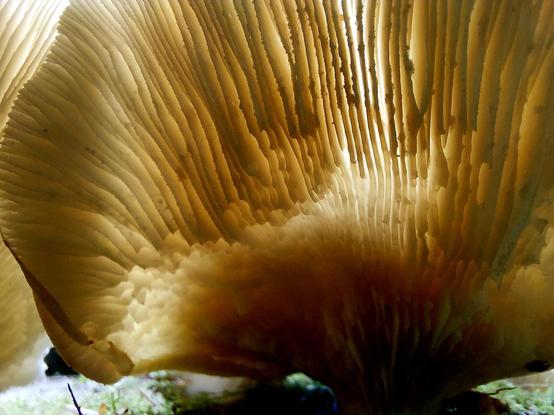
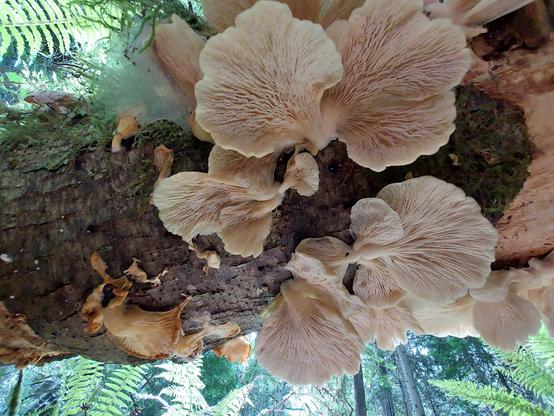
Where I live is soggy and humid, but it is also full of mushrooms and that's pretty cool 💚 🍄

#mushtodon #sporespondence #FungiFriday #NaturePhotography #mushrooms #fungi #polyporn

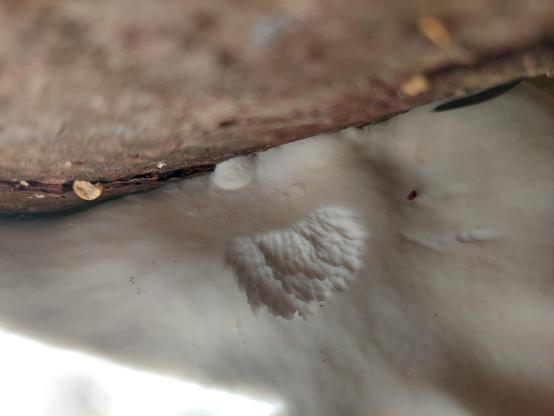
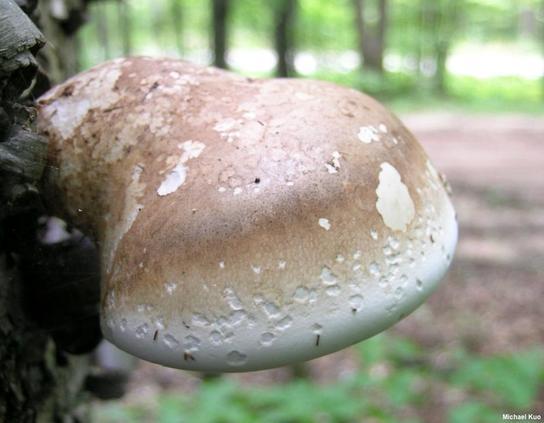
Fomitopsis betulina

https://www.mushroomexpert.com/Fomitopsis_betulina.html

Ecology: Saprobic on the deadwood of birch trees, including European white birch, paper birch, and yellow birch; also sometimes reported as parasitic on living trees; causing a brown cubical rot; growing alone or gregariously; annual; originally described from France; widespread and common in Europe, western Asia, and North America, wherever the host trees occur; also occasionally reported from South America. The illustrated and described collections are from Michigan.

Cap: At first lump-like and nearly spherical; at maturity 5-25 cm across and 4-10 cm deep; more or less semicircular in outline; convex or broadly convex; smooth or slightly roughened; whitish at first, becoming brownish and, eventually, dull brown; with a thick margin that is rolled over smoothly to form a rim around the pore surface.

Pore Surface: White, aging grayish to brownish; not bruising; with 2-4 pores per mm; tubes to 1 cm long.

Stem: Absent or rudimentary and stubby.

Flesh: White; unchanging when sliced; thick; corky.

Odor and Taste: Odor strong and fragrant when fresh; taste usually a little bitter.

Microscopic Features: Spores 4-6 x 1-1.5 m; allantoid; smooth; hyaline in KOH; inamyloid. Cystidia not found. Setae not found. Hyphal system dimitic; skeletal hyphae 3-6 m wide, smooth, thick-walled, aseptate, hyaline to slightly yellowish in KOH; generative hyphae 2-3 wide, smooth, thin-walled, hyaline in KOH, clamped.

#mushrooms #fungi #mycology #shrooms #mushtodon #sporespondence #floraspondence

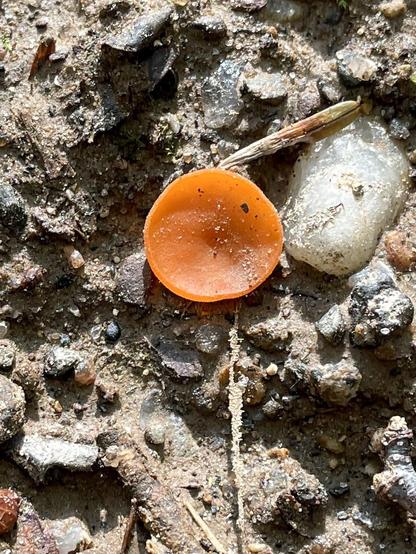
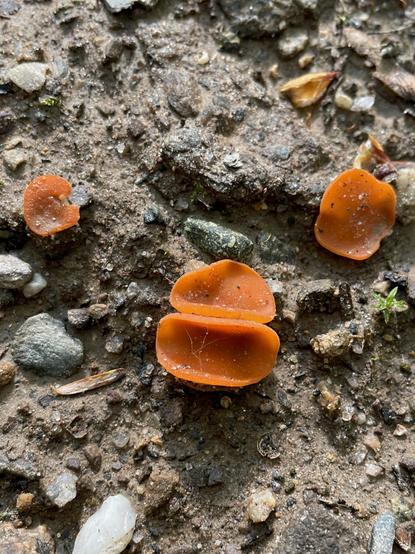
Sometimes mushrooms grow EXACTLY where the field guides say they do. 🤭

Orange Peel [Aleuria aurantia]
“often found in disturbed areas, especially on gravel”

In this case I was on an old gravel road used by trucks hauling debris.

#FungiFriday #Mushrooms #Fungi #Mushtodon

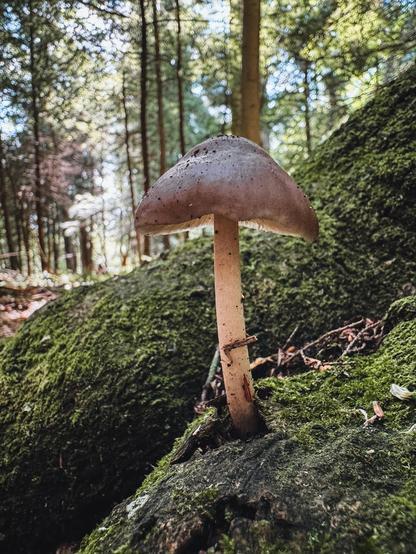
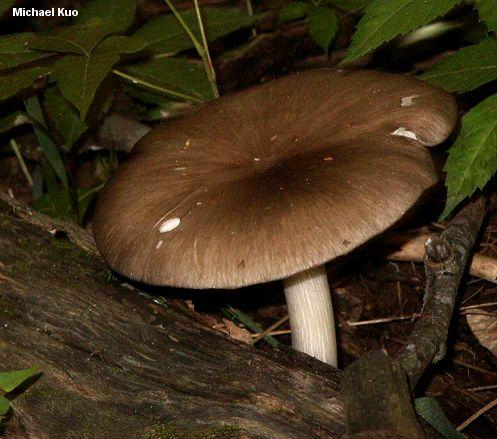
Megacollybia rodmani

https://www.mushroomexpert.com/Megacollybia_rodmani.html

Ecology: Saprobic; growing alone or gregariously on rotting hardwood logs or from buried deadwood; May through July; fairly widely distributed and common east of the Rocky Mountains, south through Mexico to Central America.

Cap: 3-20 cm; convex when young, becoming broadly convex to flat or shallowly depressed in age; dry; brown to olive brown or pale grayish brown in form rodmani; gray-brown to gray in form murina; radially streaked.

Gills: Attached to the stem broadly or narrowly; close or nearly distant; whitish.

Stem: 5-12 cm long and up to 1 cm wide in form rodmani; 5-9 cm long and up to 2.5 cm wide in form murina; finely silky; whitish; more or less equal above a slightly enlarged base--or tapering slightly to apex; base attached to copious and conspicuous rhizomorphs in form murina, or with inconspicuous or even absent rhizomorphs in form rodmani .

Flesh: Whitish, not changing when sliced.

Odor and Taste: Taste mild; odor not distinctive.

Spore Print: White.

Microscopic Features: Spores 6-10 x 5-7.5 ; smooth; ellipsoid; inamyloid. Cheilocystidia abundant; primarily clavate; to about <NOBR>60 </NOBR> long and not projecting in form rodmani; to about 80 long and usually projecting in form murina. Pileipellis a cutis of elements 4-9 wide, with brownish contents; terminal elements frequently erect, with clavate to subclavate or merely cylindric tips, 23-74 x 6-16 . Clamp connections present.

#mushrooms #fungi #mycology #shrooms #mushtodon #sporespondence #floraspondence