Release Ampliseq Version 2.17.0 · nf-core/ampliseq

nf-core/ampliseq version 2.17.0 - 2026-04-15 Summary of changes sample sheet standardization (legacy sample sheet still allowed) added Decontam for decontamination added ITSxRust alongside ITSx im...

GitHub

Accuracy of occurrence and abundance estimates from insect metabarcoding

#insect #metabarcoding #abundance #preprint

https://www.biorxiv.org/content/10.64898/2026.02.20.707016v1

Accuracy of occurrence and abundance estimates from insect metabarcoding

DNA metabarcoding - high-throughput sequencing of barcode regions from bulk samples - has become a key tool for insect biodiversity assessment. Yet, how methodological choices affect the accuracy of metabarcoding data remains insufficiently explored. In this paper, we ask: (1) How does the lysis method (non-destructive lysis vs. destructive homogenization) affect community recovery? (2) How comprehensively does metabarcoding capture species richness? (3) To what extent can spike-ins improve abundance estimates? (4) How accurately can species abundances be estimated? We evaluated the accuracy of insect metabarcoding using 4,749 bulk samples from a large-scale biodiversity survey subjected to mild lysis. Of these samples, 856 were also homogenized, allowing a systematic comparison of the effect of alternative treatments. To potentially improve abundance estimates, we added six biological spike-ins (i.e., foreign insects) to all samples, and two synthetic spike-ins (artificial DNA fragments) to the homogenization treatment. In addition, we established the contents of 15 samples by individually barcoding all specimens, enabling direct assessment of occurrence and abundance estimates. Our results revealed consistent differences between destructive and non-destructive treatments. While both methods reliably detected the majority of species, small and soft-bodied taxa were more often recovered after mild lysis than after homogenization, while the reverse was true for heavily sclerotized, hairy, and large taxa. Using biological spike-ins for calibration reduced the variance in read numbers per specimen considerably, especially in homogenized samples, while synthetic spike-ins were less effective. In a Bayesian analysis, where species data were matched to the best-fitting spike-in calibration curve, accurate abundance estimates (+/-1 individual) were obtained for 72.9% of species occurrences. Our results show that it is possible to obtain reasonably accurate abundance estimates from metabarcoding data, and that mild lysis and homogenization result in different taxon-specific biases in terms of occurrence data, with neither method outperforming the other. Accuracy is improved by homogenization rather than mild lysis of samples, and by the use of biological rather than synthetic spike-ins. Together, these findings provide a major step towards robust, quantitative biodiversity monitoring using DNA-metabarcoding. ### Competing Interest Statement The authors have declared no competing interest. Knut and Alice Wallenberg Foundation, https://ror.org/004hzzk67, 2017.088 Swedish Research Council, https://ror.org/03zttf063, 2021-04830 National Science Centre, https://ror.org/03ha2q922, 2018/31/B/NZ8/01158, 2021/43/B/NZ8/03376

bioRxiv
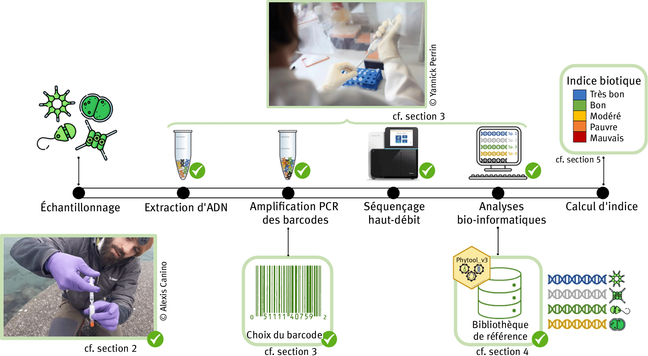
This publication is the summary of 6 years developments. All tools are freely available at
https://carrtel-collection.hub.inrae.fr/barcoding-databases/phytool
#algae #bloom #nature #ecology #science #barcoding #metabarcoding #eDNA #omics

Our new paper (in french) about metabarcoding phytoplankton in France

"Analyse du phytoplancton par l’ADN environnemental : nouveaux outils pour évaluer la qualité écologique des plans d’eau"
https://revue-set.fr/article/view/9926
#phytoplankton #edna #metabarcoding #lake

Bravo @ Clelia DURAN https://orcid.org/0009-0000-0450-3842
@ Laurine Viollaz https://orcid.org/0009-0004-9791-7962
@ Benjamin Alric https://orcid.org/0000-0003-2774-0546
@ Christophe Laplace-Treyture https://orcid.org/0000-0002-0833-473X
@ Isabelle Domaizon
https://orcid.org/0000-0001-9785-3082

“HAPP: High-accuracy pipeline for processing deep metabarcoding data” from Fredrik Ronquist’s group doi.org/10.1371/jour... #metabarcoding

HAPP: High-accuracy pipeline f...
HAPP: High-accuracy pipeline for processing deep metabarcoding data

Author summary Charting and monitoring biodiversity is essential for understanding and protecting ecosystems, but it has been difficult to collect data cost-efficiently at scale. An approach that potentially solves this problem is metabarcoding—a method that can be applied to DNA from environmental samples to identify many species at once. Unfortunately, it may produce misleading results due to noise in the data. A particularly challenging problem when analysing data from mitochondrial DNA, such as the CO1 gene often used for analysing insect biodiversity, is the existence of nuclear encoded copies of the gene that can severely inflate diversity estimates. We created an algorithm called NEEAT that helps remove such misleading signals by combining information from multiple samples and spotting unusual patterns of genetic change. We also tested many existing tools for other steps of data processing, and combined NEEAT with the best tools in creating a new, high-accuracy analysis pipeline we call HAPP. Using both simulated and real-world insect data, we show that our approach is not only more accurate than current methods but also efficient at handling large datasets. Our work aims to make biodiversity studies more precise and scalable, supporting better conservation and environmental decision-making.

Estimating Organism Abundance Using Within-Sample Haplotype Frequencies of eDNA Data

https://onlinelibrary.wiley.com/doi/pdf/10.1111/1755-0998.70104

#environmentalDNA #metabarcoding #populationGenetics

Pipeline release! nf-core/ampliseq v2.16.1 - Ampliseq release 2.16.1 2026-01-23!
Amplicon sequencing analysis workflow using DADA2 and QIIME2
Please see the changelog: https://github.com/nf-core/ampliseq/releases/tag/2.16.1

#16s #18s #ampliconsequencing #edna #illumina #iontorrent #its #metabarcoding #metagenomics #metataxonomics #microbiome #pacbio #qiime2 #rrna #taxonomicclassification #taxonomicprofiling #nfcore #openscience #nextflow #bioinformatics

Release Ampliseq release 2.16.1 2026-01-23 · nf-core/ampliseq

Two bug fixes plus modifications to adhere to Nextflow strict syntax. Fixed #943 - Fix SciLifeLab Figshare urls for reference databases. #942 - Nextflow strict syntax for non-nf-core-modules/workf...

GitHub

"The soil microbiome as an indicator of ecosystem multifunctionality in European soils"

TLDR - Reinforces the link between soil properties and microbes (bacteria and fungi) driving multiple ecosystem functions with integrated DNA metabarcoding and enzyme analysis approaches.

https://www.nature.com/articles/s41467-025-67353-9

#LUCAS #soil #metabarcoding #function #EnzymeActivity #IndicatorSpecies #monitoring

The soil microbiome as an indicator of ecosystem multifunctionality in European soils - Nature Communications

Soil microorganisms play a crucial role in maintaining ecosystem functioning across diverse environments. This study shows that soil properties and specific microbial taxa jointly shape ecosystem functioning across European soils.

Nature

Are we throwing away good data? Evaluation of chimera detection algorithms on long-read amplicons reveals high false-positive rates across algorithms

TLDR - uchime_denovo using default parameters offers the best precision and recall

https://peerj.com/articles/20456/

#DNA #metabarcoding #chimera #SimulationStudy

Are we throwing away good data? Evaluation of chimera detection algorithms on long-read amplicons reveals high false-positive rates across algorithms

Long-read amplicon sequencing has enabled us to return to full-length DNA barcodes, which benefit from the higher taxonomic resolution in metabarcoding-based biodiversity studies. However, chimeric sequences (artificial constructs formed when incomplete amplicons fuse during polymerase chain reaction (PCR)) remain challenging, potentially skewing diversity estimates and ecological inferences. Here, we benchmark three de novo chimera detection algorithms, uchime_denovo, removeBimeraDenovo, and chimeras_denovo, on simulated and empirical eukaryotic full-ITS (rRNA ITS1-5.8S-ITS2) datasets to evaluate their precision, sensitivity, and effects on the final OTUs composition/community structure. Upon simulated data, uchime_denovo achieved the highest precision even with default settings, whereas other algorithms displayed high false-positive chimera rates without setting adjustments. Similarly, the tests upon empirical data showed that uchime_denovo had lower false positive rates, whereas about half of the sequences in the putative chimeric batch were false positives when using chimeras_denovo and removeBimeraDenovo. We found that most of the false-negative chimeras contained multiple 5.8S regions, indicating PacBio library preparation artifacts rather than PCR artifacts. However, OTU-level comparisons indicated that overall richness and community-ordination patterns remain largely consistent across different chimera-filtering approaches with or without accounting for false positives and negatives.

PeerJ