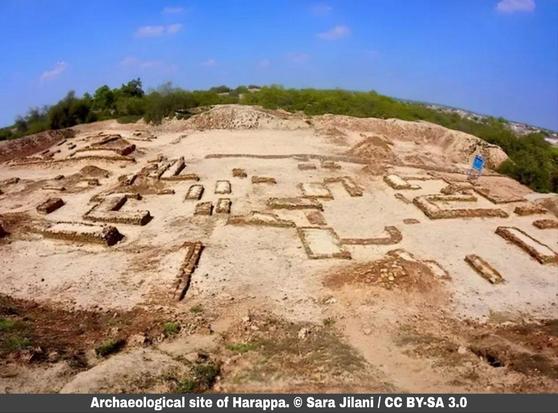
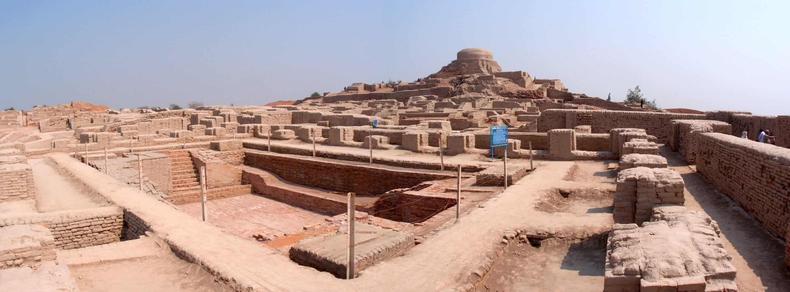
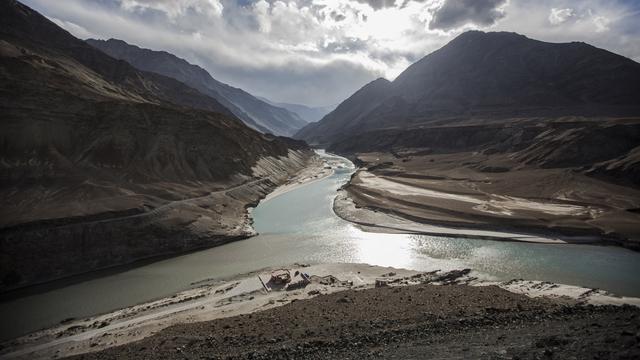
How centuries of drought doomed the Indus Valley Civilization, one of the world’s oldest civilizations

A new study provides the strongest evidence yet that long, recurring droughts played a decisive role in reshaping — and ultimately weakening — the Indus Valley Civilization, one of the world’s earliest urban societies. Flourishing between roughly 5,000 and 3,500 years ago...

More info: https://archaeologymag.com/2025/11/how-drought-doomed-indus-valley-civilization/

Follow us @archaeology

#archaeology #archeology #indusvalleycivilization #Harappa

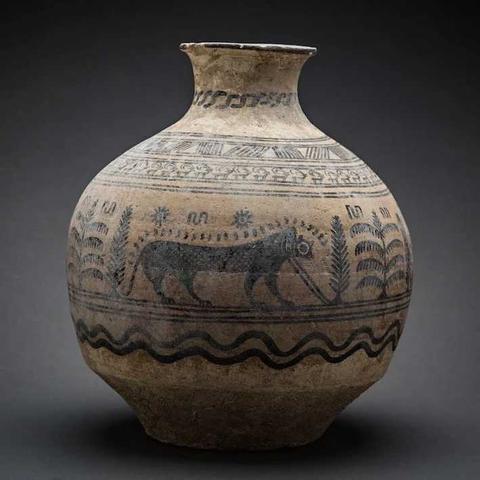
Pot of the Day: Harappan Ceramic Vessel – approx 3000–2000 BC

The Harappan Culture (also known as the Indus Valley Civilisation) was a sophisticated Bronze Age civilisation located along the banks of the Indus River, in an area that now covers most of Pakistan, northwestern India, and northeastern Afghanistan. Like the contemporaneous city-states of Mesopotamia and Egypt, the Harappan culture flourished thanks to the rich, fertile soils of the Indus delta.

This gorgeous pot, depicting tigers, snakes, a river, plants, and trees, dates from what is referred to as the Mature Harappan era (or the Urban Phase), which predates the Vedic civilisation by approximately 1,000 years. The Mature Era is characterised by its well-planned cities and the world’s first drainage systems. A standardised system of weights and measures was adopted during this time to support its prosperous trade network. Although it had become a powerful urban centre, the pottery of this time often featured naturalistic designs and motifs like this one, showing that the natural world was still very much revered.

Photo credit: barakat gallery

#pottery #history #archeology #harappancivilization #indusvalleycivilization #ceramics #ancienthistory

$1 million prize offered to decipher 5,300-year-old Indus Valley script

The government of Tamil Nadu has offered a $1-million reward for anyone who can decode the cryptic script of the Indus Valley Civilization (IVC), one of the world’s oldest urban cultures...

More information: https://archaeologymag.com/2025/01/prize-offered-to-decipher-indus-valley-script/

Follow @archaeology

#archaeology #archeology #archaeologynews #ancientlanguages #TamilNadu #indusvalleycivilization #Harappa

$1 million prize offered to decipher 5,300-year-old Indus Valley script

The government of Tamil Nadu has offered a $1-million reward for anyone who can decode the cryptic script of the Indus Valley Civilization

Archaeology News Online Magazine
MSN

Ancient genomes revealed the complex human interactions of the ancient western Tibetans

Outside the Tibetan Plateau, the western Tibetan Plateau populations interacted with both South and Central Asian populations at least 2,000 years ago, and the South Asian-related genetic influence, despite being very limited, was from the Indus Valley Civilization (IVC) migrants in Central Asia instead of the IVC populations from the Indus Valley.

‘Ancient genomes revealed the complex human interactions of the ancient western Tibetans’ (2024) ScienceDirect. https://doi.org/10.1016/j.cub.2024.04.068.

#OpenAccess #OA #Reseach #DOI #Ancient #DNA #AncientDNA #Tibet #Population #History #IndusValleyCivilization #IVC #SouthAsia #Asia #CentralAsia #Science #STEM #Genetics #Paleoanthropology #Anthropology @science @anthropology

Aryan is a designation originally meaning “civilized”, “noble”, or “free” without reference to any ethnicity. https://www.worldhistory.org/Aryan/ #History #Aryan #IndusValleyCivilization #Persia
Aryan

Aryan is a designation originally meaning “civilized”, “noble”, or “free” without reference to any ethnicity. It was first applied as a self-identifying term by a migratory group of people from Central...

World History Encyclopedia

Sumerians were known for inventiveness and were likely responsible for developing the first writing system. There are similarities in the symbols used in Sumerian and Indus Valley cultures. Do the artifacts and writings of Sumerians suggest evidence of advanced technology, astronomy, and mathematics?

#Sumer #Aliens #History #IndusValleyCivilization

https://informinx.com/ancient-sumerian-anomalies-questions-and-considerations

Ancient Sumerian Anomalies: Questions and Considerations

The Sumerians were a civilization that thrived in ancient Mesopotamia, now modern-day Iraq, from around 4000 BCE to 2000 BCE. Little is known for certain, but data and tales have been passed down, much of which is fascinating to consider. They were known for their advanced system of writing, their complex religion, and their many inventions, including the wheel, the plow, and the first known system of law. However, there are also many anomalies and mysteries associated with the Sumerians that continue to intrigue scholars and laypeople alike. Writings that have survived One of the most fascinating aspects of Sumerian

Informinx

Ucha Pind (meaning Village on a Mound) Sanghol is a village between #Chandigarh & #Ludhiana in #Punjab #India
Described as a #IndusValleyCivilization #Harappa site (c2500 BCE).
However, excavations of the site has revealed a constant human habitation upto 5th century AD.
A #Buddhist stupa, #Hindu & #Jain artefacts etc like this c2nd cent. AD #Kushan panel of a 'Yakshi piggyback riding a Yaksha'.

#AncientIndia #Art #Religion #IndianMythology #IndianHertitage #IndianHistory #Heritage #History

Two Women play #Chaturanga (#Chess) in this c1810 AD #Pahari #Painting from #Mandi (#Punjab Hill State) now in #HimachalPradesh.
Chess was invented and first played in #India as a Royal pastime.
The earliest evidence of Chess in #India comes from a Dice & few Chessmen unearthed at #Lothal in #Gujarat in 1972. These pieces are dated to around 2450 BC (over 4000 years ago).
Lothal, part of the #IndusValleyCivilization was the largest Sea Port of ancient India.
#WorldHeritageWeek #Art #Heritage