Seed for Thought

Saturday’s mail brought the first of the season’s seed catalogs. And Saturday night it snowed. The snow was just a sugar coated dusting, but it was a reminder that winter is coming—eventually—because it is forecast to be as warm as 59F/15C by next Saturday.

But today is gray and very windy and below freezing, a perfect reason to lose myself for a little while in the seed catalog. Yes, yes, I know, the garden just finished up and James picked all the collards Friday and has them fermenting—collard kraut! It’s a thing!

My internet recipe searches told me collard kraut used to be very popular across the southern United States and some people say it is even better than sauerkraut. James has ours fermenting with some garlic and crushed red pepper. I’ll let you know how it comes out.

This is the first year I’ve ever grown collards in the garden, and they’ve been a great success. Not only did they grow well, but we enjoyed eating them too. The small leaves made it fresh into salads and as they got bigger they’d get sautéed with onions and eaten as a side dish or combined with other things like tofu scramble, lentil eggs, curry, or soup. The variety I grew was “yellow cabbage” and came from a Minnesota seed company called North Circle Seeds. I asked James whether he liked the collards enough to grow them again next year, and he said that while it took him a little while to figure out how to use them and get used to cooking with them, he did indeed like them and we should definitely grow them again. Noted!

I also grew Swiss chard for the first time this year and we liked that too. I grew “bright lights” and the plant stalks and leaf vein colors ranged from golden yellow to bright red. We generally ate the leaves while they were small, chopped up in salads, which added some lovely color. The bigger leaves sometimes ended up in a stir fry. This will also make it into next year’s garden. Yum!

Tasty and nutritious!

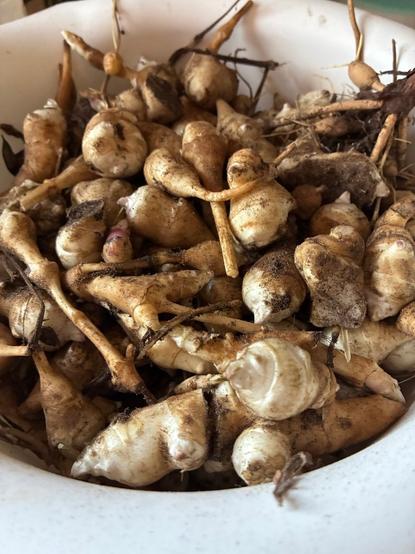
It’s sunchoke digging time! I dug up the first bowl Saturday afternoon just from one small area in the chicken garden. There are sunchokes in the chicken garden because last year I was silly enough to plant two roots along the outside of the chain link fence thinking—actually I don’t know what I was thinking. At the end of last season I dug up half a bowl of huge roots and thought, there, I’ve got them all. Yeah, right.

This year I had even more sunchokes growing along the fence outside and inside the chicken garden. So I dug and I dug and I didn’t worry about pulling out runner roots I came across because I am sure in spring I will discover that they have spread even more.

The sunchoke patch in the main garden is enormous. There will be more bowls to come as James has time to preserve them and I have time to dig and as long as the ground is not frozen. In spring when the ground thaws I will be able to dig up more, and there will be more, because I will find out as they pop up where all the runner roots have gone to this growing season. It’s a good thing we like them.

My turn for Reaping What She Sows: How Women are Rebuilding Our Broken Food System by Nancy Matsumoto came up on Friday. So far I’ve read the first chapter, “Black Mutual Aid, From the Rural South the Urban Northeast,” and it is fantastic.

As with everything in U.S. history, Black farmers have been, and continue to be, discriminated against. You can read a very good and succinct history in this September 2019 Atlantic article (gift link), The Great Land Robbery: The shameful story of how 1 million black families have been ripped from their farms.

Matsumoto tells pieces of this history in her storytelling about a number of women farmers who have created cooperatives, training and helping Black farmers acquire land, seed, and fair prices through a cooperative distribution network. The women and their stories are inspiring and full of lessons on how to support regenerative farming outside a white-supremacist agri-capitalist system.

Matsumoto is familiar with cooperatives. Her Japanese grandparents were interred during World War II and her grandfather helped create a cooperative network in the internment camps. This network became the second largest consumer co-op in the United States. Given the political and economic situation in the United States currently, I suspect we will be seeing more cooperatives and mutual aid societies popping up all over the country in the coming years.

Throughout history women have been the seed keepers, carefully saving and preserving seeds from season to season and generation to generation. A few years ago I read a wonderful novel called The Seed Keeper by Diane Wilson. It is the story of a current day Dakota woman who is gifted a cache of seeds saved by her ancestors when they ran from being attacked by U.S. troops. It is a story of healing and renewal. I was reminded of this novel while reading the first chapter of Reaping What She Sows because one of the women she profiles is a seed keeper and works for Truelove Seeds, an heirloom seed company that offers culturally important seeds.

Of course I had to look at their offerings, and wow! If you want to read more about the company, The Sierra Club has a great article about them, The Preservation of Culture Begins With a Seed I am definitely going to try and grow green striped cushaw squash! And they also have Korean hong-gochu peppers so I can make kimchi and even collard-chi next year.

The next chapter of the book is about rebuilding the grain economy. Looking forward to learning even more!

While I am on the subject of seeds, I have been a fan of Baker Creek Heirloom Seeds and bought seeds from them many times through the years. But in the last few months I’ve found out that as wholesome as they advertise themselves to be, this is not the case. In 2019 they invited a white supremacist to speak at their spring planting festival. After much uproar, they uninvited him, but issued no statement of apology or anything that I was able to discover. I have also heard that they steal seeds from indigenous peoples and then rename them and don’t acknowledge where they really came from, though I am unable to find direct confirmation of that. However, just last year the tomato they had on the cover of their catalog turned out to be a recently released GMO variety they sold as non-GMO. They said their seed came from France and they tested it and the results were inconclusive. Nonetheless, they pulled it from their stock and destroyed all the seeds.

Along with just discovering Truelove Seeds, I learned a few months ago about Native Seed Search and there is also Bertie County Seeds I just found out about. I generally buy seeds from Fedco who tell you exactly where the seeds come from (corporate grower, independent farmer, etc) and also credit and pay indigenous communities for their seeds. There is also Seed Savers Exchange. And then, as I mentioned earlier, North Circle Seeds, a small independent Minnesota seed company that sells varieties that will grow in my climate.

I guess I am getting a lesson in seed keeping and seed companies that I hadn’t thought much about before. Seeds are more than hybrid, open-pollinated, heirloom, GMO, organic. It’s important to know their origins and to make sure the people who have stewarded them are acknowledged and compensated. For some reason I always believed this was the case, but it turns out to be otherwise.

#collardKraut #collards #cooperatives #firstSnow #NorthCircleSeeds #seedCatalogs #seedKeepers #seedSaving #seeds #sunchokes #swissChard #TrueloveSeeds

#Collards getting harvested from the #garden today.

#GrowYourOwn #GardeningMastodon #Harvest

[How-To Video] Cooking With the #Maine #Harvest: Using Unusual Maine Vegetables

"University of Maine Cooperative Extension staff demonstrate how to use #RootVegetables such as #rutabaga, #celeriac, #kohlrabi, and #fennel, as well as winter greens like #BokChoy, #collards, and #MustardGreens."

Watch:
https://www.youtube.com/watch?v=L4lYPygVW0k&t=56s

#SolarPunkSunday #FoodSecurity #FoodPreparation #EatingSeasonally #Recipes #WinterVegetables #MaineHarvest

Cooking With the Maine Harvest: Using Unusual Maine Vegetables

YouTube

When the weather starts getting colder, one of my go-to comfort foods is collards! I cook mine Southern-style, with a ham hock. I like to cook them at a gentle simmer. This one is right where I want it!

#collards #cooking #comfortfood #simmer

Garden Dreaming

Autumn was long and warm, and then suddenly it was over. Upper 30sF one day and the next 20F with single digit wind chill. My body was not ready for such a drastic change. Mid-morning at work I’d get ravenously hungry. What’s going on? And then I remembered, oh yeah, biking in the really cold weather takes more energy. At night James and I would fall into bed, exhausted. I’m not sure I’ve completely acclimated yet, but I’m getting there.

Before the cold hit we managed to finish all of our outdoor chores and get the chicken coop winterized. On the last truly nice weekend day we even managed to meet a friend for breakfast. And now I am ready to draw inwards and slow down, hibernate a little.

Thanksgiving at my house this last Thursday was a quiet affair, just James and I. James made our “traditional” vegan meal of enchiladas and pumpkin pie. The pumpkins we grew in the garden this year. The variety is naked bear, a pepita pumpkin that is also sweet enough for pie, an uncommon 2-in-1! I grew Lady Godiva one year and got several huge pumpkins full of delicious pepitas. James tried cooking the pumpkin flesh and it was so bland that no amount of spice could save it. Sadly, naked bear is an f-1 hybrid, but I saved a few seeds anyway and we’ll see how they grow out.

The seed catalogs began arriving several weeks ago. I planned on saving them and not looking at them until Thanksgiving. How long do you think that plan lasted?

I must say, I was pretty proud of myself for making it an entire 24 hours before tearing through the first arriving catalog. The second one I managed to make it a couple hours. The third one, I took it out of the mailbox and immediately started paging through it.

But even though I looked through them all sooner than I had planned, I still sat down Friday morning and looked through them all again, going to the websites and creating my wishlists as though I had all the garden space and time for working in it in the world.

After lunch it was time to look reality in the face. I began to whittle things down. Then I compared prices across seed companies. And then I whittled some more. I saved so many seeds last year that I was’t planning on buying much this year. But I recently decided that I want to include more herbs and medicinal plants in the garden, and that plumped up my seed list significantly. It plumped so alarmingly that it has taken some deep thought about what, exactly, I am hoping to accomplish.

With the help of some kind folks on Mastodon, the Plants For a Future database, and Midwest Medicinal Plants, I decided to cut out everything that used only roots and bark or that required tinctures made with alcohol. We are a sober household and making medicine with vodka is a hard no. That still left quite a few plants for teas and salves.

Next I cut out ones that are potentially invasive, take up large amounts of space, or prefer moist areas—something my sandy soil cannot offer. That still left a lot. So then I decided to favor plants that could grow in shade or part shade, had culinary and medicinal uses, are easy to grow, or just had pretty flowers attractive to pollinators. And that did the trick. In a year’s time, I can get seeds to some of the ones I cut from my list this year.

In addition to food, herbs, and medicine, James is reading a book about night time critters and asked if we could grow some flowers for moths. After doing some research I came up with a list and will be getting seeds for moonflower, evening stock, evening primrose, and nicotiana.

I’ve not placed any orders yet, it’s still early. And I may cut a few more things from my list. I was going to try growing collards and Swiss chard but do I want to do both? And if I only do one, which one? I have zero luck with beets, will I have better luck with chard? I also have zero luck with cabbage. Will I have better luck with collards? I suppose there is only one real way to find out.

Also, I can’t decide whether I want to try growing long beans. Has anyone grown them? Are they worth it for more than their unusualness?

While the weather outside is frigid, spending my long holiday weekend garden dreaming has been lovely. Once I finalize my seed list, I will be sure to post it here.

On a side note, I am very behind in replying to kind comments y’all have made. I will endeavor to catch up on that in the next few days!

Reading

Quote

“To name the world as gift is to feel your membership in the web of reciprocity. It makes you happy—and it makes you accountable. Conceiving of something as a gift changes your relationship to it in a profound way, even though the physical makeup of the “thing” has not changed. A woolly knit hat that you purchase at the store will keep you warm regardless of its origin, but if it was hand-knit by your favorite auntie, then you are in relationship to that “thing” in a very different way: you are responsible for it, and your gratitude has motive force in the world. You’re likely to take much better care of the gift hat than of the commodity hat, because the gift hat is knit of relationships. This is the power of gift thinking. I imagine if we acknowledged that everything we consume is the gift of Mother Earth, we would take better care of what we are given.”

~Robin Wall Kimmerer, The Serviceberry, page 22-23

Listening

  • Podcast: Planet Critical: The Plastic Crisis with Jane van Dis. Jane van Dis is a medical doctor specializing in obstetrics and gynecology. When her patients started having more and more medical issues, she began investigating the effects of plastics and petrochemicals on our health. If you’ve been on the fence over cutting down plastics in your life, after listening to this podcast you will be horrified and motivated to change. James and I have been cutting out plastics but have hit a plateau. I feel another plastic purge coming on.
  • Podcast: The War on Cars: Cars are done with Adam McKay. McKay is the director of the films Don’t Look Up, The Big Short, and many others. McKay thinks the age of the car is over but people just haven’t realized it yet. He also talks about his movie directing career and what led him to do Don’t Look Up.

Watching

  • Movie: Paterson (2016). Starring Adam Driver as a man named Paterson who lives and works as a bus driver in Paterson, New Jersey. It is a beautiful, quiet movie that takes place over the course of a week. It’s full of poetry and the small details that make up a life. James and I both loved it.

James’s Kitchen Wizardry

James has been making magic these last couple of weeks. We’ve had spaghetti squash chow mein, and of course our Thanksgiving enchiladas and pumpkin pie (best vegan pumpkin pie recipe ever from Vegan Pie in the Sky). And week before last he made up a recipe for what he called a cookie cake: chocolate cookie on the bottom, peanut butter cookie in the middle, and chocolate chip cookie on top. Mmmmm

#collards #longBeans #medicinalHerbs #mothGardening #pumpkins #seedCatalogs #swissChard

PFAF

7000 rare and unusual plants with edible, medicinal or other uses. We place emphasis on creating an ecologically sustainable environment with perennial plants.

Creamed Collard Greens

If you love creamed spinach, you will adore this Southern spin on creamed collard greens. Tender greens are sauteed with onion, garlic and heavy cream.

The Cooking Bride
Dinner tonight

Another improvised dinner. The “before” photo above is missing a few items included in the list of ingredients: 1/2 large red onion, chopped 8 medium cloves red garlic, chopped small an…

Later On

Another bowl of #unsolicitednoods for breakfast. Today featuring smoked #mussels, some #collards, 1 #avocado, bunch of #cilantro, 3 #scallions, and 2 #radishes.

It's a happy seafood-focused hug for my mouth.

#ramen #noodles #nongshim #foodporn #food

Collards and (Purple) Kohlrabi Stew

I read also the idea of shredding kohlrabi leaves and combining with shredded cabbage to make a slaw.

This recipe tastes good and will see me through several meals.

https://leisureguy.ca/2024/07/18/kohlrabi-collards/

@vegancooking @wfpb
#food #recipe #WFPB #vegan #vegetarian #omnivore #health #cooking #kohlrabi #collards

Kohlrabi & Collards Stew

Not shown: Black lentils & purple barley; collards are covered by kohlrabi leaves I found various things that looked as though they would make a good stew, so I got out my 6-qt pot and started …

Later On
Still harvesting #collards 🥬! Having fun looking at cookbooks 📚 for new recipes. #GardeningMastodon #GrowYourOwn #Food