 Accidental Tech Podcast
656: A Long T-Shirt
https://atp.fm/656
The iPhone event! Reactions and analysis of the iPhone 17, 17 Pro, and Air; the Apple Watch Series 11, SE 3, and Ultra 3; and the AirPods Pro 3.
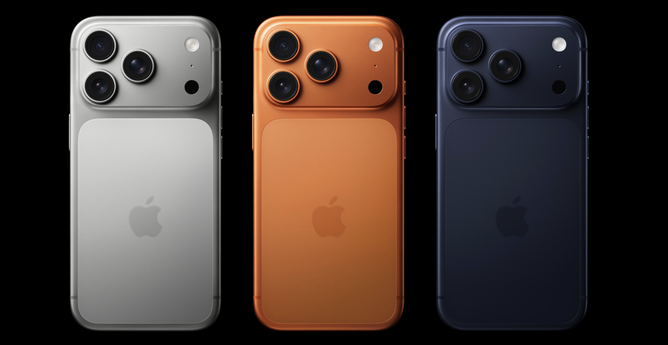
656: A Long T-Shirt
https://atp.fm/656
The iPhone event! Reactions and analysis of the iPhone 17, 17 Pro, and Air; the Apple Watch Series 11, SE 3, and Ultra 3; and the AirPods Pro 3.
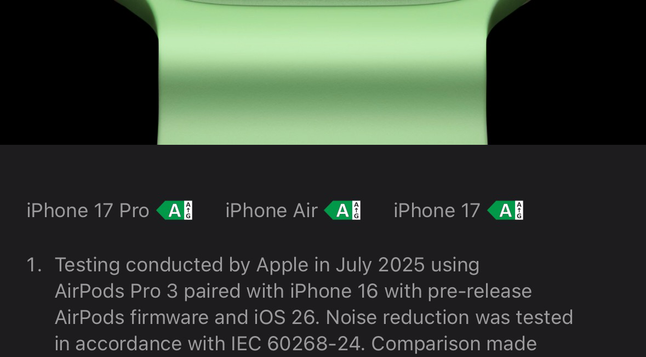
@atpfm also, the product information sheet that accompanies the energy certificate gives a standardised measure of the screen scratch resistance.
General link: https://regulatoryinfo.apple.com/energylabels
iPhone 17 Pro specific product information sheet link: https://regulatoryinfo.apple.com/cwt/api/ext/file?fileId=energyLabels/A3523_V1/A3523/A3523_Product_Information_Sheet_EN_EU.pdf
See pages 10 & 11 of this pdf for the standard battery methodology that is used for this energy label: https://regulatoryinfo.apple.com/cwt/api/ext/file?fileId=whitePaperEnergyLabels%2FEU_Energy_Label_for_iPhone_and_iPad_EN_1749628569689.pdf
2/3
@atpfm The specifics for comparison are:
Battery: "endurance duration" (capacity)
- Air: 40h (3149 mAh)
- 17: 41h (3692 mAh)
- 17 Pro: 47h (4252 mAh)
- 17 Pro Max: 53h (5088 mAh)
- 16 (2024): 37h (3561 mAh)
Scratch resistance (Mohs hardness)
- Air: 5
- 17: 5
- 17 Pro: 5
- 17 Pro Max: 5
- 16 (2024): 4
Workload (see attached image) is different to Apple's historic battery metrics from their website, hence the different numbers, but this one will be comparable between generations
3/3

@yertle @stillmoms @sharding @atpfm @marcoarment That’s a hyperbolic take on what I said - obviously there has to be *some* rational substance behind their improvement claims.
But the second half of your reply proves the point - these cameras are so different in how they work compared to conventional cameras that direct comparisons are hard to make, and may not be meaningful. APS-C and glass won’t fit in your pocket either - different tools for different needs.
@niekvdpas Past 5x, your 16 Pro is getting to 12 MP by upscaling. Not too different than taking a small image into Photoshop and using “image size” to make it larger.
With the new 48 MP sensor, the 4x lens is able to capture a 12 MP image at 8x just by using the pixels in the center. In other words, cropping rather than scaling.
@niekvdpas In other words, your 16 Pro is making up pixels, while the 17 Pro is actually capturing them. The 17 Pro’s image is going to look a lot better. (And that’s before we even get to the fact that the 17 Pro has a physically larger sensor.)
(Also worth noting that this is also how the 48 MP 1x/2x lens has worked for the last few generations.)
@niekvdpas @sharding @atpfm the 8x at 12MP on your 16 Pro is the 5x camera with a 12MP sensor using software to effectively expand the pixels in the middle of the image back up to 12MP. It’s inventing the values of some of the pixels because there simply weren’t enough sensor pixels to capture 12MP at that resolution.
In contrast, the 17 Pro has a 48MP sensor behind that 4x camera. This allows them to ignore the outer 36MP of the sensor; take a crop from the central 12MP and get an 8x image where every pixel in the photo was given data from a real sensor pixel. This is far better quality at 8x than your 16 Pro can do.
@sharding @atpfm I’m a bit torn on this. If a device has a separate 12mp 2× and 48mp 1× camera, then even if the sensors were technically identical (same pixel pitch), it definitely has two cameras.
I think where they are misleading is they do not emphasise the *sensor size* differences for each “lens”.

@emi_dubyu @sharding @atpfm I read it that your complaint was they weren't calling out that the second “lens” was only 12mp, you'd said that if a phone had two sensors at the pixel pitch they’d still be sensors. And the two modes of the telephoto are at the same pitch.
I'm also not sure how I feel about them leaning on them being different cameras/lenses. Although to normal people I expect they'll perform as if you had two different lenses/sensors (unless there are actual lens limitations)
@andynormancx @sharding @atpfm
I wish the standard was to list sensor sizes with metric dimensions. Or at least a metric diagonal. As a European I hate the fractional inches.
In the case of the iPhone, that would make the 4× sensor something like 10 by 7.5mm and the 8× would be a equivalent to a quarter of that area, 5 by 3.75mm.

@atpfm thoughts as I listen along (I've not finished, apologies if you address this later).
Firstly, I've worked internationally and currently work in an area with a large number of English as a second language speakers.
Having live translation in your ears requires a huge amount of trust in the translation being accurate. I find that with Google translate the other speaker in a conversation will occasionally see their own language transcription is inaccurate and correct it, even before the translation process (itself not always reliable).
Taking this visual cue away mean the other person will not know if they were understood correctly before they're translated. Honestly I don't trust the Siri company to get this bit right, regardless of what they then translate.
Secondly, regarding blood pressure monitoring. My watch currently offers this, but I rarely use it. Without the ability to directly apply pressure, it relies on frequent calibration with a 'real' blood pressure cuff. I've occasionally calibrated my watch when I've been to the docs/hospital but rarely check after that. If I needed to check my blood pressure regularly I would have to buy a cuff to calibrate my watch - and would probably just end up using the cuff anyway as it's more reliable.
Until Apple can find a way to measure blood pressure without relying on an external calibration, I can't see them trying to add it to the watch.
@aijcb @atpfm
Jobs’ quote was another way of saying form should follow function—a concept neither Ive nor Dye seemed to fully embrace.
Apple products were always beautiful, but more importantly they were very easy to use and accomplished more with less.
Today’s Apple is more focused on superficial novelty while making everything harder for end users, unless they willingly accept the computer’s transformation from “a bicycle for the mind” to a La-Z-Boy chair for passive content consumption.
@aijcb @atpfm
For the iPhone Air, the result was a thinner phone. Nice engineering feat and maybe attractive to some customers, but that doesn’t make it easier to use or more capable of accomplishing tasks.
Thin and light had far greater impact back when computers were all bulky and heavy. Now it’s just aesthetics and braggadocio.
The greatest opportunities now lie with software, while Apple is doubling down on hardware.

@atpfm Looks like the iPhone Air MagSafe battery does have a USB-C port that can charge smaller accessories.
https://www.macrumors.com/2025/09/11/iphone-air-magsafe-battery-usb-c-charging/
@atpfm I’m perplexed why you guys didn’t say a word that #Apple still continues their absolute BS USB2.0 speeds from literally the year 2000 in all non-Pro phones!
How come you care about 120hz on #iPhone17 but not about the fact that it takes literally 20 times longer to transfer files?!
5 minutes vs 1.5+ hours!
And Airdrop is still way slower and less reliable than the cable btw!
Why’s nobody calling Apple out on this absolute nonsense now that they’re using USB-C!
@siracusa Nice, can’t wait!
I sincerely hope we can all collectively pressure Apple to at least give us the USB speeds from the year — checks notes:
1. 2008 — 5Gbit/s, (USB3.0)
2. 2013 — 10Gbit/s (USB3.1)
3. 2017 — 20Gbit/s (USB3.2)
4. 2019 — 40Gbit/s (USB4)
5. 2022 — 80Gbit/s (USB4v2)
🤦🏻♂️🫠
Anything over current year 2000 - 0.48Gbit/s (USB2.0) will be an improvement🙄
 Christian Kent 𝘊𝘒 :\﹥
 g_hill
 Jimmy
Jimmy John Siracusa
 Sean Harding
 Matt Killmon
 David Cohen
 yertle
 Niek van de Pas
 Jeremy Kanter
 Stuart McHattie 👨🏼💻
 Andy Norman
 QuarterSwede
 Lee
Lee Blaze Sanders
 Ayo^
Ayo^ sayrer
 Phoenix Horton
 Jake Bowling
 Thom Bullock
 Andrew White
 Eric deRuiter
 Warren TenBrook
 FreediverX
 Eric Smalling
 Jonathan Broadbent
 Michael Brown
 Justin Waring 🐋
 Jay
Jay
 Pedro Fernandes
 Hadi Turk
 Frytech
 Derek Ledbetter