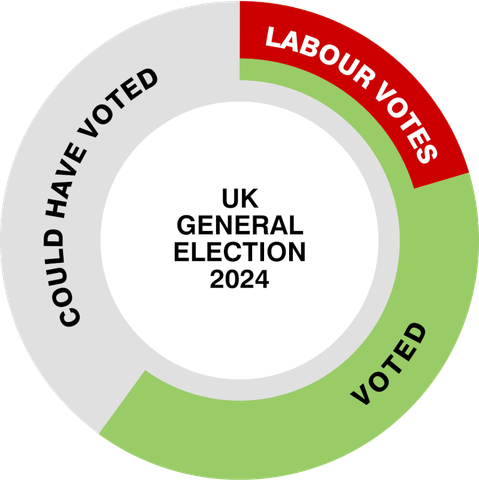
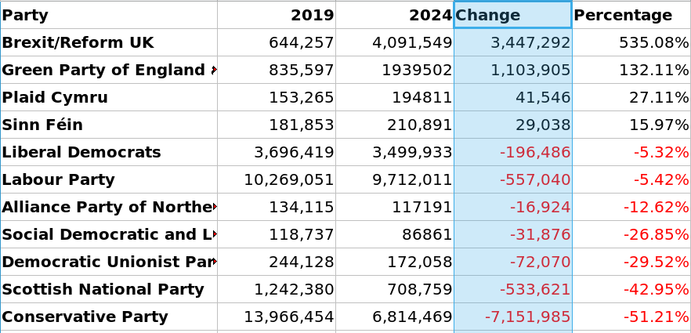
OK, the first thing to say about #GeneralElectionUK 2024 is this: #Labour lost, and lost badly. They lost, in fact, HALF A MILLION VOTES compared to their 2019 result.

All the major parties, including the #LibDems, lost. Labour just lost less badly than either the #Conservatives or the #SNP.

#UKPol
#ScotPol

https://www.journeyman.cc/blog/posts-output/2024-07-06-the-election-and-after/
The election, and after

In any election in a reasonably democratic voting system — such as that used for the Scottish Parliament and the Welsh Senedd, for example — the number of seats in the resulting parliament assigned to a party is proportional to the number seats they won. So any party or coalition capable of forming a government must have a proportion of the vote close to, or exceeding, a majority. Britain isn't like that, of course. Britain isn't a well-functioning anything at all, still less a well functioning democracy.

The Fool on the Hill

The second thing is that all these parties will now tack right. #Labour's right wingers are in the ascendant (falsely) claiming a victory -- and will have to contrast themselves against a group of #Greens and independents to their left.

The less toxic #Tories have disproportionately lost their seats, leaving more extreme Tories; who will seek to reclaim votes from #Reform. The #LibDems will target more ex-Tories. And the #SNP will try to win votes back from Labour.

#GeneralElectionUK

The third thing is that -- at least here -- the poorest and most disadvantaged had lowest turnout. Now, you may say that the lumpenproletariat never vote, that they are systematically uninformed, that that's their choice, and so on. But none of the parties had an offering that was attractive to the marginalised, and that was THEIR choice.

40% of REGISTERED voters didn't vote at all, which is larger than the number who voted for the "winning" party. There's LOTS of votes to be won there.

Finally: to those responding saying 'well, ACTUALLY, #Labour DID win because they've got the majority of seats in Westminster': no.

The Labour party won one third of the votes in an election in which under two thirds of the electorate voted. Fewer than ONE IN FIVE voters in Britain support this government. It has no mandate to do anything. If it tries, then, like Thatcher with the poll tax, it will find the difference between Westminster games and real politics.

To govern, you need consent.

@simon_brooke my hot take is that first past the post systems are fundamentally at odds with having a functional democracy
@yogthos very strong agree. In fact they're designed to prevent functioning democracy.
@simon_brooke indeed it's a feature, not a bug
@yogthos @simon_brooke
Hence why Hungary's Orban engineered a new voting system based on FPTP. It's way more likely to produce right wing governemnts.
@AndiiB @simon_brooke all capitalist societies produce governments that are fundamentally right wing because they represent the interests of capital first and foremost, it's just more obvious in some places than others
@simon_brooke So who should govern?
Who has got consent?
And I don’t mean you explaining how the voting system is flawed, I mean, if not the Labour government, who should govern today?
@gailnearedinburgh A party -- or coalition -- with more than 50% of the votes cast. Which, in a proportional system (like #Holyrood's), you get automatically. And we need much higher turnout, for which we need policy programmed which will actually make the lives of ordinary folk better. For which we need politicians who represent ordinary folk -- not Oxford PPE graduates.
@simon_brooke of course. But that would mean the ‘winning’ party hand over their advantage (for want of a better word). That’s never going to happen whichever colour gets in.
So here we are.
@simon_brooke your calculations ignore people like me who voted LibDem but wanted to vote Green. Without PR, any attempt to analyse or make sense of the outcome is a flawed exercise.
#PRNow

@dave true, but it's the best data we have. I voted #Green (in a three way marginal) knowing my vote wouldn't significantly affect the outcome this time, because I think it's more important for ALL the parties to know that there are a significant number of folk who would actually like the planet to be saved, than which particular one of three almost identical parties got in here.

Yes, I am describing #Conservatives, #Labour and #SNP as 'almost identical'. They're in descending order of evil...

@dave @simon_brooke i think i agree with this. Predictions were for a landslide labour win, many seats were safe labour victories, how many people stayed home because they were happy to let labour win, and just couldnt be bothered to add 1 more vote? iow what percentage of voters were actually expressing tacit *support* for labour? You just cant tell.
@simon_brooke so Labour should just continue existing Tory policies with no change?
@lyda that is exactly what #Labour say they're going to do. Do you think they're lying?
@simon_brooke and also the youngest age group had by far the least turnout....something we should bear in mind as the higher education system collapses and school leaver job prospects diminish even further. Oh...and as we cook the planet...

@simon_brooke

It’s my understanding that when foreigners refrain from voting, it’s in recognition of the illegitimacy of the electoral system, but when people in your own country refrain from voting, it’s because they’re lazy and treasonous.

@simon_brooke Yep, someone said not voting means you're ok with the status quo. I agree with you, it's that they didn't think anyone available would change the status quo.
@yesterzine @simon_brooke Those not voting probably also felt their vote wouldn’t count (and let’s face it that is often true), as well as that no party had their views in mind or anything to offer for the future.
@nusher @simon_brooke Understandable, although I have just worked out my area flipped for the first time in 100 years despite Labour getting 250 fewer votes here than in 2019. (I'll admit to being one of the 250 they lost)

@simon_brooke lets hope there won't be any further tacking right: there's absolutely no need. And policy-wise LDs are actually to the left of Labour.

In the South West the only thing that stopped an almost complete Tory wipeout* was the unwillingness of some Labour, LD and Green voters to tactically switch to the other party.

* 2 of the 5 surviving Tory seats had really small majorities (61 and 131) and in the others their majority was much less than the vote for the other 2 more progressive parties not placed 2nd.

@simon_brooke oh no.. what the hey is happening on those islands :(
@reinhilde I know. We're in incredibly deep shit. What's worse: I think all the major parties are going to triangulate right: the #Tories to try to recover some votes from #ReformUK, and all the others to try to feast on the undead corpse of the Tories.
@simon_brooke I weep for the countries mine has so greedily stolen from.

@simon_brooke No, Labour did not lose, because they won this election against this Tory party. They were not fighting an election against Corbyn (who lost both his elections). FPTP is a rotten system which nearly always favours the Tories. This time it didn't. I'm no fan of Starmer, but he has legitimately won this UK election under this system.

All the noise about how Labour hasn't "really" won reminds me of nothing so much as Trump's insistence that he "really" won the last US election.

@simon_brooke Low turnout shows disillusionment in politics in general arguably due to the chaos of the last few years.

But an election is not just a count of votes it’s a poll of sentiment too. Across those who didn’t vote you’ll find sentiment split in roughly similar proportions to the actual counted votes. Just those people did not feel engaged enough to cast an actual ballot.
This is a problem. But it’s not true to suggest “none of the above” took 40% of the sentiment.

@TallVenti No, you definitely WON'T "find sentiment split in roughly similar proportions to the actual counted votes".

In the 2014 #IndyRef, canvassing showed that the 'sink estates' were very solidly pro-Yes. But we failed to get that vote out: turn out of those potential 'Yes' voters was very low. Similarly, in this election, the groups in the population #Corbyn motivated didn't turn out: there was no one for them to vote for.

@TallVenti In constituencies where there were notable left candidates, turnout was higher:

Chingford and Woodford Green (Faiza Shaheen) 65%;
Islington North (Corbyn) 67%;

(I haven't yet found anyone who has collated turnout data by constituency so these results are cherry-picked -- they do support my theory but they are not conclusive)

@simon_brooke yes you will. Sorry to burst your bubble.

An actual election poll has just been held where millions of votes have been cast. The make up of the population who did not vote will be have similar sentiment as actual votes.

It’s literally how polling works. The difference is you have millions of actual votes to show the trend.

The question why people did not vote is more interesting question and will have many answers. One of which maybe “none of the above”

@simon_brooke

Interesting table. There are obviously some special factors in play - eg. for the SNP and DUP - but it does tend to confirm the big changes in voter behaviour that were already pretty clear in many 'western democracies':
1. Declining turnout; and
2. Movement to political extremes.

I would argue these are both in fact symptoms of disillusion with the 'moderate' political centre and its rotating duopoly that never seems to really affect people's lives.

But I have to say, even though I'm familiar with this trend, I was surprised that given just how appalling the Tory government has been - and not just its policies, but divided and incompetent and corrupt too - less than 60% of the electorate were motivated enough to try to vote them out.

@simon_brooke

Another interesting table - from the Electoral Reform Society - contrasting the current FPTP result with what it would have been under the proportional AMS system used for the Scottish Assembly, etc... Labour would now be negotiating a coalition (with the LibDems and Greens?).

@GeofCox Got a link, please?

@GeofCox OK, found it. It's towards the bottom of their current front page, here:

https://election2024.electoral-reform.org.uk/

Of course, that isn't very helpful in finding a permanent reference to it, and of course the page has no internal anchors. I wish people wouldn't construct web sites like this!

Electoral Reform Society

Electoral Reform Society - 2024 General Election Results

@GeofCox @simon_brooke are the figures for SNP and Plaid proportional of the overall vote or of the votes cast respectively in Scotland and Wales?
@JeniParsons @GeofCox In that table, overall vote. The figure for the SNP in Scotland is 30%.
@GeofCox @simon_brooke every time someone seems surprised at the low turnout without mentioning the voter suppression law the Tories passed specifically to lower the turnout, I wonder if I'm missing something.

@petealexharris @GeofCox Indeed. In the polling station I worked in on Thursday, every single voter presented valid (and legally acceptable) id; one voter first presented an id we weren't allowed to accept, but then was able to produce one we were.

However, there is absolutely no way of knowing how many people were deterred from attending because they didn't have valid id.

@GeofCox @petealexharris @simon_brooke If you wanted to increase turnout, you’d make it as easy as possible to vote. Enable voting in any polling station. The polling cards they send out could double as voting slips - just fill in your cross and drop it in. At the count you’d have a separate area for ‘outside’ votes which would then be communicated to the appropriate constituency. There wouldn’t be that many in most areas.

@seb321 @GeofCox @petealexharris Indeed. And given the number of separate envelopes we have to return anyway, one more would not be a great deal of extra hassle.

https://www.electoralcommission.org.uk/sites/default/files/pdf_file/Polling-station-handbook-UKPE.pdf#page=21

@simon_brooke @seb321 @petealexharris

It's true of course that voter suppression and other factors are in play in the UK, and some other countries - but declining turnout is an almost universal, long-term trend across 'western democracies', so I think you also have to look for factors common to all these countries that are increasingly driving people to give up on voting.

@simon_brooke @seb321 @petealexharris

“The number of times I heard: ‘I hope you’re not from Labour, mate.’ Or: ‘I hope you’re not from the Tories, mate,’ ‘I ain’t going to vote, there’s no point.’ We were hearing that repeatedly,... “There’s apathy, there’s disenfranchisement. They just feel that the two parties don’t represent them.”

https://www.theguardian.com/politics/article/2024/jul/06/shockat-adam-independent-muslim-mp-leicester-south-victory-not-sectarian

Independent Muslim who beat Labour in Leicester says victory was not ‘sectarian’

Shockat Adam says he is not a single-issue MP, but will fight on NHS and housing as well as Gaza

The Guardian
@GeofCox @simon_brooke @seb321 @petealexharris One of the problems is the Kimbeau effect: competent governments make it look easy and inevitable, so people start to sweat the small irritations. They end up throwing out the competent government in favour of liars and charlatans promising magic solutions, who then screw everything up. This pisses people off with ‘all politicians’.
Somehow we need to change the system to favour quiet competence.

@KimSJ @GeofCox @simon_brooke @seb321

It's a common failure mode, which is why a lot of small allied countries not all getting taken in by the same charlatans at once is a lot safer for everyone than one big one.

@GeofCox @seb321 @petealexharris we have developed a professional political class, all of whom have far more in common with one another than they have with ordinary people. Consequently, ordinary people feel alienated.

Because we are.

The parties have a consensus around the things the big donors want, because the same big donors fund all the parties. So they all support private ownership of the means of production, of services we all need, of housing, of fossil fuel extraction, for example.

@simon_brooke

I agree - and I would add 2 points:

1. Journalists and broadcasters on politics and current affairs are part of that professional political class - for them, it's interesting who's in and who's out, politics as a competitive game - but they therefore detach it from our everyday lives - they MAKE politics boring and irrelevant; and

2. 40 years of neoliberalism, plus globalisation and the internet, have resulted in such a massive transfer of wealth and power from the public (both people and governments) to super-wealthy multinational corporations and individuals that parliamentary politics really is more constrained, really does matter less and less.

@seb321 @petealexharris

@GeofCox @simon_brooke @seb321 @petealexharris

Well, collaboration with the EU on reining in big tech would make a big start. The EU has been doing stirling work

#ukpol

@mkarliner @GeofCox @seb321 @petealexharris Possibly because the UK is now out?

In the long run, it is possible that #Brexit will be good both for the continent and the planet, because the UK was acting as a brake on Europe's ability to pursue (some) progressive policies.

@simon_brooke @GeofCox @seb321 @petealexharris

My guess is that we'll land up as defacto members.

@mkarliner @GeofCox @seb321 @petealexharris well, personally I hope so. But it may not be a good thing for Europe.