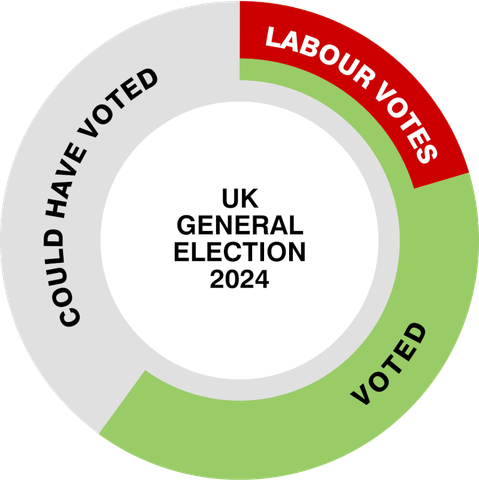
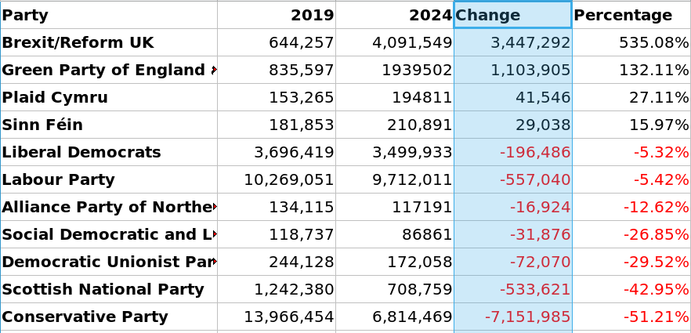
OK, the first thing to say about #GeneralElectionUK 2024 is this: #Labour lost, and lost badly. They lost, in fact, HALF A MILLION VOTES compared to their 2019 result.

All the major parties, including the #LibDems, lost. Labour just lost less badly than either the #Conservatives or the #SNP.

#UKPol
#ScotPol

https://www.journeyman.cc/blog/posts-output/2024-07-06-the-election-and-after/
The election, and after

In any election in a reasonably democratic voting system — such as that used for the Scottish Parliament and the Welsh Senedd, for example — the number of seats in the resulting parliament assigned to a party is proportional to the number seats they won. So any party or coalition capable of forming a government must have a proportion of the vote close to, or exceeding, a majority. Britain isn't like that, of course. Britain isn't a well-functioning anything at all, still less a well functioning democracy.
The Fool on the Hill

@simon_brooke Low turnout shows disillusionment in politics in general arguably due to the chaos of the last few years.

But an election is not just a count of votes it’s a poll of sentiment too. Across those who didn’t vote you’ll find sentiment split in roughly similar proportions to the actual counted votes. Just those people did not feel engaged enough to cast an actual ballot.
This is a problem. But it’s not true to suggest “none of the above” took 40% of the sentiment.

@TallVenti No, you definitely WON'T "find sentiment split in roughly similar proportions to the actual counted votes".

In the 2014 #IndyRef, canvassing showed that the 'sink estates' were very solidly pro-Yes. But we failed to get that vote out: turn out of those potential 'Yes' voters was very low. Similarly, in this election, the groups in the population #Corbyn motivated didn't turn out: there was no one for them to vote for.

@TallVenti In constituencies where there were notable left candidates, turnout was higher:

Chingford and Woodford Green (Faiza Shaheen) 65%;
Islington North (Corbyn) 67%;

(I haven't yet found anyone who has collated turnout data by constituency so these results are cherry-picked -- they do support my theory but they are not conclusive)

@simon_brooke yes you will. Sorry to burst your bubble.

An actual election poll has just been held where millions of votes have been cast. The make up of the population who did not vote will be have similar sentiment as actual votes.

It’s literally how polling works. The difference is you have millions of actual votes to show the trend.

The question why people did not vote is more interesting question and will have many answers. One of which maybe “none of the above”