 Dan Levenstein
A #preprint (#tootprint?, whatever), on how the theories we build depend on the problems we use them to solve.
#pragmatism #philosophyofscience #neuroscience
#cognitivescience
A #preprint (#tootprint?, whatever), on how the theories we build depend on the problems we use them to solve.
#pragmatism #philosophyofscience #neuroscience
#cognitivescience
Quan vàrem pujar la prepublicació al servidor de bioRxiv, vaig preparar aquest #tootprint en anglès per a ressaltar alguns dels aspectes per a mi més interessants, resultat de mapar i analitzar el cervell sencer de la larva de la mosca del vinagre, #Drosophila: https://mathstodon.xyz/@albertcardona/109422190525090990
La prepublicació és d'accés lliure a tothom: https://www.biorxiv.org/content/10.1101/2022.11.28.516756v1
Si voleu el PDF de l'article tal i com s'ha publicat, us el passo encantat.

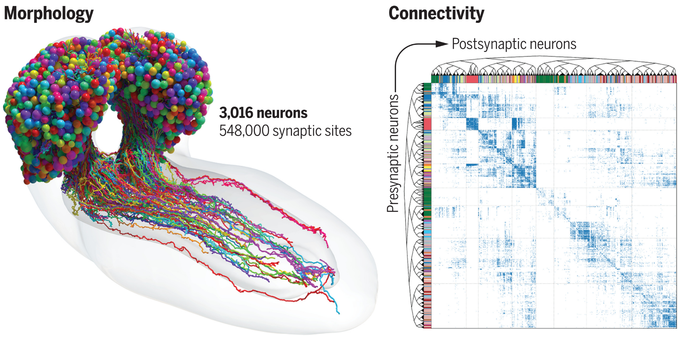
Attached: 1 image 3,013 neurons, half a million synapses: the complete #connectome of the whole #Drosophila larval brain! Winding, Pedigo et al. 2022. "The connectome of an insect brain" https://www.biorxiv.org/content/10.1101/2022.11.28.516756v1 We’ve mapped and analysed its circuit architecture, from sensory neurons to brain output neurons, as reconstructed from volume electron microscopy, and here is what we found. 1/ #neuroscience #connectomics #vEM #volumeEM
Today the peer-reviewed version of our preprint is out:
"The #connectome of an insect brain"
https://www.science.org/doi/10.1126/science.add9330
Congrats to co-first authors Michael Winding and Benjamin Pedigo, and to all our lab members and collaborators who made this work possible over the years. A journey that started over 10 years ago–and yet this is but a new beginning. So much more to come.
See my #tootprint on the preprint from back in the Autumn: https://mathstodon.xyz/@albertcardona/109422190525090990
The data is available both as supplements and directly via #CATMAID thanks to hosting by the #VirtualFlyBrain:
https://l1em.catmaid.virtualflybrain.org/?pid=1&zp=108250&yp=82961.59999999999&xp=54210.799999999996&tool=tracingtool&sid0=1&s0=2.4999999999999996&help=true&layout=h(XY,%20%7B%20type:%20%22neuron-search%22,%20id:%20%22neuron-search-1%22,%20options:%20%7B%22annotation-name%22:%20%22papers%22%7D%7D,%200.6)
(The "Winding, Pedigo et al. 2023" annotation listing all included neurons will appear very soon in an upcoming update.)
Proud to share this work connecting population-level factors to spiking activity, in @cellpress!
https://www.cell.com/neuron/fulltext/S0896-6273(22)01080-7
Latent factors are a powerful framework for understanding computation but what are factors? Just an analysis trick? Where are they in a neural circuit? (1/9) #neuroscience #tootprint #neuralnetworks
Hi #science #research #mastodon community! A few days ago, a post of mine recieved a lot of attention. Thanks for the engagement and the very interesting suggestions! https://neuromatch.social/@LeonDLotter/109632615134117119
On #Twitter, I loved the common practice of writing threads explaining new #preprints and #papers in an understandable way.
I uttered my concern that through the chronological timeline here people might miss interesting science. A solution would be to agree on names for hashtags and/or a.gup.pe groups to ease tracking these "paper threads".
Following tags were named more then once: #newPaper #paperThread #preprint #researchPaper #mastoPrint #tootPrint.
Also, there was #tootorial, but that might be a slightly different category?
I heard people like participation - so let's do a poll! What's your favourite tag for threads explaining research articles? 📊 Multiple choices possible!
#twitterMigration #scienceTwitter #scientist @academicchatter @neuroscience @cognition @psychology @phdstudents

On #scienceTwitter, my favourite thing was reading and, on rare occasions, writing "paper/preprint threads". From the researchers I followed and through the #Twitter algorithm, this became my most important source for new #research. While people start to do the same on #Mastodon, I have the feeling that I miss important work bc no algorithm "saves" it for me if I don't watch my timeline constantly. Two simple solutions would be: a commonly accepted hashtag that everybody uses when writing "paper threads" or an [...] @ a.gup.pe group with a similar adaptation rate. #Question 1: is there already a mechanism for this that I missed? #Question 2: What hashtag or group name? I saw #TootPrint before. Maybe #PaperInAToot? #PaperInAPost? #PaperInAThread? #PaperPost? #MastoPrint? Suggestions and boosts, please, we need reach for this! 🤓 #TwitterMigration #Science #Scientist @[email protected] @[email protected] @[email protected] @[email protected]
The big message we wanted to convey is that depending on what is intended for the phase to track (do you want it to act like a clock or do you want it to tell you when the peak/trough is reached?) you might want to consider alternative methods and use uncertainty metrics.
I focused in this #tootprint on one situation when the phase can become quite ambiguous - amplitude modulation, but in the paper we consider other cases as well including non-sinusoidal oscillations which lead to other considerations - do check it out! - https://doi.org/10.1101/2023.01.05.522914
Therefore, given a bunch of training data, there is a clear trade-off between selecting a few "good" training points and including more, but of lower overall quality. We provide some heuristics to select the optimal subset of data given a model and a prediction problem.
/end of my first #tootprint #masthread #preprint 😁
 Anirudh Wodeyar
 Albert Cardona
 Albert Cardona
 Brian DePasquale
 Leon Lotter
 Lorenzo Posani