 Andy Arthur - Threadinburgh
An Elephant called Murdoch: the thread about the travails of Edinburgh’s first Zoo
This thread was originally written and published in February 2024.
It’s almost exactly a year since I tweeted about the intriguing map labels on the 1849 Ordnance Survey Town Plan of Edinburgh, and I’ve been meaning to write up more about them ever since. And so here we are, this is a thread about the (first) Edinburgh Zoological Gardens, the city’s (and Scotland’s) first zoo, which existed from 1840 to 1861. It’s a story about which almost nothing has been written (except in scraps of Victorian newspaper)… Until now that is! So read on and find out more about this pioneering but ultimately unsuccessful venture.
Intriguing labels on the 1849 OS Town Plan of Edinburgh. Reproduced with the permission of the National Library of ScotlandJames IV of Scotland had built a menagerie at Holyrood in 1512 where lions, tigers are lynx reputed to have been kept. James V had an ape and James VI a camel. But it was not until the London Zoo began in 1828 that desire for a public collection in the city began to grow. The two driving figures behind a Zoo for the city were Dr Patrick Neill of Canonmills, a naturalist and botanist with a huge personal botanic garden, and Mr John Douglas, a wire-worker at 61 Princes Street and “experienced collector of foreign and British birds and quadripeds“. Travelling menageries were nothing new, they were big entertainment business in Victorian Britain – we see one here on the Mound around 1840 (we can date it from what’s on at the Panorama, a display of Jerusalem to be followed by the Battle of Waterloo in coming weeks), which is Wombwell’s Menagerie. The elephants were always a big draw and we can see one here, serving as a mobile advertising board.
Princes Street from the Mound, Edinburgh. Charles Halkerston, 1843. Museums & Galleries Edinburgh via ArtUKBut the city saw itself as having a status above that of a mere travelling circus and so something more highbrow than a menagerie was desired. Something like London had at Regents Park, with lofty, scientific ideals. So rather than form a private company to pursue the scheme, a committee of learned and interested men in the city was formed under “the control and superintendence of gentlemen in whom the public could safely confide“. The committee appointed the Duke of Buccleuch as its president and the Marquis of Lothian and Earl of Roseberry as his deputies; three of the wealthiest and most influential noblemen in the county if not the country. With this backing, John Douglas got to work.
A View in the (London) Zoological Gardens about the year 1838. Tate Gallery, S.270-199In September 1838, he began soliciting donations of animals to form the core of the new zoological collection. James Boswell bt. sent a red deer; Mr Scales of Swanston Cottage sent a buffalo; Dr Gardner in Lothian Street gave a green monkey; others supplied a Grivet and a Ring-tailed Lemur. Six Spanish partridges were sent from Ipswich by a Mr Cobbold (more on him later); J. S. Lyon esq. of Kirkmichael provided a Golden Eagle; the Misses Gibson-Craig a Macaw; a “tortoise from the plains of Troy” came from J. B. Knight esq. of Brabdon Street and Captain Turner of the Leith Smack sent a “curious variety” of gannet (perhaps this was the closely related booby, as the 3 species of gannet all look fairly similar).
The Edinburgh Zoological Garden green monkey, a plate from “The Naturalist’s Library ” by Sir William Jardine Bt.Douglas appears to have accommodated this varied and growing collection at his premises at 61 Princes Street. On October 13th 1838 he issued a prospectus for the Edinburgh Zoological Gardens, placing himself as manager of it, and began soliciting financial donors and subscribers to the scheme. The Scotsman said of the scheme that “the higher classes would hail it as a fertile and most interesting source of amusement and recreation… Every citizen who has the good of the city at heart ought cordially to help forward the establishment of so beneficial an institution.“
Advert for prospectus issued by Douglas. Caledonian Mercury, October 1838For the rest of the year, more animals continued to arrive. In December, a pair of Egyptian geese from R. J. Pringle esq. of Clifton, a raccoon from Dr Munro of the famous Leith steamship Sirius, a “Prehensile-tail” (i.e. Spider) monkey from Mr Murray at the Observer Office; Russian rabbits, a deer…
The Edinburgh Zoological Garden spider monkey. A plate from “The Naturalist’s Library ” by Sir William Jardine Bt.But money was also needed; in January 1839, the Duke of Buccleuch as President of the Committee made it publicly known he had contributed 50 Guineas, in an effort to try and solicit further donations. To keep interest in the scheme up, and pay for its upkeep, the collection of some 200 animals was put on display by the Panorama on the Mound. At a general meeting held on May 6th at the Royal Hotel, chaired by the Lord Provost, it was noted that £924 1s had been donated so far, £83 3/3d taken on the gate at the Mound and running costs were £1 a day. There was as yet no site agreed and Dr Neill of Canonmills was one of the many ordinary directors elected.
30th March 1839, Scotsman, advert for the MenagerieThe Committee had a problem however over where to locate the collection and agreed to petition the Council to extend its stay on the Mound while they tried to find a permanent home; all the temporary structures on its western edge were due to be cleared in an agreement with the “Board of Trustees for Encouraging Manufactures and Arts“, proprietors of the Royal Institution (now the Royal Scottish Academy building of the National Galleries of Scotland). But the Board of Trustees was having none of it; they were having the Mound back and the Panorama and the animals had to go. You see, there’s nothing new under the sun in Edinburgh and the age-old argument between use of the city centre for highbrow vs. lowbrow culture and temporary vs. permanent city centre structures was going on even 185 years ago.
“Royal Institution, or School of Arts, Edinburgh”, engraving of Thomas Hosmer Shepherd illustration of 1829 © Edinburgh City LibrariesMessrs. Cleghorn, the proprietors of East Princes Street gardens (whose planting had been carried out by Dr Neill of Canonmills) tried to entice the Zoo to settle there, but there was no rights to erect any structures there apart from a Church, monument or public building. Cleghorn was chancing his arm; he was in trouble. His erection of a dwelling house and greenhouses in the gardens, on which he had a lease, was contrary to the Act of Parliament but had been overlooked. But he had now begun erecting a warehouse and the proprietors of Princes Street, from whom he leased the ground, finally took action. He was facing financial ruin. It was as well the Zoo ignored his overtures as just a few years later the railway cutting through the Gardens would have obliged it to move anyway.
On January 18th 1840, the Scotsman announced that the Zoo had found a permanent home; it had taken out the lease on the grounds of Broughton Park, home of the late Sir James Donaldson (he of Donaldson Hospital). Its location, between Edinburgh and Leith, was perfect. It was located between what is now East Claremont Street, Bellevue Road and West Annandale Street.
Broughton Park on Kirkwood’s Town Plan of 1817. Reproduced with the permission of the National Library of ScotlandIn February 1840 the Edinburgh Journal of Natural History published an inventory of the principal animals in the collection then:
“The Edinburgh journal of natural history, and of the physical sciences” February 1840Work now proceeded quickly at Broughton Park. By March, the Caledonian Mercury described it was substantially complete. It described a park, entered by a gateway with refreshment rooms, a bear pit 18ft deep and 26ft across, with a pole in the middle where the bears were enticed to climb for food and the amusement of the crowds.
Detail of the Regent’s Park print, showing the bear pit and pole with a top-hatted man offering it food from a stickThere was a large aviary in the centre, a house for “rare and more delicate class of birds”, one for the carnivores and one for bears. These are the labels we can see these on that 1849 town plan. There were also stalls and paddocks for animals like deer, a pond for waterfowl and various other cages around the walls.
OS 1849 Town plan of the Edinburgh Zoological Gardens. Reproduced with the permission of the National Library of ScotlandMore animals arrived – Bengal tigers, a polar bear, a spotted hyena – as did more money from the Duke of Buccleuch. In April a prized exhibit arrived; the skeleton of a Blue Whale which had been found floating in the Forth and brought ashore by North Berwick fishermen back in October 1831. It had been dissected in situ by Dr. Knox (he of Burke & Hare infamy) who had presented its cleaned skeleton to the city.
The Edinburgh blue whale, engraving in “The Natural History of the Ordinary Cetacea Or Whales” by Robert Hamilton, 1837By June 1840, things were almost ready and so Mr Douglas headed to London to spend the last of his funds on acquiring more animals; a lioness; a dromedary; a llama (the only one in the country); two Norwegian wolves; a brown bear; three peccaries from South America, a jaguar from Surinam; two spotted deer from the banks of the Ganges; a civet, a raccoon etc. These were sent back to Edinburgh on the steamship Royal Adelaide. With this final expense, the project had now run out of money and was finished only on loans and the goodwill of its directors. But it had made it! On July 7th 1840 there was a “Grand Opening Parade” with the band of the 78th (Ross-shire Buffs) Highlanders providing the music.
Newspaper Advert from July 1840 announcing the opening of the Gardens.The 78th brought their mascot, a young elephant they had acquired on campaign in Ceylon on account of their regimental badge featuring an elephant. This was Murdoch and he had been living in Edinburgh Castle with the soldiers. It had rained all morning and the previous day, but the sun came out at 1PM for opening and “the [Zoo] entrance was literally besieged with an eager and fashionable assemblage“. Just arrived for the occasion was a Nile crocodile, a pair of swans from the Provost of Linlithgow and a king vulture (a type of condor). The day (and the Zoo) was a smash-hit success, with 6,000 people attending the opening. The below image is the only one I know of that shows it; looking across the waterfowl pond towards the animal houses and aviary. We see Murdoch the elephant and Broughton Park house in the left distance.
The only known illustration of the Edinburgh Zoological Garden, an engraving reproduced in “The Story of Edinburgh Zoo” by T. H. GillespieThroughout the summer, there were weekly promenade concerts with the bands of the 78th, or the 2nd Dragoon Guards or the 29th (Worcestershire) Regiment providing the accompaniment. This mixture of popular entertainment and zoology was a common feature of Zoos at that time, despite their ambitions to be more than just menageries. The last prom of the season was 3rd October. At a delayed AGM on March 25th 1841, the outgoings to date were recorded as £3,358 and the total income was £3,309, meaning a slight running loss. But as this had included the entire startup costs, the Directors were encouraged. To Mr Douglas, to whom “not only this city but the whole of Scotland were so deeply indebted” a £400 award was made to cover his costs to date. He was voted an £80 salary, plus 4% of gross gate takings plus one “free day” a year to organise an event and keep the whole profits.
“Popular Gardens – Tom, Jerry and Logic laughing at the bustle and alarm occasioned amongst the Visitors by the escape of a Kangaroo. “, print satirising London Zoo by Robert Cruickshank, 1830. V&A S.1677-2014In May the next year, the Directors announced the first prom of the season and the rates for next years subscriptions. These ranged from £21 to give the subscriber and seven family members perpetual admission to a donation of £10 10/- and subscription of £1 1/- to give them and six members access so long as they subscribed down to a £1 1/- subscription for the year for them and two family members. John Douglas chose to hold his annual “free day” benefit on July 3rd and arranged for a spectacular fireworks concert, however the weather was terrible and it was rained off; he had to refund disgruntled customers and it’s not clear whether he was allowed to hold another. I suspect he wasn’t, on 6th December 1841, he was sacked by the Directors, accused of mismanagement. He had tried to get them to let him take the Zoo over in its entirety and so perhaps this had triggered the fall out. The secretary, Mr Cobbold, was made honourary manager in his place. Douglas didn’t go quietly – he would turn up at the next AGM with his supporters to try and get it minuted in the annual report that he was not let go for mismanagement. He took out newspaper adverts to this effect and put on “evening entertainments” to explain how much personal effort and money he had put into the project and put his case to the public. When a rival Zoo was started in Glasgow two years later, who should they hire as General Manager but John Douglas!
In April 1842 we get an example of the difficulty early zoos had in caring for their charges, particularly big predators. One of the tigers got an ingrown claw which got infected and she was going lame. They tried, and failed, to cut the claw, so ended up devising an iron hook to pull it out from a very safe distance, using the enraged animal’s own strength to wrench it free. Dr Knox, who had provided the whale skeleton, recalled he had treated one of the lions that had an abscess in its paw by having a very long, sharp prod made and lancing it through the bars at the opportune moment. The AGM that year noted a surplus for the year of £152, but requested more public support. At this time the 78th Highlanders, late of the Castle garrison, were leaving from service in Ireland for India and they offered their mascot to the Zoo. He was readily accepted and arrived by train from Glasgow on March 24th, the directors of the railway waiving the transport costs. And so it was that Murdoch the elephant came to call the Zoo home. He would occasionally be used to carry advertising posters and leaflets into town to drum up business.
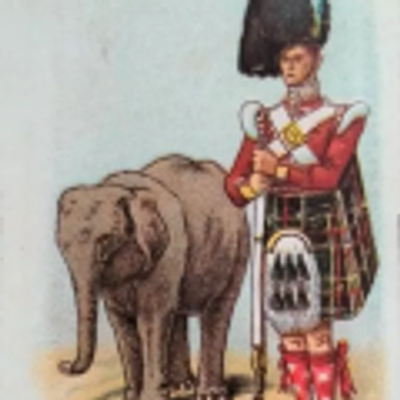
Murdoch the elephant, from a Will’s cigarette card.New acquisitions that year included a sun bear sent from Dr. Montgomery of Singapore; a pair of Egyptian geese from Lord Lurgan; three Indian monkeys from D. J. Grant esq. of Eastfield; six puffins by Miss Dalyell of Binns; a tortoise from Mr Ball of Falkirk and another from Mr Goodsir. The directors purchased a 6-banded Armadillo. But not all was well; at a public dinner of thanks for the honorary manager, Mr Cobbold, it was noted in the speeches that £1,000 of debts were outstanding and that the directors would have to cover these.
German engraving of a 6-banded armadilloThe AGM the following year, 1843, was reported in great detail in the papers. £21 8/6d had been subscribed for an elephant house; £12 10/6d had been made selling manure; £267 13/1d went on wages and £80 8/5d was spent on hiring the bands. The annual surplus was now a healthy £618 17/2½d. In September, the Leopard had three cubs (it was noted she had two cubs 2 years previously) but in October the Illustrated London News reported that a pair of Napu musk deer from Java had died during the passage of the tea clipper Monarch from Hong Kong to Leith. New Years Day events were always big business for the Zoo, when it offered half price admission. In 1844, 15,000 people passed through the gates that day. At the 1844 AGM a £100 operating surplus was declared and the collection now extended to 500 animals and as many birds. But subscriptions were falling off, it was found people were sharing season tickets and by now a total of £1,600 in loans had been taken out to cover various running costs. This growing debt would be an unshakeable millstone around the neck of the institution. But the year ended on a high with Lord Aberdeen letting the Lord Provost of Edinburgh, Adam Black, know that Queen Victoria had agreed to extend royal patronage; thus the institution became the Royal Edinburgh Zoological Garden.
In March 1845, at a sale of animals from the circus of American showman Isaac A. Van Amburgh in Manchester, Mr Cobbold purchased a male lion cub for £10 10/- for the Zoo. It would be named Wallace.
Isaac van Amburgh (1808–1865) by T. C. Wilson 1838 in National Portrait Gallery, London.In 1847 one of the oddest exhibits arrived; several swarms of Egyptian locusts had blown over from the Sahara and were found in Perthsire. One was captured, kept alive, and put on exhibit at the Zoo. The German travel writer Johann Georg Kohl visited the Zoo in 1849. He wrote it had the “largest, strongest and finest American bison” anywhere in Great Britain, and that it was kept with a “courageous but comparatively powerless” goat that butted it fearlessly and relentlessly. In 1852 the Russian brown bear gave birth to three cubs. In 1854 the directors complained of “the indifference of their fellow-citizens and the small number of shillings and sixpences that find their way into the park“.
But donations still came in; the Marquis of Dalhousie, who had been Governor-General in India, sent it two more Bengal tigers. One wonders if these repeated donations of big cats were just to cover those that had died in the Zoo’s primitive and restrictive veterinary conditions. In August 1855 a second elephant arrived, a gift from the 25th Light Dragoons, whose regimental colours had the animal at their centre. Sadly in January the following year, Murdoch died after a very short illness. But once again, all was not well at the Zoo. In July that year an advert in the Scottish Press paper had noted new management; this I think was a man called Mr Carroll, a showman and fireworks organiser. Increasingly the Zoo was used as a leisure and concert ground to try and find a way, any way, to make it profitable. The newspapers are now stuffed with adverts for fireworks concerts at the Gardens. The animals do not ever seem to be mentioned. These changes culminated in December 1857 with the opening of a very large wooden concert hall in the grounds, the “Victoria Hall“, where all kinds of entertainment, exhibitions and variety were put on.
Advert for the Victoria Hall, 28th December 1857The Victoria Hall was a financial disaster; its construction costs of £2,200 were more than 10 years of the Gardens profits; profits already required to service the existing debt. In December 1858 the park was sold to John Jennison Junior of the Belle Vue Gardens in Manchester. But Jennison couldn’t make the place pay either. In October 1861, the Town Council found out that he had put the whale skeleton – their whale skeleton – up for sale and resolved to recover it. It was sent to the Museum in Chambers Street, where it hung until 2011, a childhood favourite of myself and countless others.
Official guidebook for the Manchester Belle Vue GardensEven though military music concerts were still running at the Zoo on October 12th 1861, just a week later it was announced all the movable property had been auctioned off. The £2,200, four year old Victoria Hall fetched only £500 and was broken down on site. On November 1st, the Governors of Donaldson’s Hospital (who still owned the superiority to Broughton Park) let it be known that the lease would not be renewed when it came to expire that year and advertised the ground for feuing (breaking up into plots for development). Bits of the collection were found new homes. The eagles went to Canaan Lodge in Morningside, where John Gregory, an advocate, had a large aviary in his garden. I believe the toe bones of the late Murdoch the elephant can still be found in one of the museums in Edinburgh Castle.
1849 OS Town Plan showing Canaan Lodge, and the aviary and eagle cage in the garden. Reproduced with the permission of the National Library of ScotlandBut most of the animals wound end their days in the travelling menagerie of Mr Edmond, who had inherited Wombwell’s Menagerie that had toured Edinburgh back in the 1840s. Edmond bought them in Edinburgh in June 1862 when his tour left the city, taking them with him. Ultimately the Zoo could not be made to pay either its way or its debts. As it got ever more commercialised it descended into a “meager menagerie“, with the animals a backdrop to ever more desperate and cynical attempts to make money. The relentless fireworks concerts must have been awful for the inmates. It wouldn’t be until 1913 that the City would get a proper Zoo, one run on a scientific basis.
The gates to Edinburgh Zoo in 1914, Francis Caird Inglis photograph. © Edinburgh City LibrariesIf you have found this useful, informative or amusing, perhaps you would like to help contribute towards the running costs of this site – including keeping it ad-free and my book-buying budget to find further stories to bring you – by supporting me on ko-fi. Or please do just share this post on social media or amongst friends.
Explore Threadinburgh by map:
Travelers' Map is loading...If you see this after your page is loaded completely, leafletJS files are missing.
These threads © 2017-2026, Andy Arthur.
NO AI TRAINING: Any use of the contents of this website to “train” generative artificial intelligence (AI) technologies to generate text is expressly prohibited. The author reserves all rights to license uses of this work for generative AI training and development of machine learning language models.
#Lochend #Logan #Restalrig #StMargaret


 LordWoolamaloo
 D
D
 Gordon Cowtan


 La Pesanta
 News Beep

