On this #WOMENINSCIENCE #GIRLSINSTEM day we are thrilled to share @fannyhartmann.bsky.social newest work @molbioevol
https://doi.org/10.1093/molbev/msaf026
#Genomics #Evolution #Transposons #Supergenes #seXYevol
1/5
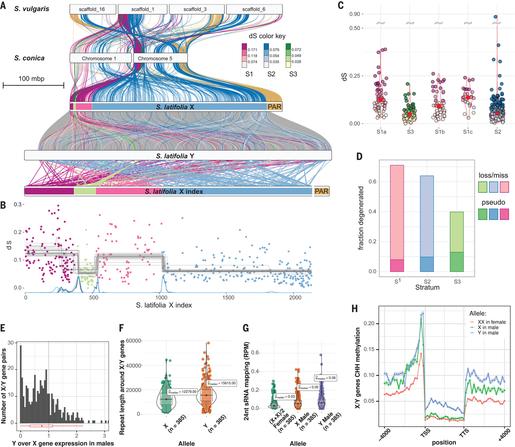
How Y became a giant
https://www.science.org/doi/10.1126/science.adj7430
Featuring team's postdoc Quentin Rougemont as one of the first authors, he applied his #EASYstrata pipeline to uncover the evolution of the largest #y_chromosome ever sequenced to date
Repo: https://github.com/QuentinRougemont/EASYstrata/
#preprint: https://www.biorxiv.org/content/10.1101/2025.01.06.631483v1.full
#Genomics #bioinformatics #Evolution #seXYevol
CellBioNews (@[email protected])

#Octopuses have some of the oldest known #sex #chromosomes, study finds. #evolution #O_bimaculoides #genomics #Z_chromosome https://phys.org/news/2025-02-octopuses-oldest-sex-chromosomes.html

Mastodon

Final paper from Marine Duhamel's PhD and second installment of our project on the causes and consequences of #recombination suppression in #sex determining #Chromosomes

The dynamics of #transposable #elements accumulation in non-recombining regions

Fully formatted, #peer reviewed and #openaccess at
https://www.nature.com/articles/s41467-023-41413-4

#seXYevol #EvolutionaryBiology #bioinformatics #FungiFriday #Genomics

Dynamics of transposable element accumulation in the non-recombining regions of mating-type chromosomes in anther-smut fungi - Nature Communications

In the absence of recombination, the number of transposable elements (TEs) increases, but their accumulation dynamics are not well characterized. This study shows that TEs rapidly accumulated in non-recombining fungal mating-type chromosomes before reaching a plateau, possibly forming a TE reservoir.

Nature
Marine Duhamel / MicroTEp · GitLab

GitLab.com

GitLab

#seXYevol #reads #preprint

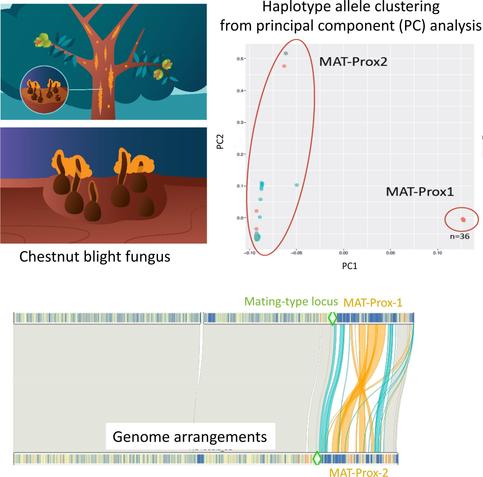
Tetrapolar #fungi with multi-allelic little degenerated HD loci and biallelic highly degenerated PR, fascinating work from @schwessinger team

https://www.biorxiv.org/content/10.1101/2023.03.02.530769v1.full

Ps. We think Pst 134E chromosomes 9 n Figure 5 should be flipped

#Recap of #publications during our social media hiatus of late 2022

Review on cheese-making #fungi by @[email protected] and @[email protected], celebrating ten years working on #CheesyFungi
https://doi.org/10.1016/j.mib.2022.102236

Our first @PeerCommunityJournal lead by PhD student @[email protected] shows that linkage to a permanently heterozygous site decreases the purging probability and increases the purging time of mutations under selfing #seXYevol
https://doi.org/10.24072/pcjournal.238
Recommendation
https://doi.org/10.24072/pci.evolbiol.100635

#introduction #how /4
So, this is how we think it works: we tell each other what we're up to and what we like/dislike, timelines will soon be full of interesting/relevant stuff 🤞

Regular or recurrent hashtags:
#semIDEEV - institutional weekly seminars #Ecology #Evolution
#CheesyFungi - research on the living stuff making your #cheese more interesting
#seXYevol - the #EvolutionaryBiology of sex chromosomes
#ShouldTryThis - new methods on #bioinformatics #popgen #Genomics
#FungiFriday

#introduction #what 1/
We are the #Genetics #Ecology and #Evolution team of the #CNRS - #AgroParisTech - #UPSaclay powered Laboratoire ESE, part of the Institut Diversité Écologie et Évolution du Vivant #IDEEV
We are broadly interested in evolutionary genomics, in particular the evolution of sex chromosomes #seXYevol, the domestication of cheese-making fungi #CheesyFungi, the footprints of pathogenicity, and molecular coevolution in symbiosis #CoEvolSym and in antagonistic interactions