#Solarpunk started out as a speculative fiction genre. Now it informs #sustainable architecture and design

By Nicola Heath, April 6, 2024

"Solarpunk is a futurist movement that began in speculative fiction and sci-fi films and has since spread to architecture and design. Practitioners envision a clean and green future built on principles of #sustainability, #SocialJustice, and #CollectiveAction."

Read more:
https://www.abc.net.au/news/2024-04-07/solarpunk-design-architecture-sustainable-future/103667452

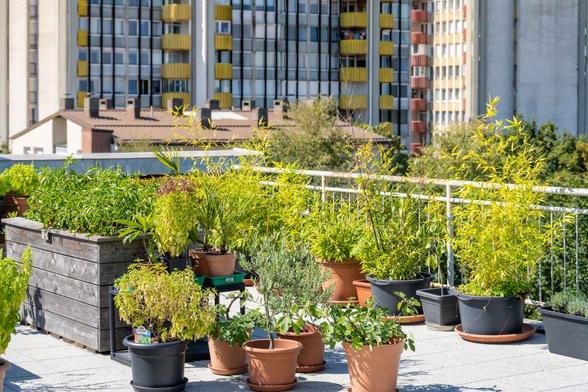
#SolarPunkSunday #RenewableEnergy #AntiCapitalist #LowTech #SeedLibraries #Clotheslines #RooftopGardens

Solarpunk started out as a speculative fiction genre. Now it informs sustainable architecture and design

It started out as a sci-fi genre, but some believe solarpunk holds the key to solving some of humanity's most pressing problems.

ABC News

#Honeybees, under threat in rural and agricultural areas, are finding an unlikely refuge: the big city

by Luca Matteucci

"The fuzzy pollinators, apis mellifera, have found new homes at places like the Beaugrenelle Commercial Center, one of Paris’s biggest indoor shopping complexes. Not far from the Eiffel Tower, the mall hosts a pesticide-free garden on its rooftop with Russian mint, Australian lemongrass, Indian holy basil and other plantings that attract local Michelin-starred chefs. The aromatic flowers and herbs also draw legions of bees that now live on a cleared corner of the roof overlooking the Seine River.

"'It’s a heavenly buffet for them. They enjoy a healthy and varied diet, which makes the colony stronger,' beekeeper Diane Jenny said on a recent day as she checked the rooftop’s six hives, each containing about 40,000 bees, for potentially harmful parasites like mites. The bees were healthy and thriving, she proclaimed, and busy making rooftop honey."
#Beekeeping #Bees #Gardens #RooftopGardens #UrbanBeekeeping #Pollinators

Read more: https://getpocket.com/explore/item/that-buzz-on-city-rooftops-beekeeping-is-going-corporate?utm_source=pocket-newtab

That Buzz on City Rooftops? Beekeeping Is Going Corporate

Urban hives are helping companies burnish their green credentials, but there are only so many city flowers to go around.

Pocket
If future cities are covered in rooftop farms, #pesticides might rain down on us. On the other hand, perhaps the height will keep many pests away.
#RooftopFarms #RooftopAgriculture #rooftopgardens

Sanjay Puri Architects designs Indian university with accessible stepped green roof

Mumbai studio Sanjay Puri Architects has designed a building for Prestige University in India that will feature a stepped green roof punctuated with courtyards.

Scheduled to be completed in June 2022, the low-rise building will be located within Prestige University's existing 32-acre campus in the Indian city of Indore.

The university building will have a stepped shape

Designed to blend into its surroundings, the five-storey Prestige University will be a red-brick, stepped building that rises out of the ground and features a series of rooftop courtyards connected by small staircases.

"As opposed to creating an imposing edifice, the building will be gradually stepped up from the approach direction, belying its 20-metre height," architect Sanjay Puri, who founded his eponymous firm in 1992, told Dezeen.

Rooftop courtyards will be reached by small staircases

The building's grass-covered roof will be stepped up from its north side, making its entire surface area an accessible terrace to be enjoyed by students and staff.

As well as small courtyards designed for recreational activities, the terrace will also include different-sized open-air sections that will provide the building's interior with natural ventilation.

A cafeteria will feature on the ground floor

Inside, a diagonal pathway will run across the length of the ground floor, which will also help to open up the building's internal spaces and fill them with fresh air.

"These design elements are planned in response to the city's climate, which varies from 30 to 40 degrees Celsius for eight months of the year," said the architecture firm.

[

Read:

CF Møller Architects hides "invisible villa" in Norway under green roof

](https://www.dezeen.com/2021/12/26/cf-moller-invisible-villa-aa-norway/)

In the interest of easy access, a cafeteria, administration offices and an auditorium will be located on the building's ground floor. The library will be arranged in various areas across the first floor, which will be connected by a bridge that will overlook the diagonal "indoor street" below.

Classrooms will occupy the second floor and be ventilated by the open-air sections above them. On the third floor, visitors will find more tiered classrooms, while administrative facilities will be located on the fourth floor.

The building's roof will be designed to blend into its surroundings

According to the studio, Prestige University's design takes its cues from traditional Indian architecture in both its materials and its ability to adapt to the local climate.

"The building will imbibe from traditional Indian architecture to create an energy-efficient, sustainable building with minimal dependence on artificial lighting and air conditioning," explained Puri.

"In addition to housing numerous activities, the building will become a large open public space with an accessible ground floor and landscaped roof."

Various open-air sections will naturally ventilate interior spaces

Based in Mumbai, Sanjay Puri Architects recently also completed the Rajasthan School in India, which was designed with oversized pergolas to cope with the desert climate of its location.

The renderings are courtesy of Sanjay Puri Architects.

The post Sanjay Puri Architects designs Indian university with accessible stepped green roof appeared first on Dezeen.

#education #all #architecture #terraces #bricks #universities #news #india #greenroofs #sanjaypuri #rooftopgardens

Sanjay Puri Architects designs university building with accessible stepped green roof

Sanjay Puri Architects has designed a building for Prestige University in India that will feature a stepped, green roof punctuated with courtyards.

Dezeen

Lakwena Maciver paints a "vision of paradise" on the roof of London tube station

London-based artist Lakwena Maciver has painted a rarely used rooftop in bright colours and geometric shapes as part of a redevelopment of a London Underground station.

Called Back in the Air: A Meditation on Higher Ground, the artwork stretches over the 1,400-square-metre roof terrace of Temple Station in central London.

Maciver was commissioned by 180 Studios and Westminster City Council to paint the station's roof terrace, which is located between the River Thames and the Strand.

Maciver was commissioned to brighten up the unused rooftop above Temple Station

The painting is meant to act as "a beacon of London's recovery" as the city comes out of the coronavirus pandemic.

"Back in the Air is about connection," Maciver told Dezeen. "I like to respond to the context of spaces when I'm making work in public spaces, and this felt really relevant here given the name Temple and the fact that the space is a raised platform, facing the heavens."

"A lot of my work is concerned with this connection between above and below and between people," she added.

The phrase Nothing can Separate Us is incorporated into the design

Maciver used a kaleidoscope of paint colours including royal blue, vibrant turquoise and bright green in stripes, squares and text for her "contemporary vision of Paradise".

After sketching out her planned designs, the artist translated her initial drawings into a pattern that was stuck to the roof using tiles that are usually used for sports arenas.

She chose the tiles as they are sturdy and the station's roof couldn't be disturbed.

A hut covered in Maciver's design is informed by a shelter near the station

"This was a really difficult site to respond to," said Maciver.

"Having a vast half-acre of space to fill, with various obstacles within it, but also not being allowed to screw or drill anything onto the surface, and also needing to create something temporary, but that would also be weatherproof," she explained.

"The connotations of both play and mosaics that the tiles brought with them really resonated nicely with the themes in the work."

The phrase Nothing Can Separate Us can be seen at the entrance to the garden. For Maciver, this phrase has a personal meaning as she began making a painting with the same text for her home in 2020.

"Shortly after the pandemic broke out, we went into lockdown, and the painting took on a wider meaning," she explained. "Those sentiments seem especially poignant now just coming out of lockdown and as the city comes back together."

"I see my paintings as prayers and meditations, so it felt right to paint this on this raised platform to the sky, and for this mosaic of colours to flow outwards from it to cover the whole surface," continued Maciver.

Tiles used in sporting halls form the foundation of the artwork

A specially constructed hut modelled on a London taxi driver's shelter was also placed on top of the roof and painted in Maciver's designs.

The charity Cabmen's Shelter aims to provide taxi drivers with wholesome meals. One of its huts can be found on the ground level near Temple Station.

The designer used bright colours and striking patterns

Commuters who use Temple station, which was built in 1870, are largely unaware of the expansive terrace above their heads.

The raised area is not visible from the street and is only seen by the few Londoners who can see it from their elevated places of work, or who work on nearby building sites.

The roof can be accessed via steps that lead up to the roof. Visitors to the artwork can walk across the colourful tiles and take in views across the River Thames towards the South Bank opposite.

Maciver is the first of a series of emerging artists who will redesign the roof terrace in a project that Westminister City Council and theCoLAB have called the Artist's Garden.

The project forms part of a burgeoning design movement that Adam Nathaniel Furman has coined the New London Fabulous. The term is used to describe work that constitutes a "highly aesthetic, sensual and celebratory of mixed cultures" by a group of creatives working in the capital.

Examples of the movement include Yinka Ilori's permanent installation along called Happy Street and Camille Walala's Les Jumeaux street artwork.

Photography is byDavid Parry/PA Wire.

The post Lakwena Maciver paints a "vision of paradise" on the roof of London tube station appeared first on Dezeen.

#all #installations #design #london #uk #terraces #art #multicoloured #rooftopgardens #publicspace #londonunderground

Lakwena Maciver paints a "vision of Paradise" on the rooftop of a London tube station

London-based artist Lakwena Maciver has painted an unused rooftop in bright colours as part of a redevelopment of a London Underground station.

Garden added to Fiat's Lingotto building rooftop test track

Italian architect Benedetto Camerana and landscape designer Torino Stratosferica have created a rooftop garden called La Pista 500 with over 40,000 plants around an electric vehicle test track on the roof of the Fiat's iconic former car factory.

The public garden is located on top of the Lingotto building in Turin, a former Fiat manufacturing plant that was converted into a multi-use space by Italian architect Renzo Piano in 1994.

La Pista 500 is located on the rooftop of the modernist Lingotto building in Turin

The building, which functioned as Fiat's headquarters from 1923 and to the early 1980s, is topped with a test track and was featured in the 1969 film The Italian Job.

Camerana and Stratosferica's garden is located on the rooftop test track, which was previously used to assess all Fiat vehicles and is now being used to test Fiat's 500 Electric vehicle range.

The garden is comprised of 28 green islands spread across the test track

"Because of its memory, the idea of a test track has been preserved and transformed into a contemporary one, open only to electrical vehicles," Camerana told Dezeen.

"So the silent clean cars can drive gently in between the green islands, looking for a new harmony between mobility and nature. The E-track blends in the garden."

It is host to almost 40,000 indigenous plants

The garden was informed by Manhattan's High Line by James Corner Field Operations and Diller Scofidio + Renfro, as well as the Environment Park in Turin by Camerana, Emilio Ambas, Giovanni Durbiano and Luca Reinerio.

"The space is designed from the start to be public," Camerana told Dezeen.

"It's not just a contemplative garden, we designed it with public functions in the sport and relax areas with learning activities related to edible and colour-dyeing plants areas, to be organized with Pinacoteca Agnelli."

[

Read:

Twelve Architects unveils plan for elevated park in Manchester

](https://www.dezeen.com/2021/07/07/castlefield-viaduct-twelve-architects-landscape-urbanism-manchester/)

Arranged on the 27,000-square-metre rooftop, the garden was formed through a collection of 28 green "islands" that are dispersed around the test track.

The green islands cover 6,000 square metres and are host to over 300 indigenous species of plants totalling almost 40,000 shrubs, trees and herbaceous plants.

The garden surrounds high-tech volumes which were added to the Lingotto building by Renzo Piano

"The 300 species and varieties are chosen with Il Giardino Segreto under my guideline of being truly indigenous species, rooted in Piemonte and northern Med areas, with no space for exotic plants at all," said Camerana.

"Just local biodiversity in a full-colour all-seasons palette. As an example, in front of Pinacoteca, we have two islands dedicated to a 'noccioleto', a hazelnuts field as you can easily find in the Langhe area," he continued.

"Some other peculiar plants are the Cotinus aka 'smoke-tree' which has a strong CO2 absorbing power or the large family of Graminacee species, long perennial and ornamental herbs. But the list can go on all day."

The space can be used for social events, wellness activities and to see views of the distant Alps

Around the green islands, the building's industrial features – including large blue-painted pipes – extend above the perennials and indigenous shrubbery.

Blue strips, to zone different paths, were painted across the test track, tying the paths to the pipes and the large blue-hued dome that Piano added to the roofscape.

The building also houses an exhibition space that can be accessed from the rooftop garden.

Plants are set within slightly raised planters

Earlier in 2021, Twelve Architects unveiled plans for an elevated park in Manchester that will occupy a disused viaduct.

A high line-style structure in Camden is also planned by New York High Line designer, James Corner Field Operations and will stretch across a disused railway.

The post Garden added to Fiat's Lingotto building rooftop test track appeared first on Dezeen.

#all #architecture #landscapeandurbanism #italy #landscapearchitecture #parksandgardens #rooftopgardens #turin

Benedetto Camerana adds garden with 40,000 plants to the rooftop test track at Fiat's former Lingotto factory

Benedetto Camerana and Torino Stratosferica converted the rooftop test track of a former car manufacturing plant into a linear garden with over 40,000 plants.

Dezeen

BIG and Castro Group plan "urban fashion village" with hill-like roof

Architecture practice BIG and developer Castro Group have unveiled designs for the Fuse Valley development in Porto, which will house the headquarters of luxury fashion platform Farfetch.

Located on the slopes of the Leça River, in the northern area of Porto, Portugal, Fuse Valley will contain Farfetch's headquarters within 12 interconnected buildings.

Top: the Fuse Valley development will be home to Farfetch and a number of technology companies. Above: the buildings will have an angular form

The whole site, described as an "urban fashion village," will be designed by [BIG](https://big.dk/#projects) and have 24 buildings in total, with the additional buildings set to house other tech and startup companies.

The 178,000 square-metre Fuse Valley development will feature buildings organised in a checkerboard formation and oriented around landscaped parks, courtyards, gardens and plazas.

The structures have an angular design that looks to mimic the surrounding hillside landscape, with hill-like peaks and valleys created through sloped green roofs.

Pathways at Fuse Valley are widened by tapering walls

The exterior walls of the office buildings are similarly sloped, with gridded, chamfered facades tapering to ground level in order to widen public paths and create canopies over walkways.

BIG incorporated outdoor paths to lead visitors around the community village and up onto the sloped-roofed offices, creating an extension of the surrounding hillside.

"The individual buildings that constitute the various elements of the organization are connected to form large contiguous work environments – physically consolidated, but spatially varied to create a human-scale experience," said BIG partner João Albuquerque.

Garden paths lead visitors and employees around the site to outdoor amphitheatres and garden roofs

Farfetch's headquarters will occupy half of Fuse Valley's site, with offices tailored to suit a number of different functions.

Alongside the headquarters, an "urban alley" by its eastern, river-facing side will house an auditorium, a canteen and wellness facilities.

"Rather than a corporate office complex, Farfetch’s future home in Fuse Valley will be a lively urban ensemble bringing every curator, creator, customer and collaborator together in the most innovative new neighbourhood of the city," said BIG founder Bjarke Ingels.

"The urban fabric will allow Fuse Valley to grow and expand organically, like a natural village."

The roof becomes an extension of the hillside with paths leading people across the sloped roof

Open-plan spaces will provide employees with flexible work areas, with added terraces to extend interior spaces to the outdoors.

The top levels of the building will form "atelier-like attics" with the sloping roofline creating triple-height spaces that taper out to the terraces.

Full-height windows on each level will connect the interior with the outdoors

"What we are going to do in Matosinhos is something unique and that puts this space on the international map of what is best done both in terms of sustainability and in terms of innovation," said Castro Group CEO Paulo Castro.

"With this project, we intend to develop a smart city, or in this case, a smart valley."

Fuse Valley is set to break ground in early 2023 and is hoped to officially open in 2025.

The interior looks to provide a biophilic environment for employees

Recently BIG broke ground on CityWave, a building with a sweeping roof that doubles as a photovoltaic power station and aims to visually connect Milan's CityLife development.

BIG also unveiled a spiralling double-helix viewing tower in Denmark earlier this year.

Images are courtesy of BIG.

The post BIG and Castro Group plan "urban fashion village" with hill-like roof appeared first on Dezeen.

#all #architecture #news #portugal #big #officearchitecture #porto #rooftopgardens

BIG and Castro Group plan "urban fashion village" with a hill-like roof

BIG and developer Castro Group have unveiled designs for the Fuse Valley development, which will house the headquarters of luxury fashion platform Farfetch.