No-Wall Apartment Design by RDTH architekti Redefines How We Think About Space
Seriously, I often feel like many apartments trap you. The rooms are fixed. The walls are permanent. The whole layout was decided long before you moved in, and it will stay that way long after you leave. That’s the default. And for the Prague-based studio RDTH architekti, that default is exactly what needed challenging.
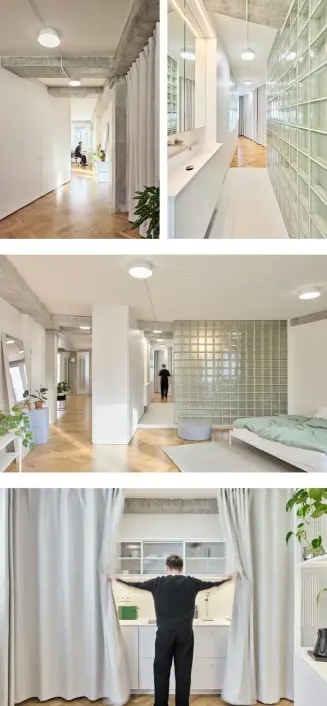
Their no-wall apartment design strips the interior down to almost nothing — and then rebuilds it on entirely different terms. No corridors, no doors (save for the toilet), and no permanent room divisions telling you where the bedroom ends and the living room begins. Instead, a single rotated furniture block at the center of the plan generates four distinct functional zones simultaneously. The result reads like an open plan apartment and a four-room apartment at once, depending on how you use it.
This project arrives at a moment when apartment living is being reconsidered from the ground up. Remote work, shifting household sizes, the collapse of the traditional live-work-sleep rhythm — all of it is pushing architects and designers to ask harder questions about what a home actually needs to do. RDTH architekti’s answer is provocative, honest, and worth examining closely.
No-Wall Apartment by RDTH architekti. Photography by
Filip Beránek.
What Happens When You Remove Every Wall From an Apartment?
The instinct, for most people, is panic. Walls mean privacy. Walls mean separation. Without them, the concern is that everything bleeds into everything else — that sleep bleeds into work, cooking bleeds into conversation, hygiene loses its boundary.
But RDTH architekti’s approach challenges that assumption directly. Their argument is that walls don’t create privacy — design does. The right arrangement of furniture, material, light, and curtain can produce the same psychological effect as a brick partition, without the permanence or the compression.
In this flexible apartment layout, the studio removed every fixed partition except the installation shaft and a skylight. That’s the structural baseline. From there, they rebuilt the space using three primary elements: built-in furniture, glass concrete blocks, and curtains. Everything else — every chair, plant, lamp, personal object — exists as a freely inserted element. The distinction between fixed and flexible is built directly into the design logic.
The central furniture block is the load-bearing idea of the entire project. By rotating it slightly off-axis, it organizes the apartment into four zones without walling any of them off. You have a sense of being in a distinct space — a bedroom, a kitchen area, a living zone — without a single partition enforcing that sense. The zones feel real because the design makes them real, not because drywall says so.
The Pivot Block Framework: One Element That Does Four Jobs
Let me name what RDTH architekti built here, because it deserves a precise term. Call it the Pivot Block Framework: a single centrally placed, rotationally offset furniture element that simultaneously creates spatial hierarchy, defines functional zones, and preserves overall openness. It’s a design strategy, not just a furniture choice.
The Pivot Block concept challenges the traditional assumption that spatial organization requires physical enclosure. It argues instead that directionality and visual anchoring can do the same work. When you enter this apartment, your eye finds the central block immediately. From there, it reads the surrounding space as organized — even though nothing is walled off.
This is a meaningful departure from how most open-plan apartments handle the same problem. Typically, open plans rely on rugs, lighting changes, or ceiling treatments to define zones. Those are additive strategies — you layer on top of the blank space. The Pivot Block is a subtractive strategy. You start with total openness and let one strong element create all the structure.
The efficiency of this is striking. One object. Four zones. No walls. And crucially, the zones remain adjustable. Shift a curtain, add a screen, rearrange a shelf — the apartment responds. RDTH architekti describe this as a design that “responds to the current needs of its users,” and that flexibility isn’t incidental. It’s the point.
Glass Concrete Blocks as a Permeability Tool
The sanitary area uses glass concrete blocks instead of solid walls. That single material choice carries enormous spatial consequences. The blocks transmit light while blocking sight lines. They create a threshold — a felt boundary — without creating a visual barrier.
Think about what that means for the quality of the space. The shower and toilet area doesn’t become a dark box tucked away behind drywall. Instead, light moves through it, connecting it to the rest of the apartment. You know it’s there. You just don’t see into it.
This is what I’d call calibrated permeability — the deliberate assignment of different levels of visual, acoustic, and light transparency to different zones within a single open space. Rather than treating each zone as either open or closed, this approach works with gradations. Some zones are fully open. Some are partially screened. One has a door. The apartment operates as a spectrum of privacy levels, not a binary of rooms versus open plan.
Two Kitchens: A Functional Argument, Not a Luxury One
The decision to include two kitchen areas might sound excessive. It’s worth slowing down on this because the logic behind it is actually quite tight.
The first kitchen sits in the main living area. RDTH architekti describe it as a “home café” — a space for morning coffee, casual preparation, the kind of kitchen activity that’s social and visible. It requires no cooking appliances and connects directly to the living and seating areas.
The second kitchen, fully equipped, sits at the back of the plan. It handles serious cooking. It connects to the laundry. And it’s separated from the rest of the space by a movable curtain. When the curtain is open, it’s part of the apartment. When it’s closed, it disappears.
This is a direct response to urban living conditions. The architects note that within ten minutes’ walking distance from this apartment are grocery stores, restaurants, cafes, a library, sports facilities, and a metro station with airport access. The apartment doesn’t need to function as a self-contained household in the traditional suburban sense. It can rely on the city to provide services that might otherwise require dedicated domestic infrastructure.
That insight — that urban proximity changes what a home needs to contain — is one of the more interesting planning arguments embedded in this project. If the city is your pantry, you don’t need a large kitchen. If the city is your gym, you don’t need a home office with a closing door for focus. The apartment can be lighter, more open, less burdened by every possible domestic function.
How the No-Wall Apartment Handles Privacy Without Partitions
Privacy is the obvious objection. If there are no walls, who can live here comfortably? And the architects’ answer is worth taking seriously.
First, curtains. Throughout the apartment, blackout curtains serve as movable partitions. They’re not a compromise or a workaround — they’re a genuine design element, chosen because they do something walls cannot: they change. In seconds, a fully open space becomes a closed one. In seconds, it opens again. No renovation, no dust, and no permanent decision.
Second, the Pivot Block itself creates psychological privacy through visual separation. Even without a door, the bedroom zone feels like a bedroom zone because of how the central furniture element directs movement and sight lines. Spatial psychology research consistently shows that felt privacy depends more on visual boundaries than physical ones. RDTH architekti are working with that understanding directly.
Third — and this is the most honest point — this apartment is a conscious choice. The architects describe openness as a decision, not a default. It suits certain people, certain lifestyles, certain stages of life. It doesn’t suit everyone, and the project makes no pretense that it does. But for the right inhabitant, it offers something that a traditionally partitioned apartment cannot: continuous, fluid, responsive space.
The Temporal Dimension of the Layout
One aspect of this project that deserves more attention is the role of time. RDTH architekti explicitly acknowledge that “time plays an important role here.” The apartment responds to current needs — but future needs may differ.
I’d argue this represents a significant shift in how we think about residential design. Most apartments are designed as if the life of the inhabitant is fixed. The bedroom is always a bedroom. The living room is always a living room. The kitchen never moves.
This adaptive apartment design works from a different assumption: that a home is a medium-term proposition, and that its layout should be adjustable as circumstances change. Add a curtain here. Replace a shelf there. The underlying structure — the Pivot Block, the glass concrete blocks, the built-in furniture — stays in place. Everything layered over it can shift.
That’s a genuinely different philosophy of interior design. And it aligns with how more people are actually living — through transitions, through changing work patterns, through periods of cohabitation and solitude that alternate unpredictably.
Materials and Atmosphere in a Minimalist No-Wall Space
The material palette is restrained and intentional. Exposed concrete returns the building skeleton to its natural state — no paint, no plaster, no disguise. External walls keep their plaster. The floor is traditional oak parquet, warm and familiar against the rawness of the concrete above.
White built-in furniture works neutrally within that palette. It doesn’t compete with the concrete. It lets the space read as unified rather than assembled from competing material statements. The iconic freestanding pieces — a handful of them, carefully chosen — add specificity and character without cluttering the openness.
Lighting is handled with similar economy. A single circuit covers the entire apartment. Individual lights are controlled digitally — from a phone or a wall-mounted tablet. The simplicity of this system is itself a statement: a no-wall apartment doesn’t need complex zone-by-zone lighting schemes, because the zones aren’t fixed. One adaptable system serves the whole.
The indoor plants and personal items complete the picture — not as decoration, but as evidence of inhabitation. RDTH architekti describe these as “freely inserted elements.” That’s exactly right. They belong to the person, not the architecture. The architecture holds them, but doesn’t define them.
What the No-Wall Apartment Predicts About Future Residential Design
RDTH architekti’s project isn’t an outlier. It’s a signal. Several trends are converging that make this kind of wall-free apartment design increasingly relevant.
Urban apartments are getting smaller as land costs rise. Traditional room-based layouts become increasingly inefficient at smaller scales. When every square meter counts, fixed partitions are expensive in both cost and spatial flexibility. The Pivot Block Framework offers an alternative — maximum spatial organization from minimum built infrastructure.
Household composition is becoming less predictable. The idea of designing for a fixed family unit — two adults, two children, permanent — no longer maps onto how many people actually live. Single-person households, rotating cohabitants, live-work arrangements, remote work patterns: all of them demand spaces that can reconfigure rather than spaces that assume a single mode of use.
Finally, there is a growing appetite — particularly among younger urban residents — for spaces that feel genuinely free. Not Instagram-free. Not the staged openness of a hotel lobby. Actually free: responsive, honest about what they are, uncluttered by rooms that exist because convention demands them. RDTH architekti’s no-wall apartment is that kind of space. It’s free because it was designed to be free, not because someone removed the walls and called it a day.
What This Means for Architects and Interior Designers
The professional implications of this project are worth stating clearly. RDTH architekti demonstrate three things that are transferable to other projects.
First: spatial organization doesn’t require enclosure. Direction, visual anchoring, and material differentiation can create felt zones within continuous space. Second: permeability is designable. The spectrum from open to private can be calibrated using material choices — glass block, curtain, solid wall — rather than defaulting to either fully open or fully enclosed. Third: temporal flexibility is a design value. Building for how people will live now while allowing adjustment for how they’ll live later is a more honest approach to residential design than pretending future needs are knowable.
These aren’t radical ideas. But this project executes them with unusual discipline and clarity. It’s worth studying for that reason alone.
Frequently Asked Questions About No-Wall Apartment Design
What is a no-wall apartment?
A no-wall apartment is a residential layout in which most or all internal partitions have been removed. Spatial zones — sleeping, living, cooking, hygiene — are defined through furniture arrangement, material changes, curtains, and design strategy rather than fixed walls. RDTH architekti’s project is one of the most fully realized examples of this approach in contemporary residential architecture.
Does a no-wall apartment work for privacy?
Yes, with the right design strategy. Privacy in a no-wall apartment is achieved through movable curtains, directional furniture placement, visual anchoring, and calibrated material permeability. Blackout curtains can instantly close off zones. Glass concrete blocks transmit light while blocking sight lines. The result is a spectrum of privacy levels rather than a binary of open versus closed.
Who is a no-wall apartment suitable for?
This type of layout suits single occupants or couples without fixed daily routines who value spatial flexibility over room-based separation. It works well for people living in walkable urban environments where city services reduce the domestic infrastructure a home must carry. It’s a conscious lifestyle choice, not a universal solution.
How does a no-wall apartment handle a kitchen?
In RDTH architekti’s design, two kitchen areas serve different functions. A “home café” in the main living zone handles casual preparation. A fully equipped kitchen at the back of the plan handles serious cooking and is separated by a movable curtain. This division responds to the reality of urban living, where restaurants and food markets within walking distance reduce the need for a large, enclosed kitchen.
What is the Pivot Block Framework in apartment design?
The Pivot Block Framework is the term I use to describe RDTH architekti’s central design strategy: a single furniture block, placed at the center of the plan and rotated slightly off-axis, that simultaneously creates spatial hierarchy, defines functional zones, and preserves overall openness. It’s a subtractive organizational strategy that works without any fixed partitions.
Can a no-wall apartment be adapted in the future?
Yes. RDTH architekti designed their apartment explicitly for future modification. Curtains can be added or removed. Furniture elements can be replaced. Dividing screens can be introduced. The underlying built infrastructure — the Pivot Block, the glass concrete sanitary zone, the built-in furniture — stays in place while everything layered over it remains flexible.
What materials define the no-wall apartment aesthetic?
RDTH architekti use exposed raw concrete, plastered external walls, oak parquet flooring, white built-in furniture, glass concrete blocks for the sanitary area, and flexible blackout curtains. The palette is intentionally restrained — strong on texture and material honesty, minimal on color and decoration. Iconic freestanding furniture pieces and indoor plants complete the interior without cluttering the openness.
How is lighting managed in a no-wall apartment?
RDTH architekti connect the entire apartment to a single lighting circuit, controlled digitally from a mobile phone or wall-mounted tablet. Individual lights can also be operated via digital rocker switches. The simplicity of this system reflects the spatial logic of the apartment: one adaptable system for one continuous space.
All images © Filip Beránek. Do not hesitate to find other trending Interior Design projects here at WE AND THE COLOR.
#apartment #interiorDesign #openPlan #RDTHArchitekti nocturnal_moose
 WE AND THE COLOR
 ferricoxide
 Kagan MacTane (he/him)
 OsteoarthriticAutistic
 ThuH
ThuH

 chavan
 Stuart D Neilson
 Max Leibman has moved!