 Nick Byrd, Ph.D.
Can 3-6 year-olds distinguish between reliable vs. unreliable informants?
A study of 93 #kids found the children were sensitive to source reliability, with limited abilities to generalize across contexts.

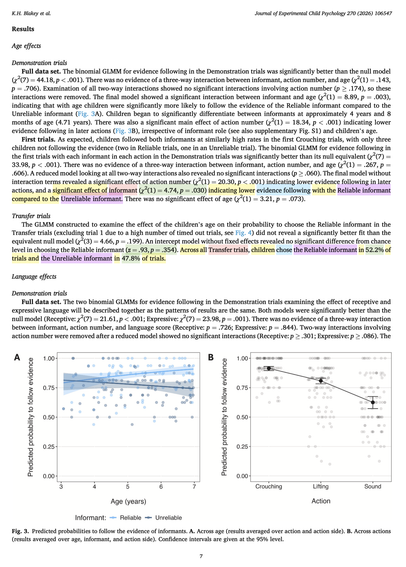
Can 3-6 year-olds distinguish between reliable vs. unreliable informants?
A study of 93 #kids found the children were sensitive to source reliability, with limited abilities to generalize across contexts.
RT this #ResearchOpportunity🔬🌟 A #postdoc opening in Dr. Rina Eiden's #research lab @ PSU! Dive into an RCT, learn about #substance use, and get the opportunity to collaborate and work with longitudinal datasets. 🤰#AcademicJobs #ScienceJobs #DevPsych
https://psu.wd1.myworkdayjobs.com/PSU_Academic/job/Penn-State-University-Park/Postdoctoral-Scholar---Development--Risk--and-Resilience-Lab_REQ_0000049015-1
#AcademicChatter #AcademicLife #PhD #PhDchat #WomenInAcademia
#PhDdone #DoctoralLife #PhDresearcher #PhDchatter #PostDoc #PosdoctoralScholar
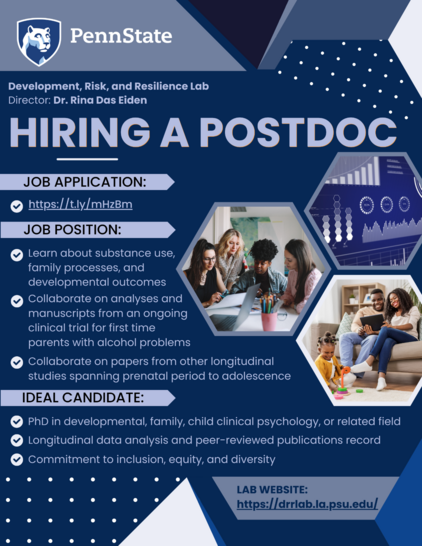

APPLICATION INSTRUCTIONS: CURRENT PENN STATE EMPLOYEE (faculty, staff, technical service, or student), please login to Workday to complete the internal application process. Please do not apply here, apply internally through Workday. CURRENT PENN STATE STUDENT (not employed previously at the university) and seeking employment with Penn State, please login to Workday to complete the student application process. Please do not apply here, apply internally through Workday. If you are NOT a current employee or student, please click “Apply” and complete the application process for external applicants. JOB DESCRIPTION AND POSITION REQUIREMENTS: The laboratory of Rina Eiden (Development, Risk, and Resilience (DRR) Lab: https://drrlab.la.psu.edu) at the Pennsylvania State University invites applications for a Postdoctoral Scholar position. The anticipated start date is as soon as possible. The position involves working primarily on data management, analyses, and manuscript preparation for a randomized clinical trial – Strong Family Foundations (SFF). SFF is a randomized clinical trial for expecting families with heavy drinking fathers/non-pregnant partners. SFF is an adaptation of a universal preventive intervention to include alcohol content combined with couple level brief motivational intervention to promote health behavior change at the transition to parenthood. The aims of this trial are to examine the intervention effects on fathers’/non-pregnant partners’ heavy drinking, parent adjustment, couple functioning, and co-parenting, as well as to examine these as mediators of intervention effects on parenting and infant regulation. Opportunities exist to engage in other aspects of the clinical trial and to work on existing data from other longitudinal cohort studies, spanning prenatal period to adolescence. More information on our research can be found at https://drrlab.la.psu.edu. Opportunities also exist in this role for working on your own research questions. The ideal applicant will have a Ph.D. in developmental, family, child clinical psychology, or a related field by the appointment date; an excellent background in longitudinal data analysis; a record of peer-reviewed publications; and an interest in developmental and prevention science. In addition, successful candidates must either have demonstrated a commitment to building an inclusive, equitable, and diverse campus community, or describe one or more ways they would envision doing so, given the opportunity. This term position is funded for one year from the date of hire, with a possible extension to two years. Salary and benefits follow NSF/NIH guidelines; more information on benefits can be found at https://www.research.psu.edu/opa/benefits. Applicants must submit an application online at Penn State’s Job Posting Board and should include the following as attachments: a CV, three reprints, and a one- to two-page statement of research interests. This statement should describe the candidate's goals for research and training during a postdoctoral position, including previous experience. System limitations allow for a total of 5 documents (5mb per document) as part of your application. Please combine materials to meet the 5-document limit. Applicants should arrange for two letters of recommendation to be sent separately to Rina Eiden at [email protected]. Review of applications will begin immediately and will continue until the position is filled. This position requires the following clearances: PA State Police Criminal Background Check, PA Child Abuse History Clearance Form, and Federal Bureau of Investigation (FBI) Fingerprint Criminal Background Check. Penn State is committed to and accountable for advancing diversity, equity, and inclusion in all of its forms. We embrace individual uniqueness, foster a culture of inclusion that supports both broad and specific diversity initiatives, leverage the educational and institutional benefits of diversity, and engage all individuals to help them thrive. We value inclusion as a core strength and an essential element of our public service mission. CAMPUS SECURITY CRIME STATISTICS: Pursuant to the Jeanne Clery Disclosure of Campus Security Policy and Campus Crime Statistics Act and the Pennsylvania Act of 1988, Penn State publishes a combined Annual Security and Annual Fire Safety Report (ASR). The ASR includes crime statistics and institutional policies concerning campus security, such as those concerning alcohol and drug use, crime prevention, the reporting of crimes, sexual assault, and other matters. The ASR is available for review here. Employment with the University will require successful completion of background check(s) in accordance with University policies. EEO IS THE LAW Penn State is an equal opportunity, affirmative action employer, and is committed to providing employment opportunities to all qualified applicants without regard to race, color, religion, age, sex, sexual orientation, gender identity, national origin, disability or protected veteran status. If you are unable to use our online application process due to an impairment or disability, please contact 814-865-1473. Federal Contractors Labor Law Poster PA State Labor Law Poster Affirmative Action Penn State Policies Copyright Information Hotlines University Park, PA There’s a reason Penn State consistently ranks among the top one percent of the world’s universities. Across 24 campuses, our 100,000 students and 40,000 faculty and staff know the real measure of success goes beyond the classroom – it’s the positive impact made on communities across the world. Our ideals stem from our origins as Pennsylvania’s sole land-grant institution, which allow us to continue to bring positive impact to humanity through our teaching, research, and engagement mission. And across the world is a community of Penn Staters – more than half a million strong – driven by that same spirit to serve our local and global communities. At Penn State, passion is met with collaboration in an environment that is rooted in shared pride for the accomplishments of our fellow students, faculty, staff, and alumni. Penn Staters cheer each other on to build a culture committed to service and engagement. Our University values represent our core ethical aspirations for all our daily activities and actions as students, faculty, staff, and volunteers at Penn State. Our values are as follows; Integrity, Respect, Responsibility, Discovery, Excellence, and Community. We Are Penn State. One Community. Impacting Many.
Do you expect #kids to learn #math better alone, collaboratively, or competitively?
In a study of 274 1st and 2nd graders, it varied by gender (and not how I would have expected).
Boys performed better after working alone or collaboratively, but didn’t seem to benefit from competition.
On the harder tasks, girls benefitted *only* from competition.
Autistic adults weren't more likely to report lying in everyday situations than non-autistic adults (p - 0.259).
Age and theory of mind predicted fewer lies from non-autistic adults, but not autistics adults.
Lie acceptability predicted more lies in both groups.
Do you expect higher-quality #dialogue in small group discussions or whole class discussions?
It might depend on the metric:
- small groups fostered more invitation for peers to weigh in (d = 0.78, p < 0.001)
- whole classes generated more justifications of one's viewpoint (d = 0.69, p < 0.001)
Loads more insight from Herculean corpus analyses involving over 4000 students from 5 countries: https://doi.org/10.1016/j.linged.2023.101223
#edu #teaching #argumentation #P4C #corpusLinguistics #textAsData #DevPsych
Will high school students' reflection test performance predict the reasoning preferences and habits it does in adults?
Rizek and Toplak report "patterns of correlations are generally consistent with what has been reported in adult samples" in a sample of over 300 9th through 12 graders from North America:
Cool little comment paper by Michael Frank on why LLMs and other Large Pre-Trained AI models can be fruitfully studied using methods and techniques coming from developmental psychology:
https://www.nature.com/articles/s44159-023-00211-x
I've been working on a similar approach to understanding such systems, so it's great to see such ideas get their chance in the Nature spotlight!
Large language models show remarkable capacities, but it is unclear what abstractions support their behaviour. Methods from developmental psychology can help researchers to understand the representations used by these models, complementing standard computational approaches — and perhaps leading to insights about the nature of mind.
(2/2) ...autistic people's “attention to detail” Autism Quotient subscores *strongly* predicted more reflection—significantly more than neurotypical participants' scores!
(z-scores mine)
These results of better matching help explain why scientists *sometimes* find a correlation between #autism and #reflection test performance: #attention to detail?
Find the free paper in Journal of #intelligence https://doi.org/10.3390/jintelligence11060124

The cognitive reflection test (CRT) is a short measure of a person’s ability to resist intuitive response tendencies, and to produce normatively correct responses that are assumed to be based on effortful, analytic thinking. A remarkable characteristic of the CRT is that although the questions are open-ended, for each item, the vast majority of people either produce a correct, analytic response or a typical incorrect (i.e., intuitive) response. This unique feature of the CRT makes it possible to investigate the question of whether autistic and neurotypical people share the same intuitions. We report a study that included adolescents and young adults. In both age groups, autistic and neurotypical participants were matched on age, gender, cognitive ability, and educational background. In line with previous findings, the results showed an age-related increase in analytic responding on the CRT, and a decrease in intuitive responding. Crucially, the proportion of both intuitive and analytic responses across autistic and neurotypical participants was identical in both age groups. The current results are in contrast with claims that autistic individuals have an increased tendency toward an analytic/rational type of processing, which is commonly attributed to an impairment within their intuitive reasoning mechanisms.
Teresa McCormack closed the #SPP2023 #preconference on #memory with “The value of remembering and anticipating experiences: a developmental perspective”
It was—as Teresa put it—dangerously close to an #xPhi talk. It adapted a famous thought experiment (from Derek Parfit?) to test kids’ and adults’ intuitions about how much we care about past, present, or future versions of us.
Follow Dr. McCormack on gScholar: https://scholar.google.com/citations?user=g9T7yn8AAAAJ&hl=en&oi=ao
Tamar Kushnir’s #SPP2023 presidential address tried to answer, “When do children become responsible for moral decisions?”
Evidence suggests people’s opinions vary by culture, as do laws, but there’s evidence that kids develop the ability to understand moral aspects of decisions (including that some decisions seem to be moral).
Find/follow Dr. Kushnir on gScholar: https://scholar.google.com/citations?user=TMuSMXoAAAAJ&hl=en
 Miglena Ivanova, M.S. 🧠🌶️
 Dimitri Coelho Mollo
