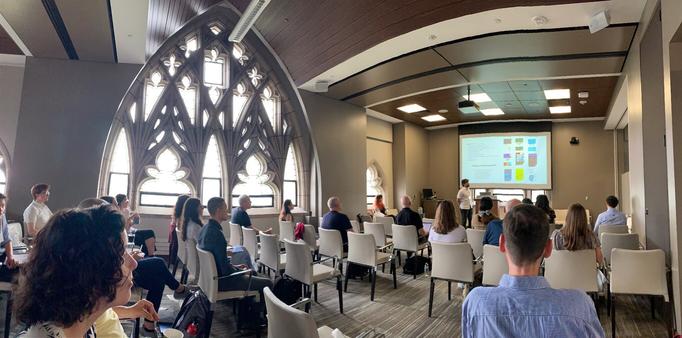
That wraps up my #SPP2023 experience. Thanks to Chantel and Jennifer for excellent logistics, Edouard Machery for local organizing, and Nadia Chernyak and Sara Aronowitz for co-charing the program!

As usual, I left the SPP thinking, "These are my people". I really hope I can attend again soon!
Teresa McCormack closed the #SPP2023 #preconference on #memory with “The value of remembering and anticipating experiences: a developmental perspective”

It was—as Teresa put it—dangerously close to an #xPhi talk. It adapted a famous thought experiment (from Derek Parfit?) to test kids’ and adults’ intuitions about how much we care about past, present, or future versions of us.

Follow Dr. McCormack on gScholar: https://scholar.google.com/citations?user=g9T7yn8AAAAJ&hl=en&oi=ao

#personalIdentity #PhilMind #psychology #devPsych #P4C

Teresa McCormack

Professor of Psychology, Queen's University Belfast - Cited by 5.167

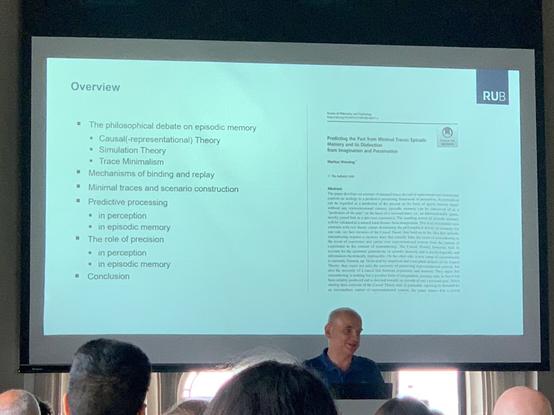
Markus Werning presented “Episodic memory as a predictive process: minimal hippocampal traces as error signals and the role of precision weights” at the #SPP2023 #preconference on #memory

Find Markus’s work on gScholar: https://scholar.google.com/citations?user=V87KRwsAAAAJ&hl=en&oi=ao

#neuroscience #computationalModeling

Markus Werning

Department of Philosophy, Ruhr University Bochum - Cited by 1.626 - Episodic Memory - Compositionality - Bayesian Pragmatics - Philosophy of Language - Epistemology

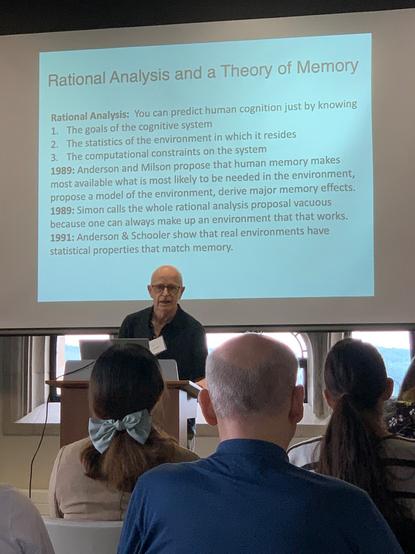
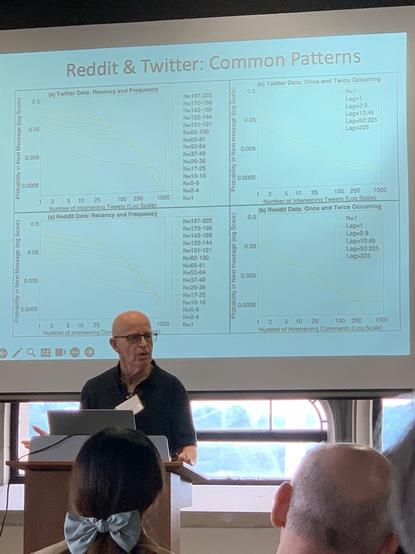
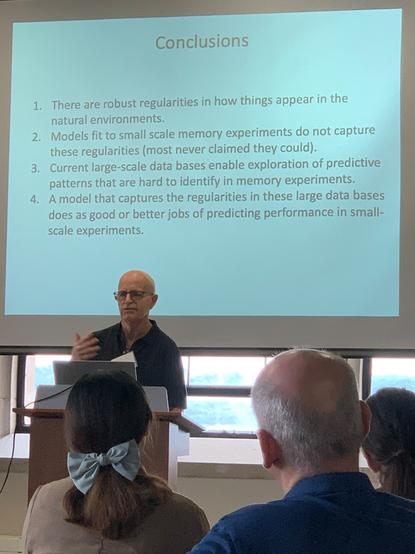
John Anderson presented “The Environmental Basis of Memory”, at #SPP2023’s #preconference on #memory.


Dr. Anderson applied “rational analysis” of human cognition (based on only goals, the environment, and constraints of the cognitive system) to explain memory (with Milson in 1989) and find evidence for this (with Schooler in 1991).

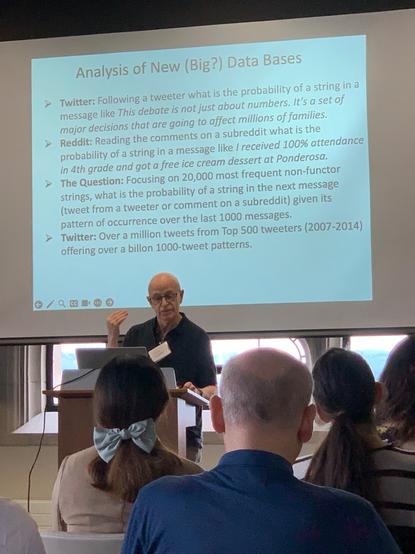
More recent #bigData from #Reddit and #Twitter fit the model.


Dr. Anderson’s career on gScholar: https://scholar.google.com/citations?user=PGcc-RIAAAAJ&hl=en&oi=ao

#cogSci #computationalModeling

John R Anderson

Professor of Psychology, Carnegie Mellon University - Cited by 161.846 - Cognitive Psychology

Catching up on the #SPP2023 #preconference on #memory:

Felipe De Brigaard introduced us to the topic and some recent trends before a series of talks ensued.

Find Felipe's work on gScholar: https://scholar.google.com/citations?user=l9gS2joAAAAJ&hl=en&oi=ao

#philosophy #PhilMind #PhilosophyOfMemory #google #nGram

Felipe De Brigard

Associate Professor, Duke University - Cited by 3.658 - Philosophy of Mind - Memory - Imagination - Counterfactual Thinking - Philosophy of Neuroscience

Tamar Kushnir’s #SPP2023 presidential address tried to answer, “When do children become responsible for moral decisions?”

Evidence suggests people’s opinions vary by culture, as do laws, but there’s evidence that kids develop the ability to understand moral aspects of decisions (including that some decisions seem to be moral).

Find/follow Dr. Kushnir on gScholar: https://scholar.google.com/citations?user=TMuSMXoAAAAJ&hl=en

#DevPsych #Ethics #PhilMind #cogSci #xPhi

Tamar Kushnir

Professor, Psychology & Neuroscience, Duke University - Cited by 4.720 - Cognitive Development - Causal Learning - Social Cognition - Social Learning - Moral Cognition

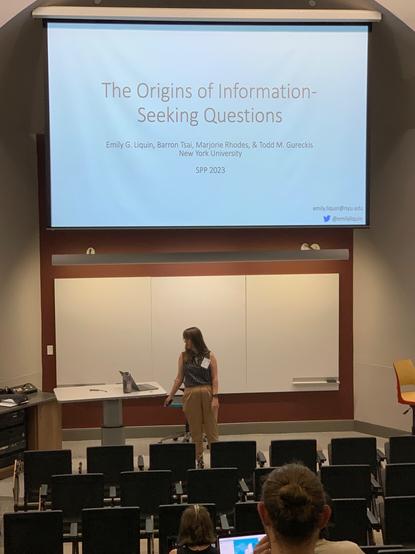
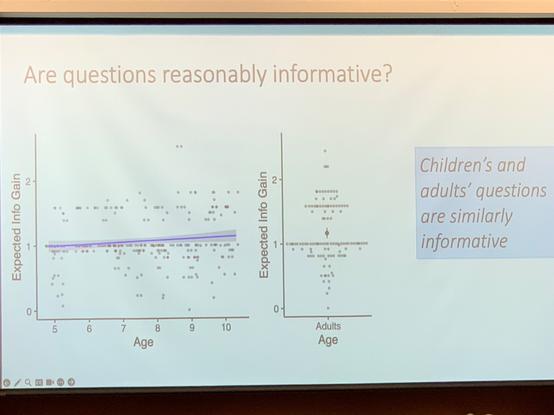
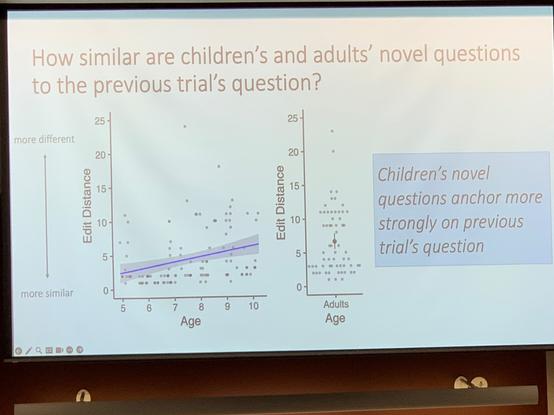
Emily Liquin presented “The Origins of Information-Seeking Questions”

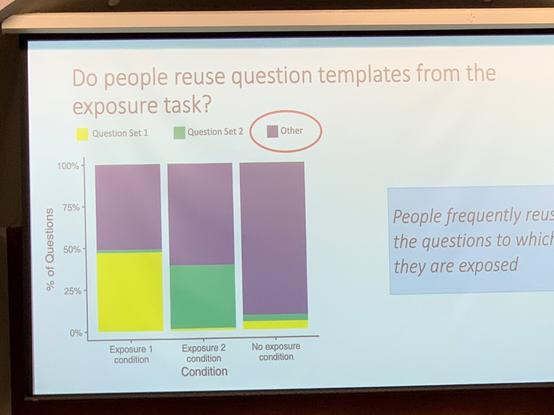
People
1. re-used previously seen “question templates”
2. even “novel" questions were similar to templates.

This anchoring decreased with age.

Curiously, older kids and adults didn’t ask questions that could reveal more information.

Collaborators: Barron Tsai, Marjorie Rhodes, & Todd Gureckis

Dr. Liquin’s on gScholar: https://scholar.google.com/citations?user=IdymDGQAAAAJ&hl=en&oi=ao

#xPhi #Epistemology #Rationality #Intelligence #Psychology #CogSci #SPP2023

Emily G. Liquin

New York University - Cited by 229

“Norm Emergence from Cognitive Biases and Cultural Transmission” presented by Scott Partington


Three experiments suggest that people
- Infer impermissibility from imprudence
- that impermissibility can be retained

Why care? Cuz we see biased pedagogy that caused this deontic inference in many developmental contexts (like teaching and parenting).


Collaborators: Rachana Kamtekar, Shaun Nichols

Scott’s on gScholar: https://scholar.google.com/citations?user=jAq0UGIAAAAJ&hl=en&oi=ao

#DevPsych #xPhi #ethics #teaching #cogSci #SPP2023

Scott Partington

University of Cambridge - Cited by 4 - philosophy of science - moral psychology - cognitive science

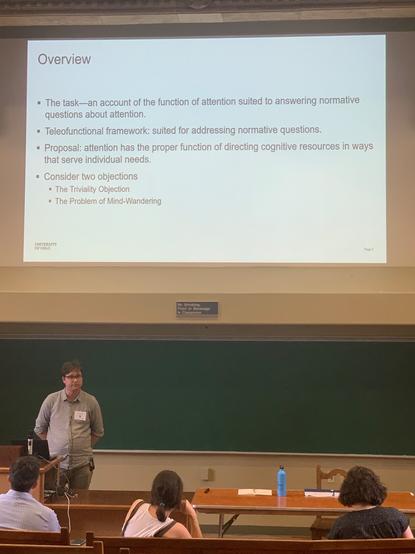
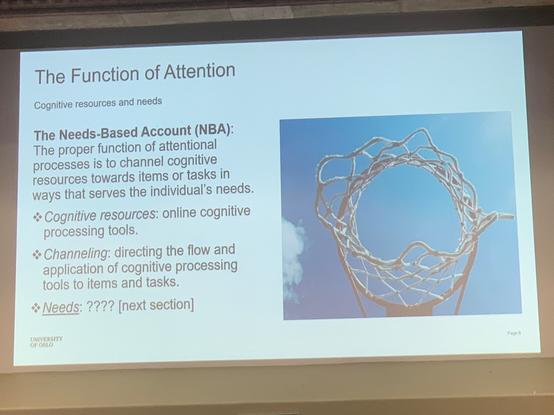
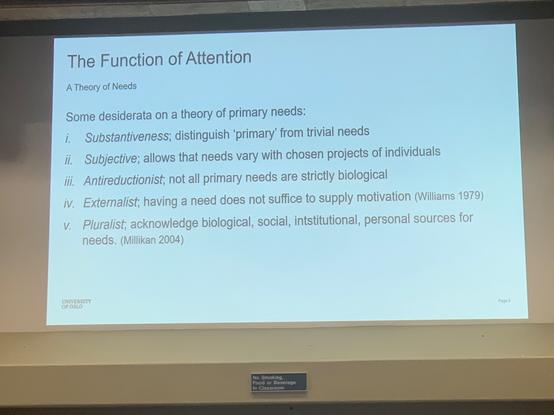
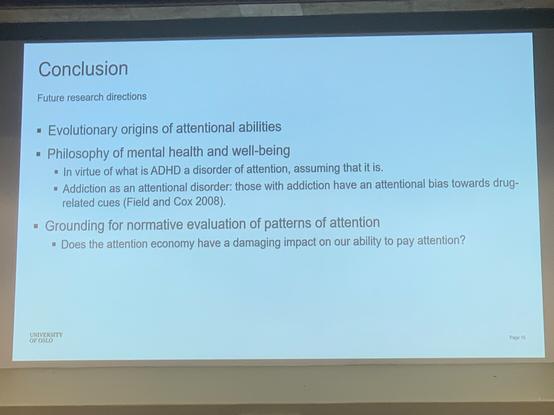
Drew Johnson presents a “Needs-Based Account” (NBA) of attention, develops some desiderata for “need”, considers two objections, and considers future directions in evolutionary psychology, clinical psychology, and epistemology.

You can find/follow Drew on PhilPeople: https://philpeople.org/profiles/drew-johnon


#SPP2023 #philosophyOfMind #CogSci #epistemology

Drew Johnson (University of Oslo) - PhilPeople

Drew Johnson is a post-doctoral fellow at University of Oslo, Department of Philosophy, Classics, History of Art and Ideas. They are interested in Epistemology, Meta-Ethics, Metaphysics and Epistemology, Social Epistemology, Skepticism, Self-Knowledge, Moral Disagreement, Moral Epistemology, Expression-Based Accounts of Self-Knowledge, and Moral Cognitivism. Follow them to stay up to date with their professional activities in philosophy, and browse their publications such as "Hinge Epistemology, Radical Skepticism, and Domain Specific Skepticism", "Deep Disagreement, Hinge Commitments, and Intellectual Humility", and "Disjunctive luminosity".

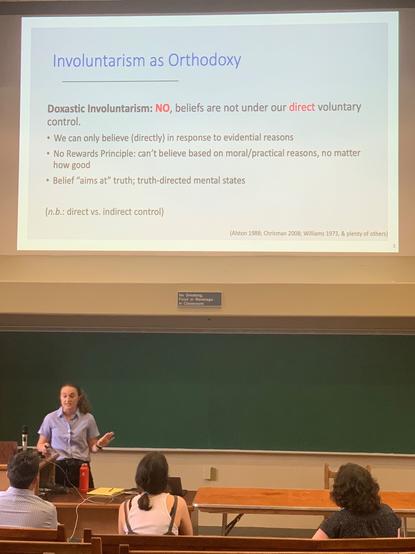
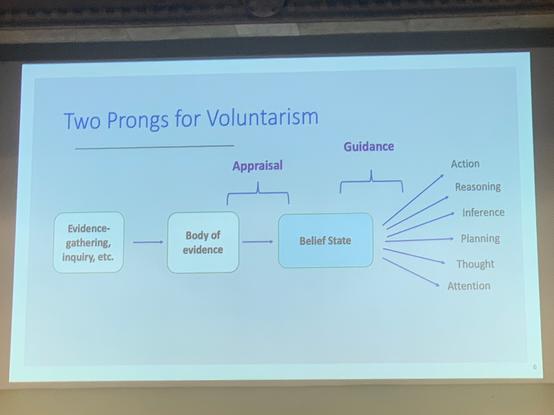
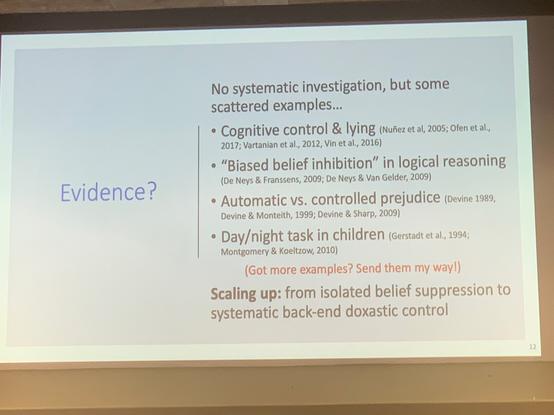
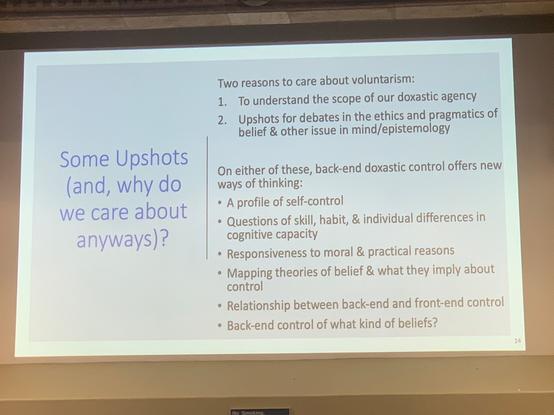
In "Rethinking (In)Voluntarism", Dr. Laura Soter points out that voluntarism has focused on the process of appraisal and then turns our attention to a “backend” or “indirect” control (evidence gathering, inquiry, etc.) of belief formation.

Soter argues we have this backend/indirect control and then responds to some objections, thereby reinvigorating doxastic voluntarism.

You can find/follow Laura research on gScholar: https://scholar.google.com/citations?user=LBIbs2YAAAAJ&hl=en&oi=ao

#xPhi #Epistemology #PhilMind #Psychology #SPP2023

Laura K Soter

Postdoctoral Research Associate, Duke University - Cited by 115 - cognitive science - philosophy of mind - ethics - moral psychology - epistemology