Die Onlineplattform filmportal.de ist die zentrale öffentliche Ressource zum deutschen Filmerbe und wird vom DFF – Deutsches Filminstitut & Filmmuseum betrieben – David Kleingers war von Beginn an ihrer Entwicklung beteiligt. In diesem Interview gibt er einen umfassenden Einblick in die Entstehung und Funktionsweise der Plattform.

Zum Interview: https://doi.org/10.5281/zenodo.17234420

Das Portal: https://www.filmportal.de/

#DigitalFilmHistory #DFF #DH #Databases #DataPractices #EN15907 #Standards #FilmStudies

Standardisierung von Filmdaten auf filmportal.de. Interview mit David Kleingers

Die Onlineplattform filmportal.de ist die zentrale öffentliche Ressource zum deutschen Filmerbe und wird vom DFF – Deutsches Filminstitut & Filmmuseum betrieben (DFF) – David Kleingers war von Beginn an ihrer Entwicklung beteiligt. In diesem Interview gibt er einen umfassenden Einblick in die Entwicklung und Funktionsweise der Plattform und anderen Informationssystemen des DFF. Er erläutert die Standardisierung von Filmdaten auf Basis des Standards EN 15907, der für den Datenaustausch zwischen Filmarchiven entwickelt wurde. Außerdem betont Kleingers die Bedeutung historischer Quellen für die nachvollziehbare Dokumentation des Filmerbes und weist auf Lücken in der Digitalisierung hin. Dabei verweist er auf Herausforderungen im Zusammenhang mit geschlechtsspezifischen Kategorisierungen von Berufen und betont die Notwendigkeit einer inklusiveren Darstellung der Daten. Das Interview ist Teil einer fortlaufenden Interviewreihe zu Datenpraktiken, Datenprovenienz und Kategorisierungen in der Filmgeschichte, die von der BMFTR-Forschungsgruppe „Ästhetiken des Zugangs. Datenvisualisierungen in der digitalen Filmgeschichtsschreibung am Beispiel der Forschung zu Frauen im Frühen Kino“ (DAVIF) (2021–2025) initiiert wurde. Ziel der Forschungsgruppe ist es, Datenvisualisierungen zu erstellen, um die Tätigkeiten von Frauen in der Filmgeschichte sichtbarer zu machen. Das DFF – Deutsches Filminstitut & Filmmuseum (DFF) gehört neben dem Women Film Pioneers Project (WFPP) zu den zentralen Kooperationspartner*innen des Projekts, die ihre Forschungsdaten für die Datenvisualisierungen zur Verfügung gestellt haben. Die Interviewsammlung: https://doi.org/10.5281/zenodo.17233942  Zur Projektwebsite: https://uni-marburg.de/Q85oo 

Zenodo

Kate Saccone has served as a project manager for the Women Film Pioneers Project (WFPP) since 2013. In her interview, she talks about the origins, community, and editorial practices of the WFPP and addresses the platform's role as a social networking space for feminist film historians. She also outlines the WFPP's strategies for long-term preservation and accessibility.

https://doi.org/10.5281/zenodo.17234442

#FeministFilmHistory #WFPP #DigitalScholarlyPublishing #Metadata #EarlyCinema #DH #DataPractices

On the Origins, the Community, and the Database of the Women Film Pioneers Project. Interview with Kate Saccone

In this interview, Kate Saccone, project manager of the Women Film Pioneers Project (WFPP) since 2013, reflects on the origins, the community, and the database of the WFPP. She highlights the role of the WFPP as a digital platform for research and publication. The interview discusses the handling of gaps, ambiguities, and absences in the data, accessibility, licensing, and long-term preservation of digital content, particularly with regard to Creative Commons licenses and technical infrastructure. Saccone addresses the WFPP as a social networking space for feminist film historians and outlines future developments for the project. The interview is part of an interview series on data practices, provenance, and categorizations in film history initiated by the research group „Aesthetics of Access. Visualizing Research Data on Women in Film History“ (DAVIF) (2021–2025), funded by the German Federal Ministry of Research, Technology and Space (BMFTR). The goal of the research group is to explore data visualizations in order to tell different stories differently. The WFPP is one of the film historiographical project partners, in addition to the DFF – Deutsches Filminstitut & Filmmuseum (DFF), both of whom have provided their research data for data visualizations. The interview series: https://doi.org/10.5281/zenodo.17233942 The project website: https://uni-marburg.de/Q85oo

Zenodo

'Chief author Rep. Steve Elkins, DFL-Bloomington, said it’s time for more oversight on the troves of personal information consumers provide to businesses, knowingly or not. That includes data harvested by seemingly free applications like weather apps, which may sell the information to turn a profit. …

'“If you got turned down for an apartment or for a favorable insurance rate or a job and the company is just telling you, ‘Sorry I can’t tell you that’ — now, they have a responsibility to tell you,“ he said.'
https://www.startribune.com/law-taking-effect-this-week-empowers-minnesotans-to-request-delete-personal-consumer-data/601394237?utm_source=gift

#Minnesota #DataPractices #ConsumerProtection

Minnesota offers new protections to control ‘staggering’ amounts of personal info

Attorney General Keith Ellison’s office is staffing up to investigate complaints that will be filed against businesses under the new law.

✨ Such a delight to officially launch our new book "Doing Digital Film History. Concepts, Tools, Practices" at #NECS25! 📕Huge thanks to my brilliant co-editors, the inspiring contributions, and the fantastic team at De Gruyter! Check it out 👉 https://www.degruyterbrill.com/document/doi/10.1515/9783111082486/html

#DigitalFilmHistory #MediaStudies & #DH #DataPractices #DataViz

👋 We are looking for a Machine Learning team (industry or research) who want to review and refine their data practices for improved documentation and reflexivity of their ML data workflow and better ML model outcomes. Is that you? Reach out!

This collaboration can take different shapes: jointly evaluating datasets, organizing workshops, action research, or other activities. More information and some options here: https://justsustainabilitydesign.org/2025/03/27/dcml_project_recruitment.html

#ML #datacuration #MachineLearning #AI #datapractices

Research Collaboration Opportunity: Data Curation in Machine Learning

Technologies for Just and Sustainable Communities.

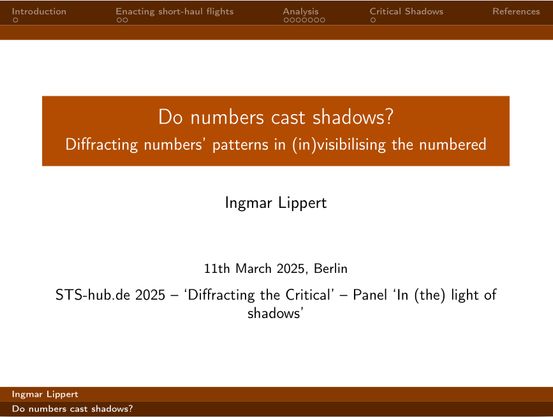
Presenting today from 3pm @ #stshub2025 Panel 8 – In (the) light of shadows, room 1.404

Do numbers cast shadows? Diffracting numbers’ patterns in (in)visibilising the numbered.

I shall try to think with #Barad's take on the dynamic entangled effects of lights and shadows within #datapractices and #number work in mudane capitalist-adminstrative forms of #EnvironmentalGovernance.

On to 36 hours of #EnvironmentalSTS #STS teaching at @KAEEGoetheUni of #GoetheUniversity. Starting with a class on #ethnography, continuing with 6 hours of seminar discussions of #fish, #valuationstudies, #EnvironmentalGovernance, #environmentalJustice, #DataPractices, #AnthroSTS, #SociologyOfQuantification. Tomorrow we do a field trip and meet an #hydropower manager and a #fishery expert and explore a dam and various locally entangled #natures & #infrastructures close to #Frankfurt.
Upcoming conference on #VoiceAssistants, their #linguistic inclusion in everyday #practices, and the e/valuation of connected #DataPractices:
Voice Assistants in Private Homes: Media, Data and Language in Interaction and Discourse https://u-si.de/03FM6
Conference: „Voice Assistants in Private Homes: Media, Data and Language in Interaction und Discourse“ » Medien der Kooperation

On to the second day of the #STShubDe, starting for me with a session on #enviromental #STS, continuing later with a session on #Critical #Data & #SoftwareStudies, giving a paper based on a theoretical sociological analysis of concepts of ontology, illustrated by my data on #datapractices in #EnvironmentalManagement. Before the subsequent keynote by #SusannWagenknecht on leakage, and the Open Forum #WeDoSTS.
Environmental Data, Media, and the Humanities: Henriette Herz Fellowship and Hackathon in Berlin

critical engagements with digital data, methods and infrastructures

jonathan w. y. gray