#statstab #540 Measures of Central Tendency for an Asymmetric Distribution, and Confidence Intervals
Thoughts: Pseudomedian, Central Limit Theory, and more.
#CLT #pseudomedian #confidenceintervals #distributions #signedranktest
https://www.fharrell.com/post/aci/
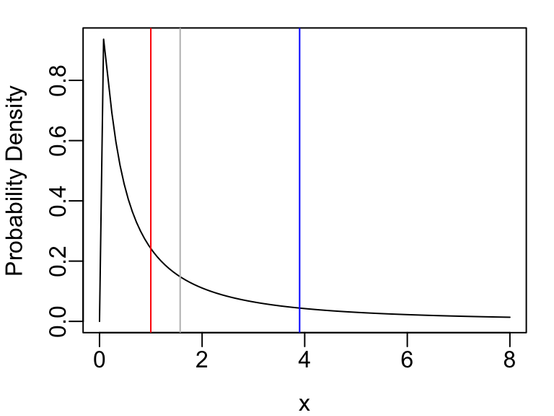
Measures of Central Tendency for an Asymmetric Distribution, and Confidence Intervals – Statistical Thinking
There are three widely applicable measures of central tendency for general continuous distributions: the mean, median, and pseudomedian (the mode is useful for describing smooth theoretical distributions but not so useful when attempting to estimate the mode empirically). Each measure has its own advantages and disadvantages, and the usual confidence intervals for the mean may be very inaccurate when the distribution is very asymmetric. The central limit theorem may be of no help. In this article I discuss tradeoffs of the three location measures and describe why the pseudomedian is perhaps the overall winner due to its combination of robustness, efficiency, and having an accurate confidence interval. I study CI coverage of 18 procedures for the mean, one exact and one approximate procedure for the median, and five procedures for the pseudomedian, for samples of size \(n=200\) drawn from a lognormal distribution. Various bootstrap procedures are included in the study. The goal of the confidence interval procedures is to achieve non-coverage probabilities that are close to the nominal 0.025 level in both tails. The usual standard deviation-based central limit theorem approach failed in both tails. The BCa bootstrap method was the most accurate for computing confidence limits for the mean, but the upper limit was too small with \(n=200\), having non-coverage probability of 0.086 for the right tail instead of the nominal 0.025. Three types of intervals for the more robust pseudomedian were extremely accurate, giving more reasons to use the pseudomedian as a primary location measure, whether or not the distribution is symmetric.
How to interpret “confidence intervals” in observational studies
This question complements the one in the thread Random sampling versus random allocation/randomization- implications for p-value interpretation. Given that observational studies involve neither random sampling nor random allocation, why are they riddled with “95% confidence intervals”?
@n_dimension Well it all is very interesting. The pursuit of evidence continues. We can realistically expect reasonable
#ConfidenceIntervals on a few things that were considered complete
#Nutterville scenarios in the past. It's fun doing the work. That may be what actually makes the difference

Sampling Error
Part 1c of Sampling and Confidence Intervals by Dr. Alvin Ang
#statstab #421 Sample Size Planning for Statistical Power and Accuracy in Parameter Estimation
Thoughts: AIPE is based on controlling the width of the CI.
Sample size can be computed independent of effect size!
#samplesize #confidenceintervals #AIPE #power #poweranalysis #precision #accuracy #research #design
https://www.annualreviews.org/content/journals/10.1146/annurev.psych.59.103006.093735
Sample Size Planning for Statistical Power and Accuracy in Parameter
Estimation | Annual Reviews
This review examines recent advances in sample size planning, not only from the
perspective of an individual researcher, but also with regard to the goal of
developing cumulative knowledge. Psychologists have traditionally thought of
sample size planning in terms of power analysis. Although we review recent
advances in power analysis, our main focus is the desirability of achieving
accurate parameter estimates, either instead of or in addition to obtaining
sufficient power. Accuracy in parameter estimation (AIPE) has taken on
increasing importance in light of recent emphasis on effect size estimation and
formation of confidence intervals. The review provides an overview of the logic
behind sample size planning for AIPE and summarizes recent advances in
implementing this approach in designs commonly used in psychological
research.
#statstab #357 Uncertainty Estimation with Conformal Prediction
Thoughts: Haven't parsed this properly but maybe be an interesting discussion point. How best to quantify uncertainty?
#conformalprediction #bayesian #confidenceintervals #uncertainty
https://m-clark.github.io/posts/2025-06-01-conformal/
Uncertainty Estimation with Conformal Prediction – Michael Clark
More options for uncertainty estimation
#statstab #337 Confidence intervals and tests are two sides of the same research question
Thoughts: Comment describing the connection between NHST p-values/test and Confidence Intervals (CI).
#NHST #ConfidenceIntervals #pvalues #frequentist #estimation
https://doi.org/10.3389/fpsyg.2015.00034

What fraction of repeat experiments will have an effect size within the 95% confidence interval of the first experiment?
Let's stick to an ideal situation with random sampling, Gaussian populations, equal variances, no P-hacking, etc.
Step 1. You run an experiment say comparing two sample means, and compute a 95%
#statstab #312 {presize} pkg: Understanding Precision-Based Sample Size Calculations
Thoughts: Do you care about effect sizes? Then precision-based planning is for you. Expect higher Ns!
#r #samplesize #precision #estimation #power #Confidenceintervals
https://library.virginia.edu/data/articles/understanding-precision-based-sample-size-calculations
Understanding Precision-Based Sample Size Calculations | UVA Library
 Dr Mircea Zloteanu 🌺🌞🍃
 KilleansRow 🇺🇲 🇺🇦🍀
 aicoder
 CSTBooks