 Dr Mircea Zloteanu 🌺🌞🍃
#statstab #540 Measures of Central Tendency for an Asymmetric Distribution, and Confidence Intervals
Thoughts: Pseudomedian, Central Limit Theory, and more.
#CLT #pseudomedian #confidenceintervals #distributions #signedranktest
Measures of Central Tendency for an Asymmetric Distribution, and Confidence Intervals – Statistical Thinking
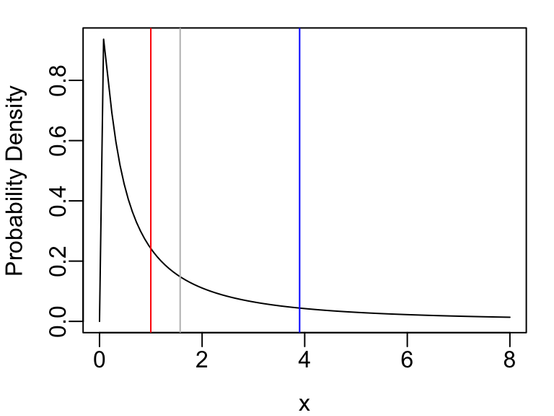
There are three widely applicable measures of central tendency for general continuous distributions: the mean, median, and pseudomedian (the mode is useful for describing smooth theoretical distributions but not so useful when attempting to estimate the mode empirically). Each measure has its own advantages and disadvantages, and the usual confidence intervals for the mean may be very inaccurate when the distribution is very asymmetric. The central limit theorem may be of no help. In this article I discuss tradeoffs of the three location measures and describe why the pseudomedian is perhaps the overall winner due to its combination of robustness, efficiency, and having an accurate confidence interval. I study CI coverage of 18 procedures for the mean, one exact and one approximate procedure for the median, and five procedures for the pseudomedian, for samples of size \(n=200\) drawn from a lognormal distribution. Various bootstrap procedures are included in the study. The goal of the confidence interval procedures is to achieve non-coverage probabilities that are close to the nominal 0.025 level in both tails. The usual standard deviation-based central limit theorem approach failed in both tails. The BCa bootstrap method was the most accurate for computing confidence limits for the mean, but the upper limit was too small with \(n=200\), having non-coverage probability of 0.086 for the right tail instead of the nominal 0.025. Three types of intervals for the more robust pseudomedian were extremely accurate, giving more reasons to use the pseudomedian as a primary location measure, whether or not the distribution is symmetric.