 R. K. W. Donahue
Investigating the Impact of Chatbots on Mental Wellbeing - Thursday, June 4, 2026, 11:30a-12:30pm CT.
Event Details: https://pulitzercenter.org/event/investigating-impact-chatbots-mental-wellbeing
Registration/Submit Questions: https://events.zoom.us/ev/Ap7zVIYqqMbr5-NaCV7a3qVxIHzPK2xqm5cfrFxD8ZeHoG8woq29~AtpLN9XFIPeClJEaEaWuOMsZ4iX3lxrXZxHMGb1WvvMXEwJhAkQafDwM8A
#AI #ArtificialIntelligence #genAI #generativeAI #MentalHealth #wellness #chatbot #chatbots
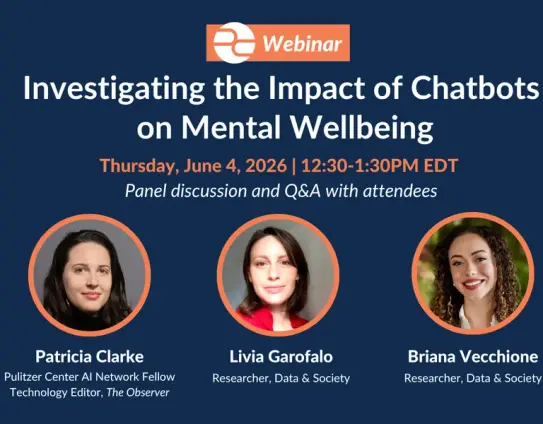
Investigating the Impact of Chatbots on Mental Wellbeing
Image How is engagement with chatbots impacting the mental wellbeing of users worldwide? What needs to be better understood about the ways that chatbots are designed and how interactions with chatbots can lead users to feel increased loneliness and emotional dependency? Join us for a webinar on Thursday, June 4, 2026, 12:30-1:30pm EDT, to explore these questions in a conversation with Pulitzer Center AI Accountability Network Fellow Patricia Clarke, as well as Data & Society researchers Livia Garofalo and Briana Vecchione. The discussion will be moderated by Pulitzer Center staff, and will also explore the methods panelists used to plan and execute their investigations. The discussion will be followed by a Q&A with attendees. Clarke’s Center-supported project, An AI Risk to Mental Health for The Observer, examines how the design of leading AI chatbots—systems built to be agreeable, flattering, and affirming—may be contributing to a rise in psychiatric harms among some users, including cases of psychosis and mania. Garofalo and Vecchione’s research explores how people use large language models for companionship and emotional or therapeutic support. They recently published the piece “All the Lonely People,” discussing some initial findings from their research. The full report is coming this fall. Click here to register and share your questions for the panelists. Participants Patricia Clarke is a 2025 Pulitzer Center AI Accountability Network Fellow. She is a technology journalist at The Observer and reports on the ways emerging technologies are reshaping lives, business, and power. Briana Vecchione is a researcher at the Data & Society Research Institute. She explores what happens when people turn to AI for socioemotional use—particularly with respect to mental health, therapeutic support, and the spectrum of AI companionship. Vecchione holds a doctorate in information science from Cornell University, and her work has received support from the NSF, MacArthur Foundation, Mozilla Foundation, Google, Meta, and Microsoft. Livia Garofalo is a cultural and medical anthropologist, and a researcher at Data & Society, where she focuses on technologies and the infrastructures of health care. She is interested in understanding how people experience and make meaning in times of crisis, how technology and AI are mobilized, and how power and subjectivity show up in everyday life. Garofalo holds a doctorate in anthropology and a master’s in public health from Northwestern University. Her work has been funded by NSF, Fulbright, Wenner-Gren, and the Internet Society Foundation.
 Rod2ik 🇪🇺 🇨🇵 🇪🇸 🇨🇱 🇺🇦 🇨🇦 🇬🇱 ☮🕊️
 Rod2ik 🇪🇺 🇨🇵 🇪🇸 🇨🇱 🇺🇦 🇨🇦 🇬🇱☮🕊️
 Jacob Alexander Tice
 McDonald_69
 Spatialists
 BGDon 🇨🇦 🇺🇸 👨💻
 numerama
 Kadda
Kadda
 Renaud JOLY