👏#call4reading

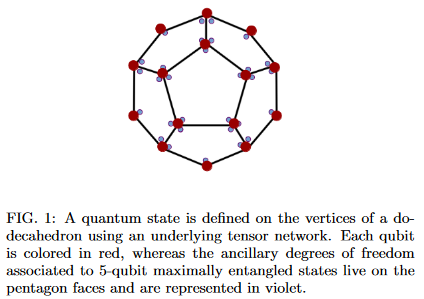
✍️Platonic #entanglement #by Jose I. Latorre and German Sierra

🔗10.26421/QIC21.13-14-1 (#arXiv:2107.04329)

#Entanglement #TensorNetworks

Interested in #QuantumMechanics, #QuantumSimulation, or #TensorNetworks? Well, check out my #PhD thesis:

"Parallel Tensor Network Methods for Quantum Lattice Systems: Matrix Product State Simulations on a Supercomputer"

Available to download from my personal website: http://www.secular.me.uk/

Because of the growing multidisciplinary interest in tensor networks, I've tried to make the #thesis as self-contained as possible. I am hoping it will be useful for #Physics, #Chemistry, #Mathematics, and #ComputerScience graduates meeting tensor networks for the first time. It features 700+ references, 100+ figures, 15 epigraphs, and a list of eponyms!

P. M. Secular

The personal website of P. M. Secular including his research on tensor networks, quantum mechanics, and physics education.

Independent verification of results is an important part of the #scientific process. However - in #physics at least - #replication and #verification studies rarely seem to be published. Despite this, I decided to attempt to verify the results of a groundbreaking Nature Physics paper from 2012, in which the authors describe the first dynamical #quantum #simulator. You can read the fruits of my labour in my #arxiv preprint: "Classical verification of a quantum simulator: local relaxation of a 1D Bose gas". I hope you find it interesting.

https://scirate.com/arxiv/2401.05301

#ScientificProcess #QuantumSimulator #QuantumSimulation #QuantumAdvantage #science #ClassicalVerification #ComputationalPhysics #ParallelComputing #HPC #HighPerfomanceComputing #supercomputer #TensorNetworks #MatrixProductStates #TEBD

Classical verification of a quantum simulator: local relaxation of a 1D Bose gas

In [Nat. Phys. 8, 325-330 (2012)], Trotzky et al. utilize ultracold atoms in an optical lattice to simulate the local relaxation dynamics of a strongly interacting Bose gas "for longer times than present classical algorithms can keep track of". Here, I classically verify the results of this analog quantum simulator by calculating the evolution of the same quasi-local observables up to the time at which they appear "fully relaxed". Using a parallel implementation of the time-evolving block decimation (TEBD) algorithm to simulate the system on a supercomputer, I show that local densities and currents can be calculated in a matter of days rather than weeks. The precision of these numerics allows me to observe deviations from the conjectured power-law decay and to determine the effects of the harmonic trapping potential. As well as providing a robust benchmark for future experimental, theoretical, and numerical methods, this work serves as an example of the independent verification process.

SciRate

Happy our paper on reviving product states in the disordered Heisenberg model has finally been published in Nat. Comms. @Nature

https://www.nature.com/articles/s41467-023-41464-7

We show that the paradigmatic model for many-body localization hosts product state that show periodic high-fidelity revivals and local observables that oscillate indefinitely. The system neither equilibrates nor thermalizes.

#manybodyphysics #manybodylocalization #nonequilibriumdynamics
#TensorNetworks

Reviving product states in the disordered Heisenberg chain - Nature Communications

Many-body localized systems are believed to reach a stationary state without thermalizing. By using analytical and numerical calculations, the authors construct simple initial states for a typical MBL model, which neither equilibrate nor thermalize, similar to non-ergodic behavior in many-body scarred systems.

Nature

[thread] ML, tensor-based models

Enhancing Deep Learning Models through Tensorization: Comprehensive Survey & Framework
https://arxiv.org/abs/2309.02428

* comprehensive overview of tensorization
* bridges gap betw. inherently multidimensional nature of data, simplified 2D matrices used in linear algebra-based ML algorithms

#ML #MachineLearning #tensors #tensorization #LinearAlgebra #matrices #Python #dimensionality #DNN #NeuralNetworks #HilbertSpace #TuckerDecomposition #TensorNetworks #graphs

Enhancing Deep Learning Models through Tensorization: A Comprehensive Survey and Framework

The burgeoning growth of public domain data and the increasing complexity of deep learning model architectures have underscored the need for more efficient data representation and analysis techniques. This paper is motivated by the work of (Helal, 2023) and aims to present a comprehensive overview of tensorization. This transformative approach bridges the gap between the inherently multidimensional nature of data and the simplified 2-dimensional matrices commonly used in linear algebra-based machine learning algorithms. This paper explores the steps involved in tensorization, multidimensional data sources, various multiway analysis methods employed, and the benefits of these approaches. A small example of Blind Source Separation (BSS) is presented comparing 2-dimensional algorithms and a multiway algorithm in Python. Results indicate that multiway analysis is more expressive. Contrary to the intuition of the dimensionality curse, utilising multidimensional datasets in their native form and applying multiway analysis methods grounded in multilinear algebra reveal a profound capacity to capture intricate interrelationships among various dimensions while, surprisingly, reducing the number of model parameters and accelerating processing. A survey of the multi-away analysis methods and integration with various Deep Neural Networks models is presented using case studies in different application domains.

arXiv.org

A 3-year #Postdoc position at @BCAMBilbao with Jean Bernard Bru and I on mathematical aspects of quantum information (#QuantumComputation, #algorithms or #metrology)

www.bcamath.org/en/research/job/ic2023-01-postdoctoral-fellowship-in-mathematics-of-quantum-many-body-problems-and-quantum-information-science

Soon another 2-year position with Luis Vega on #QuantumChannels and #TensorNetworks.

#Tensornetworks help to solve the puzzle of the ground state of the spin-1/2 Heisenberg anti-ferromagnet on the #Shuriken lattice.

https://scirate.com/arxiv/2211.16932

Tensor network study of the spin-$1/2$ Heisenberg anti-ferromagnet on the Shuriken lattice

We investigate the ground state of the spin $S=1/2$ Heisenberg anti-ferromagnet on the Shuriken lattice, also in the presence of an external magnetic field. To this end, we employ two-dimensional tensor network techniques based on infinite projected entangled pair and simplex states considering states with different sizes of the unit cells. We show that a valence bond crystal with resonances over length six loops emerges as the ground state (at any given finite bond dimension) yielding the lowest reported estimate of the ground state energy $E_0/J = -0.4410 \pm 0.0001$ for this model, estimated in the thermodynamic limit. We also study the model in the presence of an external magnetic field and find the emergence of $0$, $1/3$ and $2/3$ magnetization plateaus with states respecting translation and point group symmetries, that feature loop-four plaquette resonances instead.

SciRate
Today's #arXivsummary: https://arxiv.org/abs/2211.14389 by Veríssimo et. al. Authors investigate the interplay between dissipation and symmetry-protected topological order in a dissipative Spin-1 Affleck-Kennedy-Lieb-Tasaki model via tensor network techniques. For time-reversal symmetric dissipation, topological signatures remain. #CondMat #StrEl #OpenSystems #TensorNetworks #arXiv_2211_14389
Dissipative Symmetry-Protected Topological Order

In this work, we investigate the interplay between dissipation and symmetry-protected topological order. We considered the one-dimensional spin-1 Affleck-Kennedy-Lieb-Tasaki model interacting with an environment where the dissipative dynamics are described by the Lindladian master equation. The Markovian dynamics is solved by the implementation of a tensor network algorithm for mixed states in the thermodynamic limit. We observe that, for time-reversal symmetric dissipation, the resulting steady state has topological signatures even if being a mixed state. This is seen in finite string-order parameters as well as in the degeneracy pattern of singular values in the tensor network decomposition of the reduced density matrix. We also show that such features do not appear for non-symmetric dissipation. Our work opens the way toward a generalized and more practical definition of symmetry-protected topological order for mixed states induced by dissipation.

arXiv.org

An absolute joy is coming back to a paper I struggled with two years ago and being "Huh, this makes sense to me now! Noice!" 😁

#QuantumComputing #TensorNetworks #DMRG

In Episode 4, we talked to Prof. Román Orús about #TensorNetworks, #QuantumAlgorithms and #QuantumInspired techniques.

We heard about how algorithms that originated in many-body physics could be put to use in solving real-world optimisation problems and how #MultiverseQC is applying these techniques with real clients in areas such as finance.

Take a listen to the episode if you'd like to know more - available on all good podcasting platforms!

https://youtu.be/TnE96-oIyfU

#QuantumInformation #Multiverse #QuantumComputing #DMRG #Tensors #ManyBodyPhysics #Quantum #insideQuantum #DIPC #QuantumTechnology

insideQuantum: Episode 4 - Prof Román Orús

YouTube