From
@PLOS #Computational #Biology | Ten simple rules for training scientists to make better software |
#TSRPLOSCB #Education #Bioinformatics #softwaredevelopment | I like Rule 7: Encourage collaboration within mixed-ability groups | journals.plos.org/ploscompbiol...

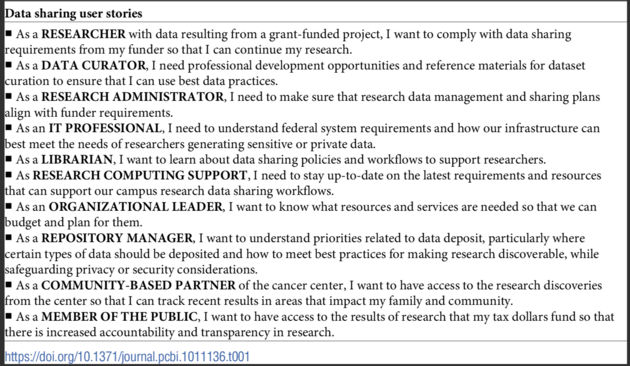
Ten simple rules for organizations to support research data sharing

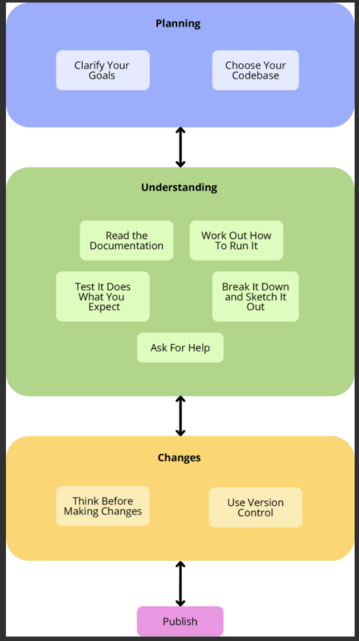
Ten simple rules for working with other people’s code
From
@PLOS #ComputationalBiology | Ten simple rules for socially responsible science |
#TSRPLOSCB #PLOSCB #Education | As an editor I have to like Rule 7: Seek a rigorous review and editorial processes , but I also like Rule 9: Address criticism from peers and the general public with respect |
https://journals.plos.org/ploscompbiol/article?id=10.1371/journal.pcbi.1010954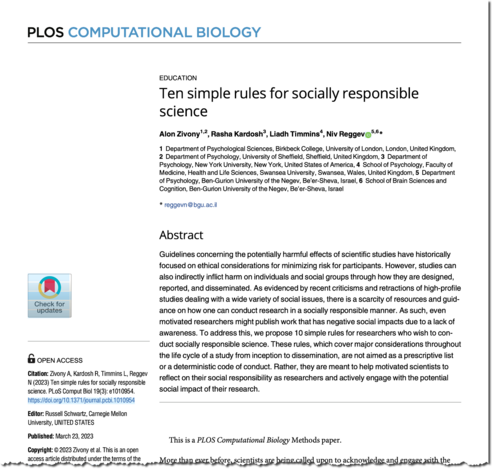
Ten simple rules for socially responsible science
Guidelines concerning the potentially harmful effects of scientific studies have historically focused on ethical considerations for minimizing risk for participants. However, studies can also indirectly inflict harm on individuals and social groups through how they are designed, reported, and disseminated. As evidenced by recent criticisms and retractions of high-profile studies dealing with a wide variety of social issues, there is a scarcity of resources and guidance on how one can conduct research in a socially responsible manner. As such, even motivated researchers might publish work that has negative social impacts due to a lack of awareness. To address this, we propose 10 simple rules for researchers who wish to conduct socially responsible science. These rules, which cover major considerations throughout the life cycle of a study from inception to dissemination, are not aimed as a prescriptive list or a deterministic code of conduct. Rather, they are meant to help motivated scientists to reflect on their social responsibility as researchers and actively engage with the potential social impact of their research.
From
@PLOS #ComputationalBiology | Ten simple rules for designing and conducting undergraduate replication projects |
#TSRPLOSCB #Education #openScience #OpenEducation | I like Rule 4: Encourage open communication and collaboration with the original authors |
https://journals.plos.org/ploscompbiol/article?id=10.1371/journal.pcbi.1010957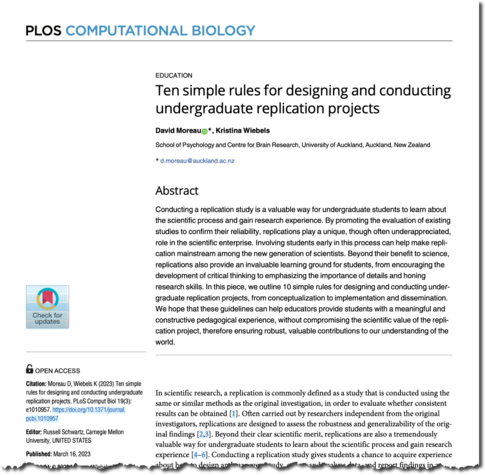
Ten simple rules for designing and conducting undergraduate replication projects
Conducting a replication study is a valuable way for undergraduate students to learn about the scientific process and gain research experience. By promoting the evaluation of existing studies to confirm their reliability, replications play a unique, though often underappreciated, role in the scientific enterprise. Involving students early in this process can help make replication mainstream among the new generation of scientists. Beyond their benefit to science, replications also provide an invaluable learning ground for students, from encouraging the development of critical thinking to emphasizing the importance of details and honing research skills. In this piece, we outline 10 simple rules for designing and conducting undergraduate replication projects, from conceptualization to implementation and dissemination. We hope that these guidelines can help educators provide students with a meaningful and constructive pedagogical experience, without compromising the scientific value of the replication project, therefore ensuring robust, valuable contributions to our understanding of the world.
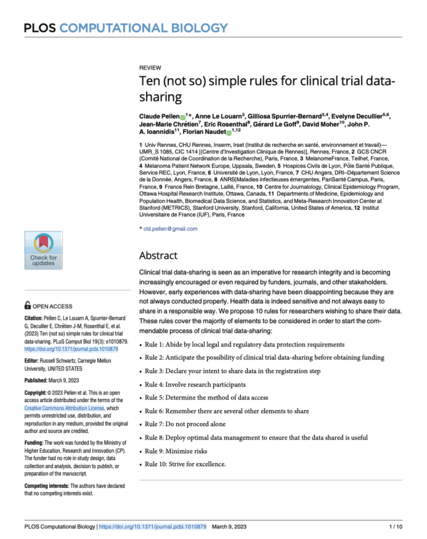

Ten (not so) simple rules for clinical trial data-sharing
Clinical trial data-sharing is seen as an imperative for research integrity and is becoming increasingly encouraged or even required by funders, journals, and other stakeholders. However, early experiences with data-sharing have been disappointing because they are not always conducted properly. Health data is indeed sensitive and not always easy to share in a responsible way. We propose 10 rules for researchers wishing to share their data. These rules cover the majority of elements to be considered in order to start the commendable process of clinical trial data-sharing: Rule 1: Abide by local legal and regulatory data protection requirements Rule 2: Anticipate the possibility of clinical trial data-sharing before obtaining funding Rule 3: Declare your intent to share data in the registration step Rule 4: Involve research participants Rule 5: Determine the method of data access Rule 6: Remember there are several other elements to share Rule 7: Do not proceed alone Rule 8: Deploy optimal data management to ensure that the data shared is useful Rule 9: Minimize risks Rule 10: Strive for excellence.
From
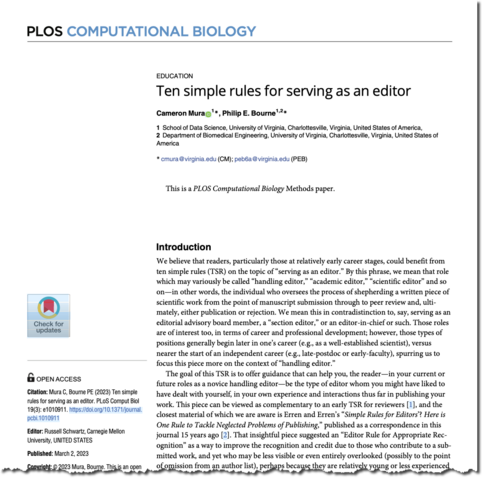
@PLOS #ComputationalBiology | Ten simple rules for serving as an editor |
#TSRPLOSCB #Education | I've definitely come across this Rule 5: Remember the 90:10 rule: 10% of manuscripts will take 90% of your time |
https://journals.plos.org/ploscompbiol/article?id=10.1371/journal.pcbi.1010911
Ten simple rules for serving as an editor
From
@PLOS #Computational #Biology | Ten simple rules for implementing
#open and
#reproducible #research practices after attending a training course |
#TSRPLOSCB #Education | I like that there is a "Limitations" section ... Maybe all
#TSRPLOSCB &
#QTPLOSCB papers should have this section? |
https://journals.plos.org/ploscompbiol/article?id=10.1371/journal.pcbi.1010750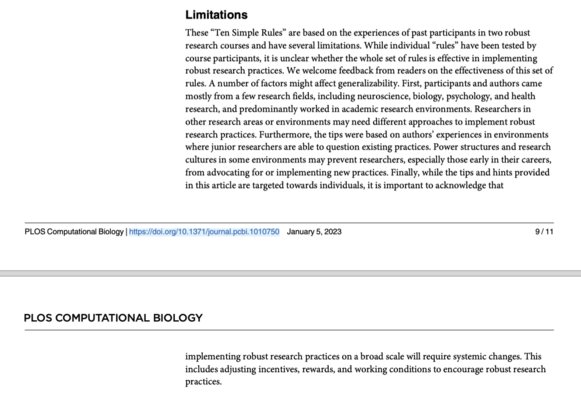

Ten simple rules for implementing open and reproducible research practices after attending a training course
Open, reproducible, and replicable research practices are a fundamental part of science. Training is often organized on a grassroots level, offered by early career researchers, for early career researchers. Buffet style courses that cover many topics can inspire participants to try new things; however, they can also be overwhelming. Participants who want to implement new practices may not know where to start once they return to their research team. We describe ten simple rules to guide participants of relevant training courses in implementing robust research practices in their own projects, once they return to their research group. This includes (1) prioritizing and planning which practices to implement, which involves obtaining support and convincing others involved in the research project of the added value of implementing new practices; (2) managing problems that arise during implementation; and (3) making reproducible research and open science practices an integral part of a future research career. We also outline strategies that course organizers can use to prepare participants for implementation and support them during this process.

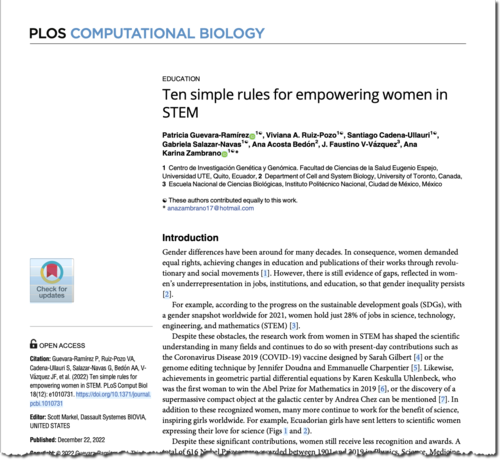
Ten simple rules for empowering women in STEM
From
@plos #Computational #Biology | Ten simple rules and a template for creating workflows-as-applications |
#TSRPLOSCB #Education | I like Rule 8: Include a simple test dataset |
https://journals.plos.org/ploscompbiol/article?id=10.1371/journal.pcbi.1010705Ten simple rules and a template for creating workflows-as-applications
 Francis Ouellette