From
@PLOS #Computational #Biology | Ten simple rules for implementing
#open and
#reproducible #research practices after attending a training course |
#TSRPLOSCB #Education | I like that there is a "Limitations" section ... Maybe all
#TSRPLOSCB &
#QTPLOSCB papers should have this section? |
https://journals.plos.org/ploscompbiol/article?id=10.1371/journal.pcbi.1010750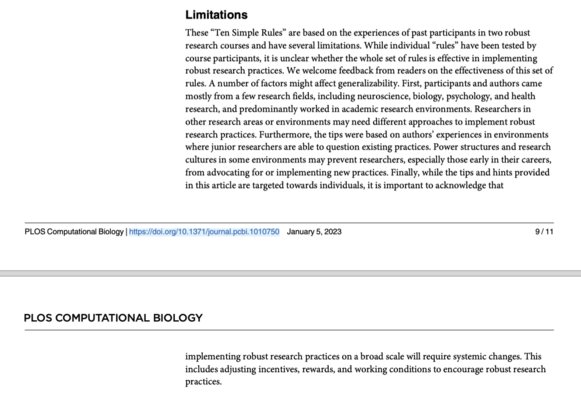

Ten simple rules for implementing open and reproducible research practices after attending a training course
Open, reproducible, and replicable research practices are a fundamental part of science. Training is often organized on a grassroots level, offered by early career researchers, for early career researchers. Buffet style courses that cover many topics can inspire participants to try new things; however, they can also be overwhelming. Participants who want to implement new practices may not know where to start once they return to their research team. We describe ten simple rules to guide participants of relevant training courses in implementing robust research practices in their own projects, once they return to their research group. This includes (1) prioritizing and planning which practices to implement, which involves obtaining support and convincing others involved in the research project of the added value of implementing new practices; (2) managing problems that arise during implementation; and (3) making reproducible research and open science practices an integral part of a future research career. We also outline strategies that course organizers can use to prepare participants for implementation and support them during this process.
From
@PLOS #Computational #Biology | Ten quick tips for computational analysis of medical images |
#QTPLOSCB #Education | I like Tip 4: Only use open source programming languages and software platforms |
https://journals.plos.org/ploscompbiol/article?id=10.1371/journal.pcbi.1010778
Ten quick tips for computational analysis of medical images
Medical imaging is a great asset for modern medicine, since it allows physicians to spatially interrogate a disease site, resulting in precise intervention for diagnosis and treatment, and to observe particular aspect of patients’ conditions that otherwise would not be noticeable. Computational analysis of medical images, moreover, can allow the discovery of disease patterns and correlations among cohorts of patients with the same disease, thus suggesting common causes or providing useful information for better therapies and cures. Machine learning and deep learning applied to medical images, in particular, have produced new, unprecedented results that can pave the way to advanced frontiers of medical discoveries. While computational analysis of medical images has become easier, however, the possibility to make mistakes or generate inflated or misleading results has become easier, too, hindering reproducibility and deployment. In this article, we provide ten quick tips to perform computational analysis of medical images avoiding common mistakes and pitfalls that we noticed in multiple studies in the past. We believe our ten guidelines, if taken into practice, can help the computational–medical imaging community to perform better scientific research that eventually can have a positive impact on the lives of patients worldwide.
From
@PLOS #Computational #Biology | Eleven quick tips for data cleaning and feature engineering |
#QTPLOSCB #Education | I like Tip 10: Make your dataset, software code, and article open and publicly available |
https://journals.plos.org/ploscompbiol/article?id=10.1371/journal.pcbi.1010718Eleven quick tips for data cleaning and feature engineering
Applying computational statistics or machine learning methods to data is a key component of many scientific studies, in any field, but alone might not be sufficient to generate robust and reliable outcomes and results. Before applying any discovery method, preprocessing steps are necessary to prepare the data to the computational analysis. In this framework, data cleaning and feature engineering are key pillars of any scientific study involving data analysis and that should be adequately designed and performed since the first phases of the project. We call “feature” a variable describing a particular trait of a person or an observation, recorded usually as a column in a dataset. Even if pivotal, these data cleaning and feature engineering steps sometimes are done poorly or inefficiently, especially by beginners and unexperienced researchers. For this reason, we propose here our quick tips for data cleaning and feature engineering on how to carry out these important preprocessing steps correctly avoiding common mistakes and pitfalls. Although we designed these guidelines with bioinformatics and health informatics scenarios in mind, we believe they can more in general be applied to any scientific area. We therefore target these guidelines to any researcher or practitioners wanting to perform data cleaning or feature engineering. We believe our simple recommendations can help researchers and scholars perform better computational analyses that can lead, in turn, to more solid outcomes and more reliable discoveries.
 Francis Ouellette