From
@plos #ComputationalBiology | Bioschemas training profiles: A set of specifications for standardizing training information to facilitate the discovery of training programs and resources |
#PLOSCB #Education #OpenScience CC/
@P_Palagi |
https://journals.plos.org/ploscompbiol/article?id=10.1371/journal.pcbi.1011120
Bioschemas training profiles: A set of specifications for standardizing training information to facilitate the discovery of training programs and resources
Author summary In the absence of understandable and readily implementable standards for life science training resources such as courses, materials, data, etc., such resources are difficult to locate or to harmonize in a central repository. From a FAIR (Findable, Accessible, Interoperable, Reuse) principles lens, this gap hinders findability and by extension accessibility, which, in the field of bioinformatics training, is a critical problem. Our work describes the standards development process and the finalized web metadata standards for life science training resources (Course, CourseInstance, TrainingMaterial). It builds upon existing metadata standard creation processes such as that from Schema.org and narrows down the standards to those relevant for life science audiences (under Bioschemas.org). Importantly, our work considers the hurdles of implementing metadata standards within existing training resource websites and lowers the barrier to implementation by describing a set of minimum standards needed for each training profile. With the recent release of our life science–focused training standards, we have seen rapid uptake among the bioinformatics training community highlighting the need for such standards in both the bioinformatics and broader life science training communities.
From
@PLOS #ComputationalBiology | Ten simple rules for socially responsible science |
#TSRPLOSCB #PLOSCB #Education | As an editor I have to like Rule 7: Seek a rigorous review and editorial processes , but I also like Rule 9: Address criticism from peers and the general public with respect |
https://journals.plos.org/ploscompbiol/article?id=10.1371/journal.pcbi.1010954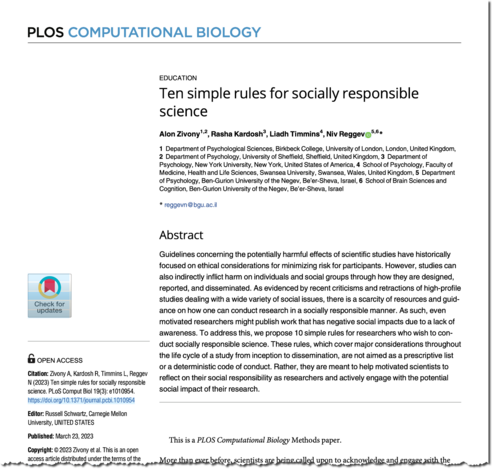
Ten simple rules for socially responsible science
Guidelines concerning the potentially harmful effects of scientific studies have historically focused on ethical considerations for minimizing risk for participants. However, studies can also indirectly inflict harm on individuals and social groups through how they are designed, reported, and disseminated. As evidenced by recent criticisms and retractions of high-profile studies dealing with a wide variety of social issues, there is a scarcity of resources and guidance on how one can conduct research in a socially responsible manner. As such, even motivated researchers might publish work that has negative social impacts due to a lack of awareness. To address this, we propose 10 simple rules for researchers who wish to conduct socially responsible science. These rules, which cover major considerations throughout the life cycle of a study from inception to dissemination, are not aimed as a prescriptive list or a deterministic code of conduct. Rather, they are meant to help motivated scientists to reflect on their social responsibility as researchers and actively engage with the potential social impact of their research.

An overview of bioinformatics courses delivered at the academic level in Italy: Reflections and recommendations from BITS
In Italian universities, bioinformatics courses are increasingly being incorporated into different study paths. However, the content of bioinformatics courses is usually selected by the professor teaching the course, in the absence of national guidelines that identify the minimum indispensable knowledge in bioinformatics that undergraduate students from different scientific fields should achieve. The Training&Teaching group of the Bioinformatics Italian Society (BITS) proposed to university professors a survey aimed at portraying the current situation of bioinformatics courses within undergraduate curricula in Italy (i.e., bioinformatics courses activated within both bachelor’s and master’s degrees). Furthermore, the Training&Teaching group took a cue from the survey outcomes to develop recommendations for the design and the inclusion of bioinformatics courses in academic curricula. Here, we present the outcomes of the survey, as well as the BITS recommendations, with the hope that they may support BITS members in identifying learning outcomes and selecting content for their bioinformatics courses. As we share our effort with the broader international community involved in teaching bioinformatics at academic level, we seek feedback and thoughts on our proposal and hope to start a fruitful debate on the topic, including how to better fulfill the real bioinformatics knowledge needs of the research and the labor market at both the national and international level.
 Francis Ouellette